Fundamentals & Concepts | Ranges, Position, Board & Betting Actions
A comprehensive guide to poker fundamentals. Learn range chart reading, position-based strategy, IP/OOP, board textures, c-bets, barrels, and donk bets — step by step.
Once you've mastered the play basics, it's time to systematically learn the foundational knowledge and concepts of poker.
Ranges (the scope of possible hands), positional advantages, board reading, and post-flop betting actions — understanding these will give your decisions a clear foundation and take a big step toward the intermediate level.
The Step Up Is Thinking in Ranges, Not Hands
Up to this point, judging your own two cards was enough. What changes at the intermediate level is that you stop trying to guess your opponent's exact hand.
Guess "he has AK" and your plan collapses the moment you are wrong. Think instead "given how he has played it, he is somewhere from AK and AQ down to about JJ," and you can see where your top pair sits inside that span — which makes betting or checking an easy call.
That way of thinking is what a range is. The nine topics below hand you the tools for it, one at a time.
How the Nine Fit Together
| Block | Topics | What it lets you do |
|---|---|---|
| A. Think in ranges | 1–3 | Describe your hand and your opponent's as spans, out loud |
| B. Understand your seat | 4–5 | See why your position and preflop role change how you play |
| C. Read the board and act | 6–9 | Decide who should be attacking from the flop onward |
A builds the vocabulary, B locates you and your opponent, C turns it into actions. Jump straight to the betting actions in C — c-bets, barrels, donk bets — and you will have frequencies with no basis for judging which boards they apply to, so it is worth taking these in order.
1. Reading Range Charts
In poker, we think about the range of hands an opponent might hold. Start by learning how to read the 13×13 range chart.
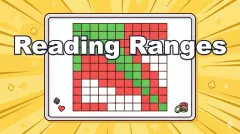
2. Position-Based Open Ranges
Once you can read range charts, learn which hands to play from each position. Master the open ranges from UTG through BTN.
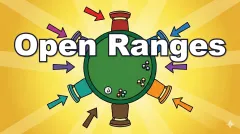
3. Estimating Your Opponent's Range
Reading ranges isn't just about your own — deducing your opponent's range from their actions is at the core of poker. Learn the fundamentals of range estimation.
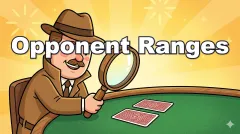
How to practise this — ranges do not develop in your head alone. At the table or in review, actually say it: "given that action, roughly this to this." Naming the two edges of the span is what gives it an outline. Being badly wrong at first is fine — noticing you were wrong means you are thinking in ranges at all.
4. IP (In Position) and OOP (Out of Position)
Post-flop, the player who acts last — IP (In Position) — has a significant advantage. Understand the difference between IP and OOP and how to play each.
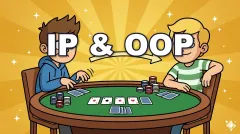
Position is worth exactly two things — you get to act after seeing what your opponent does, and when you check back you see the next card without paying for it. Those two compound on every street, which is why the same hand is worth more in position.
5. Aggressor and Caller
In poker, the "last raiser (aggressor)" and the "caller" are in very different positions. Learn each role and how strategies differ.

Different roles, different ranges — the preflop raiser arrives at the flop with more strong hands in their range. The caller, missing that top slice, sits slightly lower. Who is expected to attack first on the flop follows directly from that gap.
6. Board Texture
The combination of cards on the flop (board texture) significantly changes the strategy you should take. Learn 9 key terms: wet, dry, rainbow, monotone, and more.

Read boards by asking who they favour — wet and dry are not labels to memorise. They are tools for judging whose range the board connects with more. A♠K♦7♣ tends to favour whoever raised preflop; 7♥6♥5♦ tends to favour the caller. Getting to that judgement is the whole point.
7. Continuation Bet (C-Bet)
When the preflop raiser bets again on the flop — that's a c-bet. Learn which boards to c-bet on and how to adjust by the number of opponents.

The board decides, not the raise — a c-bet is not something you owe every time you raised preflop. Bet often when the board fits your range, less when it does not. The board texture topic above is literally the input to this decision.
8. Double Barrel & Triple Barrel
Betting on the turn and river after a flop c-bet is called barreling. Learn when to fire based on the turn/river card and how opponent ranges shift.
9. Donk Bet
A donk bet is when the caller bets before the aggressor. Learn why beginners tend to do this and why checking is usually the better default.

Checking is not an admission of weakness — donk betting is generally discouraged because letting the aggressor act first gives you more information and more options. That does not make a check a sign of a weak hand. Deliberately checking strong hands is standard at higher levels.
Three Places People Get Stuck
Your opponent's range stays too wide
This happens to everyone at first. The trick to narrowing is to work from actions, subtracting rather than adding.
Say UTG raises preflop, you call on the button, and UTG checks the flop. Some portion of the hands UTG would always bet has just left their range. Counting what dropped out is faster than trying to list what remains.
You follow the charts and still lose
Range charts only cover preflop. Poker is decided after the flop, and that territory is not on any chart.
A correct starting standard with guesswork after the flop produces inconsistent results. Once the charts are familiar, move your study time to the postflop half — topics 6 through 9 on this page.
Your c-bet frequency is far too high or too low
"Always bet" and "too scared to bet" are both signs of not looking at the board. The order of operations is fixed:
- Does this board favour your range or your opponent's?
- If yours, you can bet at a high frequency
- If theirs, lower the frequency
Run those three steps every time and the extremes disappear.
FAQ
Q1: Should I memorise range charts?
Show answer
Understand the shape before memorising anything.
Ranges widen the later your position, and they widen in a regular way. Grasp the pattern and you will be close even without a chart in front of you. Rote memory alone leaves you stranded in every spot the chart does not cover — after a 3-bet, at short stacks, and so on.
Q2: Once I finish these nine, can I move on to GTO?
Show answer
Finish the math first.
Solver output is a set of frequencies: bet this often here. Without pot odds and MDF behind you, there is no way to read why a frequency is what it is, and it turns into memorisation.
Q3: Should I mostly check when out of position?
Show answer
No — betting out of position is a completely normal action.
Your checking frequency does rise out of position, but not because being out of position calls for caution. If you bet all of your strong hands, your checking range is left holding only weak ones and becomes easy to read — so some strong hands have to check too, to protect it. Understand that reason and you will stop hesitating in spots that call for a bet.
Next Step
Now that you understand the fundamentals and concepts, it's time to master poker math. Learn to make decisions backed by pot odds and equity.
Found this helpful?
Bookmark this page to revisit anytime!
Ctrl+D (Mac: ⌘+D)
Found an error or have a question about this article? Let us know.
✉️ Contact Us