What Is a Donk Bet in Poker? Why Beginners Should Avoid It
Learn what a donk bet is in poker and why it's usually a losing play. Understand why beginners tend to donk bet and how simply checking can prevent costly mistakes.
📝 Where this article fits: If you understand the relationship between Aggressor and Caller and the basics of Continuation Betting (C-bet), read on. If not, start with those articles first.
Donk Bet — You Can Skip This Play
In the Aggressor and Caller article, you learned that the aggressor attacks and the caller checks and waits. But does the caller ever bet first? In fact, there is an action where the caller bets before the aggressor — this is called a donk bet. However, this play loses money more often than not, and beginners are better off avoiding it entirely. Let's make sure you understand it so you don't fall into the trap.
What You'll Learn
- What a donk bet is
- Why donk bets tend to lose money
- Common situations where beginners donk bet
🃏 What Is a Donk Bet?
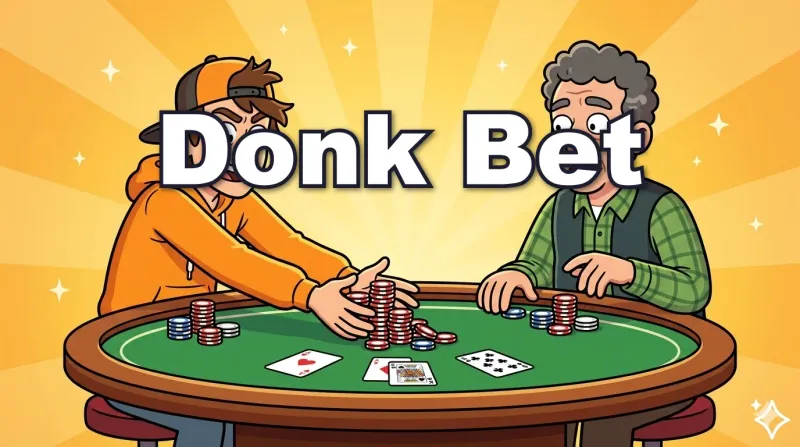
When a player who called on the previous street bets before the aggressor acts on the next street, that bet is called a donk bet.
The most common situation where beginners donk bet is after calling the aggressor's raise preflop and then betting into them on the flop.
A Concrete Example
- Preflop: CO open-raises → BB calls
- Flop: BB bets ← This is a donk bet
In most situations, BB would check first and see whether CO fires a C-bet or checks. A donk bet skips that flow entirely — the caller bets before the aggressor has a chance to act.
Where the Name Comes From
"Donk" is slang for a weak or clueless player. A donk bet is named after this because betting first gives away information about your hand — a move associated with inexperienced play. As the name suggests, it's generally a play to avoid.
Situations That Are NOT Donk Bets
It's important to understand that betting after the aggressor has already checked is NOT a donk bet.
Situation 1: The OOP caller bets on the next street after the aggressor checks
- Preflop: CO open-raises → BB calls
- Flop: BB checks → CO also checks (no C-bet)
- Turn: BB bets ← This is NOT a donk bet
CO checked on the flop, giving up the action. Even though BB bets first on the turn, they are betting after the aggressor's action, so this is not a donk bet.
Situation 2: The IP caller bets after the aggressor checks
- Preflop: CO open-raises → BTN calls
- Flop: CO checks → BTN bets ← This is NOT a donk bet
The aggressor CO checked first, so BTN is betting after the aggressor's action. This is not a donk bet — it's a normal bet.
A donk bet only occurs when the caller bets before the aggressor has had a chance to act.
💡 If you called, check! That's all you need to remember. The player who called on the previous street should check first on the next street and observe their opponent's action — this is the fundamental flow of poker.
❌ Why Donk Bets Tend to Lose Money
In donk bet situations, players tend to unconsciously fall into a pattern of betting strong hands and checking weak hands, making it difficult to maintain range balance. This makes it easy for the opponent to exploit you — they can simply fold when you bet and bet when you check.
Even if you could maintain perfect balance, donk bet situations almost always occur when the aggressor's range has the advantage. Betting from a weaker range is a losing proposition most of the time.
🃏 Common Donk Bet Mistakes
Hitting Top Pair and Betting Out of Excitement
CO: open-raises → BB: A♠8♣ calls Flop: A♦ 7♣ 3♥
BB has hit top pair with their Ace. The natural instinct is "I hit my Ace! Let me bet!" But an Ace-high board heavily favors the aggressor's range. CO's range is loaded with hands like AK, AQ, and AJ — stronger Aces that dominate A8.
If BB donk bets here, CO will call with their strong Aces and fold their weak hands. Checking and observing the aggressor's action before deciding is far more profitable.
Betting on a Draw-heavy Board Out of Fear
CO: open-raises → BB: K♠Q♠ calls Flop: K♦ 9♥ 8♥
BB has hit top pair with their King, but the board has straight draw and flush draw possibilities. "If I give a free card here, I might get outdrawn!" — the fear kicks in and you want to bet first.
But giving in to that fear and donk betting only gives your opponent information. Check and let the aggressor's action guide your decision.
⚠️ When in doubt, check: If you're thinking "Should I bet first here?", the default answer is to check and wait for the aggressor to act. That alone will prevent many costly mistakes.
🎯 Summary
- A donk bet is when the caller bets before the aggressor has a chance to act
- "Donk" = a clueless play. You're giving away information about your hand
- As a beginner, you can skip this play entirely
- If you called, check — follow this rule and you'll avoid donk betting
- Once you reach an advanced level, you can learn when donk bets are actually effective in a separate article
Now that you understand donk bets and can resist the urge to bet first, it's time to learn Raises and Check-Raises — a powerful way to fight back after checking.
Found this helpful?
Bookmark this page to revisit anytime!
Ctrl+D (Mac: ⌘+D)
Found an error or have a question about this article? Let us know.
✉️ Contact Us