How to Read Hand Range Charts | A Beginner's Guide
Learn how to read poker hand range charts. Understand the 13x13 grid structure, color coding, combo counts, and mixed strategies with clear examples.
📝 Where this article fits: Fundamentals 1 / 3 | This article is for players who have finished the Super Basics and want to dive deeper into poker theory. Reading Starting Hand Types and Terminology first will help.
How to Read Hand Range Charts
In the Super Basics, we looked at hands one at a time — "AA is strong," "72o is weak." But as soon as you start studying poker seriously, you'll find that strategy articles and tools all rely on something called a "hand range chart." If you can't read one, your poker education hits a wall. This article will teach you exactly how to read a hand range chart.
What You'll Learn
- The structure and layout of a hand range chart (13x13 grid)
- Where pocket pairs, suited hands, and offsuit hands are placed
- What the color coding and mixed strategies mean
- How combo counts work (why AA has 6 combos and AKo has 12)
📊 What Is a Hand Range Chart?
Let's start by looking at the real thing.
| A | K | Q | J | T | 9 | 8 | 7 | 6 | 5 | 4 | 3 | 2 | |
|---|---|---|---|---|---|---|---|---|---|---|---|---|---|
| A | AA | AKs | AQs | AJs | ATs | A9s | A8s | A7s | A6s | A5s | A4s | A3s | A2s |
| K | AKo | KK | KQs | KJs | KTs | K9s | K8s | K7s | K6s | K5s | K4s | K3s | K2s |
| Q | AQo | KQo | QJs | QTs | Q9s | Q8s | Q7s | Q6s | Q5s | Q4s | Q3s | Q2s | |
| J | AJo | KJo | QJo | JJ | JTs | J9s | J8s | J7s | J6s | J5s | J4s | J3s | J2s |
| T | ATo | KTo | QTo | JTo | TT | T9s | T8s | T7s | T6s | T5s | T4s | T3s | T2s |
| 9 | A9o | K9o | Q9o | J9o | T9o | 99 | 98s | 97s | 96s | 95s | 94s | 93s | 92s |
| 8 | A8o | K8o | Q8o | J8o | T8o | 98o | 88 | 87s | 86s | 85s | 84s | 83s | 82s |
| 7 | A7o | K7o | Q7o | J7o | T7o | 97o | 87o | 77 | 76s | 75s | 74s | 73s | 72s |
| 6 | A6o | K6o | Q6o | J6o | T6o | 96o | 86o | 76o | 66 | 65s | 64s | 63s | 62s |
| 5 | A5o | K5o | Q5o | J5o | T5o | 95o | 85o | 75o | 65o | 55 | 54s | 53s | 52s |
| 4 | A4o | K4o | Q4o | J4o | T4o | 94o | 84o | 74o | 64o | 54o | 44 | 43s | 42s |
| 3 | A3o | K3o | Q3o | J3o | T3o | 93o | 83o | 73o | 63o | 53o | 43o | 33 | 32s |
| 2 | A2o | K2o | Q2o | J2o | T2o | 92o | 82o | 72o | 62o | 52o | 42o | 32o | 22 |
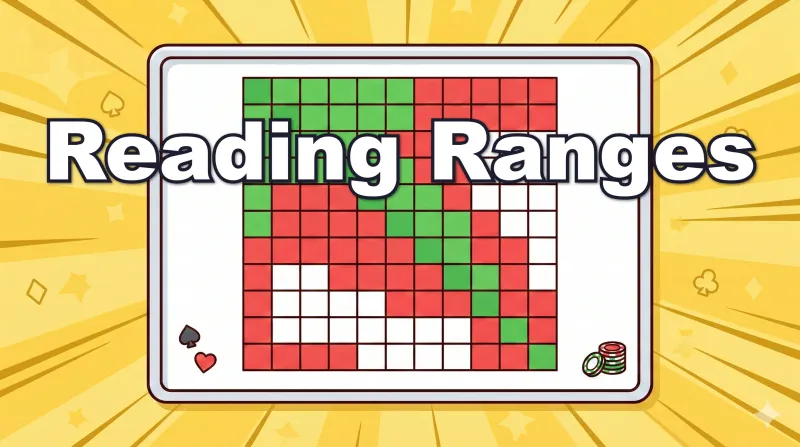
📝 A hand range chart is a table that displays all 169 possible starting hands in poker on a 13x13 grid. You'll see these constantly in strategy articles and poker tools.
What Is a Hand Range?
So what exactly is a "hand range"?
📝 A hand range (or simply "range") is the set of all hands a player could possibly hold in a given situation.
When you color in each cell of the chart to show "this player holds / doesn't hold this hand," the colored cells as a group represent that player's range.
In the diagram on the right, only AA, AKs, AQs, AKo, KK, and QQ are colored red. This set of colored hands is the range. In poker, strategy is built around these sets of hands — not individual hands in isolation.
🗺️ The 13x13 Grid Structure
Take another look at the chart above. Both the rows and columns list the 13 card ranks (A, K, Q, J, T, 9, 8, 7, 6, 5, 4, 3, 2).
There are only 3 rules to remember:
- Diagonal = Pocket Pairs (AA, KK, QQ, JJ...)
- Above the diagonal = Suited hands (AKs, AQs, AJs...) — two cards of the same suit
- Below the diagonal = Offsuit hands (AKo, AQo, AJo...) — two cards of different suits
Check the diagram below. Yellow = pocket pairs, green = suited, blue = offsuit.
| A | K | Q | J | T | … | |
| A | AA | AKs | AQs | AJs | ATs | … |
| K | AKo | KK | KQs | KJs | KTs | … |
| Q | AQo | KQo | QJs | QTs | … | |
| J | AJo | KJo | QJo | JJ | JTs | … |
| T | ATo | KTo | QTo | JTo | TT | … |
| … | … | … | … | … | … | … |
💡 Just remember: "upper triangle = s (suited), lower triangle = o (offsuit), diagonal = pocket pairs." That's all you need.
🔢 Combo Counts — Same Hand, Different Suit Combinations
Each cell on the range chart actually represents multiple "combos."
📝 A combo is a specific two-card combination defined by actual suits. The same rank pairing can produce multiple combos depending on which suits are involved.
Pocket Pairs: 6 Combos
For AA, you're choosing 2 suits out of 4 (♠♥♦♣):
A♠A♥, A♠A♦, A♠A♣, A♥A♦, A♥A♣, A♦A♣ → 6 combos
Suited Hands: 4 Combos
For AKs, there are 4 same-suit pairings:
A♠K♠, A♥K♥, A♦K♦, A♣K♣ → 4 combos
Offsuit Hands: 12 Combos
For AKo, you combine different suits:
A♠K♥, A♠K♦, A♠K♣, A♥K♠, A♥K♦, A♥K♣ ... → 12 combos (4 x 3)
| Category | Combos | Examples |
|---|---|---|
| Pocket Pair | 6 | AA, KK, 22 |
| Suited | 4 | AKs, T9s, 54s |
| Offsuit | 12 | AKo, T9o, 54o |
All 169 hand types x their respective combo counts = 1,326 total combos. This is every possible starting hand in poker.
💡 Knowing combo counts is useful. For example, AKo is 3 times more likely to be dealt than AKs (12 vs 4). Even though they're both "AK," suited and offsuit have very different frequencies.
🎓 Reading a Real Range Chart
Now that you understand the structure, let's look at a color-coded range chart. The chart below shows the preflop hand range for UTG (the first position to act). Red = Raise, Blue = Fold.
📝 Color schemes vary between tools. In this article, we use "red = raise, blue = fold, green = call," but other tools may use different colors. Always check the legend.
Let's read this chart together.
Where is the AA cell? → Top-left of the diagonal. Solid red, so you always raise.
Where is the AKs cell? → Above the diagonal (A row, K column). Solid red — always raise as well.
Where is the K4s cell? → Solid blue. Fold.
In other words, when you're UTG preflop, AA and AKs are opens, while K4s is a fold.
Two-Color Cells — Mixed Strategies
Look closely at the chart. Notice that some cells are split between two colors — red and blue?
For example, 77 is about 75% red and 25% blue. K7s also shows a mix. This is called a mixed strategy.
📝 Mixed strategy means using multiple actions (e.g., raise and fold) at certain frequencies in a given spot. Hands with a mixed strategy are at an indifference point — the expected value is the same regardless of which action you choose. In practice, use your opponent's tendencies to decide which action to take.
If the 77 cell is painted 75% red and 25% blue, it means "the optimal strategy raises 77 at a 75% frequency and folds it at a 25% frequency." Since either action yields the same expected value, use your reads on your opponent to guide your decision in real play.
Who Creates These Range Charts?
"Same expected value." "Optimal frequencies." — How are these numbers determined? The answer lies in a tool called a solver.
📝 A solver is a computer program that calculates optimal poker strategies. Popular examples include GTO Wizard and PioSolver.
A solver runs massive calculations to determine the optimal raise, call, and fold frequencies for all 169 hand types. The range chart you saw above is the result of that computation. These aren't rules of thumb built from human experience — they're mathematically derived answers produced by computers.
Actions and Strategy
Let's clarify some important terms here.
A single cell on the range chart tells you the action (raise, fold, etc.) and its frequency for that hand.
The entire range chart — the collection of actions for every hand — is what we call a strategy. In poker, strategy isn't about "what to do with one hand." It's the big picture of how you act across your entire range.
🎓 Practice Scenarios
Q1: On the UTG range chart, where is the QJs cell?
Show answer
Above the diagonal (Q row, J column). Since it's suited, it sits in the upper triangle. At UTG, it's solid red — always raise.
Q2: How many combos does 77 have?
Show answer
It's a pocket pair, so 6 combos: 7♠7♥, 7♠7♦, 7♠7♣, 7♥7♦, 7♥7♣, 7♦7♣.
Q3: On the UTG range chart, the K7s cell is split between red and blue. What does this mean?
Show answer
It indicates a mixed strategy between raise and fold. Both actions have the same expected value, so use your reads on your opponent to decide which to choose in practice.
Q4: A single cell on the range chart shows an "action." What does the entire range chart represent?
Show answer
A strategy. Each cell shows "what to do with that hand (the action)," and the complete set of actions across every hand forms the "strategy."
⚠️ Common Misconceptions
1. "Red cells = strong hands"
The color indicates action frequency, not hand strength. For example, both A5s and ATs are solid red (always raise) at UTG, but ATs is the stronger hand.
2. "I need to memorize all 169 cells"
You don't. Start by learning the diagonal (pocket pairs) and the key parts of the upper triangle (suited hands). The next article will show you patterns that make this easier.
🎯 Summary
- A hand range chart is a 13x13 grid that displays all 169 starting hands at a glance
- Diagonal = pocket pairs, upper triangle = suited, lower triangle = offsuit
- Combo counts: pocket pair = 6, suited = 4, offsuit = 12 → 1,326 total combos
- Cell colors represent action frequencies. The combined actions across all hands form a "strategy"
Now that you can read range charts, the next step is to learn which hands to open from each position using these charts.
Found this helpful?
Bookmark this page to revisit anytime!
Ctrl+D (Mac: ⌘+D)
Found an error or have a question about this article? Let us know.
✉️ Contact Us