Double Barrel and Triple Barrel — Betting Across Multiple Streets
Learn double-barreling and triple-barreling in poker. Understand how your opponent's range gets stronger with each call, and when to keep betting for value or as a bluff.
📝 Where this article fits: If you already understand C-bets, read on. If not, start with C-bet Basics first.
Double Barrel and Triple Barrel — Betting Across Multiple Streets
In the previous article, you learned about C-bets. But what happens after the C-bet when the turn card comes? Or the river? Continuing to bet across multiple streets is called a double barrel or triple barrel. The key insight here isn't just "is my hand strong?" — it's that every time your opponent calls, their remaining range gets stronger. Let's develop that perspective.
What You'll Learn
- What double barrels and triple barrels are
- How your opponent's range gets stronger with each street
- How to decide whether to double barrel for value or as a bluff
- The logic behind triple-barrel bluffs and when to avoid them
🃏 What Are Double Barrels and Triple Barrels?
📝 Street: In poker, each betting round is called a "street." There are three post-flop streets: the flop (3 community cards), the turn (4th card), and the river (5th card).
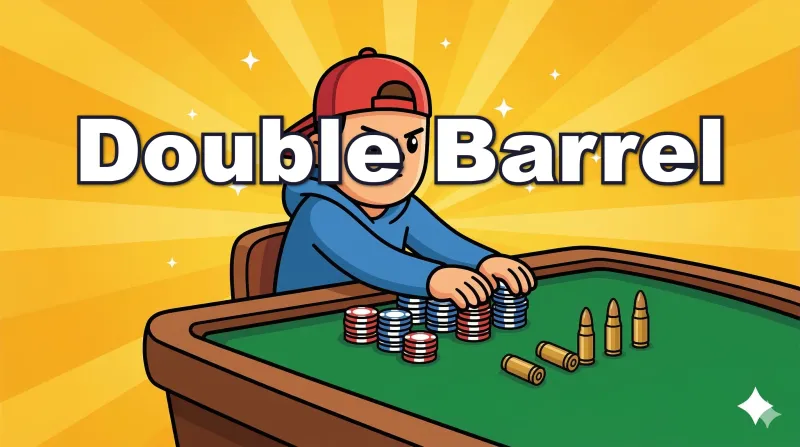
Double barrel and triple barrel refer to betting on consecutive streets. "Barrel" is slang for a bet — the image comes from firing bullets from a gun.
- Double barrel = betting on two consecutive streets (flop and turn, or turn and river)
- Triple barrel = betting on all three streets (flop, turn, and river)
🎯 Your Opponent's Range Gets Stronger with Each Call
This is the single most important concept for understanding double and triple barrels.
Every time your opponent calls a bet, they fold away their weak hands. The range they have left gets progressively stronger.
| Timing | Opponent's Remaining Range |
|---|---|
| Calls the C-bet | Wide — top pair, middle pair, bottom pair, draws, high cards |
| Calls the double barrel | Narrower — top pair, middle pair, strong draws |
| Calls the triple barrel | Very narrow — top pair or better, two pair, near-nut hands |
Whether to continue betting across multiple streets comes down to one question: "Is my bet effective against the range my opponent still has?"
The thinking is the same for both value and bluffs.
| Goal | Key Question |
|---|---|
| Value | Does my hand beat the hands my opponent would call with? |
| Bluff | Are there hands in my opponent's range that would fold to this bet? |
For a refresher on value bets and bluffs, see Betting Fundamentals.
🎯 As the streets progress, your opponent's range gets narrower and stronger. Don't just "keep firing" — re-evaluate your opponent's range on each new street.
🃏 Double Barrel Examples
Case 1: Value Double Barrel (Good Example)
BTN: A♠J♠ open-raises → BB: calls Flop: A♥ J♦ 4♣ → BTN: C-bet → BB: calls Turn: 6♠
BTN flopped two pair (Aces and Jacks) and C-bet. BB called.
Think about the opponent's range: BB called the C-bet, so they likely hold an Ace with a weaker kicker, middle pair (Jacks or lower), or a straight draw. The 6♠ on the turn doesn't change the board much.
Why double barrel: BTN's two pair is well ahead of the hands BB would call with (Ace-high one pair, draws). If BB calls with a weaker Ace, BTN wins even more chips.
Case 2: Value Double Barrel (Bad Example)
CO: 8♦7♦ open-raises → BB: calls Flop: K♣ 8♠ 3♥ → CO: C-bet → BB: calls Turn: A♠
CO flopped middle pair (8s) and C-bet. BB called.
Think about the opponent's range: BB called the C-bet, so they likely hold a King, overcards (like an Ace), or a draw. The A♠ on the turn means anyone holding an Ace just made top pair.
Why not double barrel: Against the hands that would call a double barrel — mainly Ace-high pairs and King-high pairs — CO's middle pair (8s) is behind almost all of them. The better play is to check and try to reach showdown.
💡 Value double barrel decision: Ask yourself, "Does my hand beat the hands my opponent would call with?" If yes, bet. If you'd lose to most calling hands, stop.
🃏 Triple Barrel Example
Case 3: Triple-Barrel Bluff (Missed Straight Draw)
BTN: 9♠8♠ open-raises → BB: calls Flop: K♥ 7♣ 6♦ → BTN: C-bet → BB: calls Turn: 2♣ → BTN: double barrel → BB: calls River: 3♠
BTN had a straight draw on the flop (6-7-8-9, needing a 5 or T to complete) and C-bet, then continued with a double barrel on the turn. But the 3♠ on the river didn't complete the draw. Should BTN fire a triple-barrel bluff?
Think about the opponent's range: BB called two barrels, so they almost certainly have at least a King-high pair or better. Weak hands (low pairs, draws) have already folded.
The question: "Are there hands that called the double barrel but would fold to a triple barrel?"
Good Triple Barrel: When King-high Pairs Would Fold
If your opponent holds a King-high pair and would fold to a large river bet — thinking "I must be up against two pair or better" — then a triple-barrel bluff is effective. There are hands in their range that will fold.
Bad Triple Barrel: When King-high Pairs Would Call
If your opponent is the type to think "I've come this far, I'm not folding" with a King-high pair, then a triple barrel just wastes chips. There's no point bluffing when nothing in their range will fold. Check and give up.
⚠️ Your opponent's tendencies determine bluff effectiveness: Whether a triple-barrel bluff works depends heavily on how your opponent responds — what they call with and what they fold. The same spot can be a great bluff against one player and a costly mistake against another. Observing your opponent's tendencies is crucial.
🎓 Practice Scenarios
Q1: BTN open-raises, BB calls. BTN: A♦K♦. Flop: A♣ 8♠ 3♦ → C-bet → BB calls. Turn: 5♥. Should BTN double barrel?
See the answer
Yes, this is a good spot to double barrel. BTN has top pair with the best kicker (AK). BB's range after calling the C-bet includes weaker Aces, middle pair (8s), and draws. Against the hands that would call a double barrel (weaker Aces, etc.), AK is well ahead. This is an effective value bet.
Q2: CO open-raises, BB calls. CO: 6♠5♠. Flop: K♣ 6♦ 2♥ → C-bet → BB calls. Turn: T♣. Should CO double barrel with middle pair (6s)?
See the answer
No, CO should not double barrel. CO's middle pair (6s) is a very weak hand. BB likely holds at least a King-high pair after calling the C-bet. Against the hands that would call a double barrel, CO is behind almost all of them. The better play is to check and hope BB checks back, giving CO a cheap showdown.
Q3: BTN open-raises, BB calls. BTN: T♠9♠. Flop: K♥ 8♣ 7♦ → C-bet → BB calls. Turn: 2♠ → double barrel → BB calls. River: 3♦. BTN's straight draw (7-8-9-T) didn't complete. Should BTN triple-barrel bluff?
See the answer
If you think your opponent would fold a King-high pair, triple barrel. If you think they'd call, check. After calling two barrels, BB almost certainly holds at least a King-high pair. If your opponent is the type to fold a King to a large river bet, the bluff is effective. If they're the type to say "I've come this far, I'm calling," you'd just be throwing chips away — so check and give up.
⚠️ Common Misconceptions
❌ "I decide based on my hand strength alone"
What matters for double and triple barrels isn't the absolute strength of your hand — it's the relative strength against the hands your opponent would call with. Even top pair should stop betting if the calling range beats it, and even one pair should keep betting if it's ahead of the calling range.
❌ "Once I C-bet, I should keep betting through the river"
A C-bet is just the first bet. Whether to continue on the turn and river should be re-evaluated on each street based on your opponent's remaining range. Forcing bets in unfavorable situations costs more chips than stopping.
🎯 Summary
- Double barrel = betting on two consecutive streets; triple barrel = betting on all three streets
- Each time your opponent calls, they fold their weak hands → their remaining range gets stronger
- Value double barrels: Confirm that your hand beats the hands your opponent would call with
- Bluff triple barrels: Confirm that your opponent's range contains hands that would fold to this bet
- When in doubt, ask: "Am I ahead if called? Are there hands that would fold?"
Next, let's learn about a bet made not by the aggressor but by the caller — the donk bet.
Found this helpful?
Bookmark this page to revisit anytime!
Ctrl+D (Mac: ⌘+D)
Found an error or have a question about this article? Let us know.
✉️ Contact Us