In Position (IP) vs. Out of Position (OOP) — Why Position Matters
Learn what In Position (IP) and Out of Position (OOP) mean in poker. Discover why IP is advantageous, how to play OOP, and how position affects 3-bet and 4-bet sizing.
📝 Where this article fits: If you already know position names, the action order, and the basics of open-raises and 3-bets, read on. If not, start with Position Basics and Open Raises and 3-Bets first.
In Position (IP) and Out of Position (OOP) — Why Position Matters
In Position Basics, you learned the names of the six seats and the action order. We mentioned that "BTN is advantageous because it acts last after the flop," but why exactly is acting last such a big deal? Let's dig into the reasons while learning two key terms: In Position (IP) and Out of Position (OOP).
What You'll Learn
- What In Position (IP) and Out of Position (OOP) mean
- IP and OOP describe a relative relationship between players
- Two reasons why IP has the advantage
- Why OOP players check more often
- How position affects 3-bet and 4-bet sizing
🃏 What Are IP and OOP?
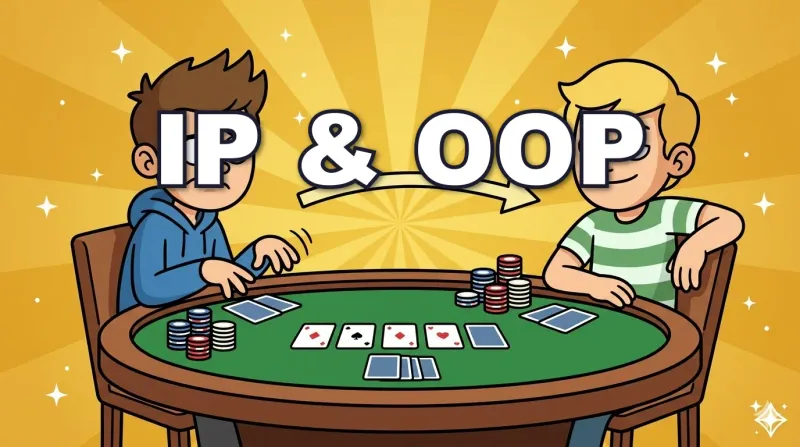
📝 In Position (IP): The player who acts last post-flop relative to their opponent. Short for "In Position."
📝 Out of Position (OOP): The player who acts first post-flop relative to their opponent. Short for "Out of Position."
If you picture the player who acts later as being on the "inside," the terms In Position and Out of Position become easier to remember.
The key point is that IP and OOP are not seat names. Unlike fixed seat labels such as BTN or SB, they describe a relative positional relationship between players in a hand. Even in pots with three or more players, an IP/OOP relationship exists between each pair of players.
Examples
Example 1: CO open-raises → BTN calls
Recall the post-flop action order. Starting from SB and going clockwise, CO acts first and BTN acts last.
- CO = acts first = Out of Position (OOP)
- BTN = acts last = In Position (IP)
Example 2: BTN open-raises → BB calls
Post-flop, BB acts before BTN.
- BB = acts first = Out of Position (OOP)
- BTN = acts last = In Position (IP)
Example 3: UTG open-raises → BB calls
- BB = acts first = Out of Position (OOP)
- UTG = acts last = In Position (IP)
💡 Easy rule: "The player who acts later post-flop is IP." That's all you need to remember.
IP and OOP are relative concepts, but some seats are always on the same side. BTN always acts last post-flop, so it is always IP regardless of the opponent. Conversely, SB always acts first post-flop, making it always OOP.
UTG, HJ, and CO can be either IP or OOP depending on their opponent. For example, CO is OOP against BTN but IP against BB.
🎯 Two Reasons Why IP Has the Advantage
In Position Basics, you learned that "BTN is the best seat." Let's look more closely at why being IP is so advantageous.
Reason 1: You see your opponent's action before deciding
The biggest strength of IP is the information advantage.
Your opponent acts first, so you get to see their action before making your own decision. Did they check? Bet? How much did they bet? You can take all of that information into account before choosing your action.
The OOP player doesn't have this luxury. They must act first, making decisions without knowing how their opponent will respond.
💡 It's like playing rock-paper-scissors after seeing your opponent's throw. Obviously, the player who gets to see first has the edge.
Reason 2: You can close the round with a check back
IP has another major benefit.
When your opponent checks and you check behind — a check back — you close the round. On the turn, this means you get to see the next card for free. On the river, you can go straight to showdown.
OOP players can't do this. Even if they check, the IP opponent might bet. Being IP means you always have the option to "close the round with a check back."
Example 1: Your hand is A♥T♥, and the flop is K♥7♥3♠
You have a flush draw. If your opponent checks, you can check back and see the turn for free. If a ♥ comes on the turn — flush complete!
Example 2: Your hand is 9♠8♠, and the board on the river is 9♥5♠3♦K♣2♦
You have middle pair — a decent hand. If your opponent checks, you can check back and go to showdown, avoiding the risk of betting and getting raised.
🛡️ OOP Players Check More Often
Now that we've seen why IP is advantageous, what should you do when you're OOP?
The answer: check more frequently when you're OOP.
Why Does OOP Check So Much?
The logic is simple. If you bet all your strong hands when OOP, then whenever you check, only weak hands remain in your range.
Your opponent would think:
- They checked → only weak hands → I can attack freely
- They bet → only strong hands → I can just fold
This creates a very easy situation for your opponent.
That's why OOP players need to mix some strong hands into their checking range. When strong hands are mixed in, your opponent can't just assume "they checked, so they're weak" and attack freely.
As a result, OOP checking frequency naturally becomes higher.
💡 OOP default: When in doubt, check. As a beginner, simply being aware that "I should check more often when OOP" is enough.
💰 IP, OOP, and 3-Bet / 4-Bet Sizing
The IP/OOP dynamic also affects preflop 3-bet and 4-bet sizing.
You already learned about open-raise sizing. Here, let's cover 3-bet and 4-bet sizes based on your post-flop position.
3-bet and 4-bet sizing changes depending on whether you'll be IP or OOP after the flop.
| Action | When you'll be OOP | When you'll be IP |
|---|---|---|
| 3-bet | 4× the open-raise | 3× the open-raise |
| 4-bet | 2.5–2.8× the 3-bet | 2–2.2× the 3-bet |
The reason OOP uses larger sizes is to compensate for the positional disadvantage. A bigger size makes opponents less likely to call, reducing the number of times you play post-flop at a disadvantage.
From IP, you already have the positional edge, so a smaller size is sufficient.
Example: BTN open-raises to 2.5bb. You want to 3-bet from SB.
SB will be OOP post-flop, so the target is 2.5bb × 4 = 10bb.
Example: CO open-raises to 2.5bb. You want to 3-bet from BTN.
BTN will be IP post-flop, so the target is 2.5bb × 3 = 7.5bb.
⚠️ These are guidelines. Adjustments may be needed based on stack depth and table dynamics, but beginners should start with these benchmarks.
🎓 Practice
Let's test your understanding of IP and OOP.
Q1: CO open-raises and BB calls. Who is IP on the flop?
Show answer
CO is IP. Post-flop, BB acts first and CO acts second. The player who acts later is IP.
Q2: BTN open-raises, SB 3-bets, and BTN calls. Who is IP on the flop?
Show answer
BTN is IP. Even in a 3-bet pot, the action order doesn't change. Post-flop, SB acts first and BTN acts second.
Q3: CO open-raises to 2.5bb. You want to 3-bet from BTN. What's the target size?
Show answer
7.5bb (2.5bb × 3). BTN will be IP post-flop, so the 3-bet target is 3× the open-raise.
Q4: BTN open-raises to 2.5bb. You want to 3-bet from SB. What's the target size?
Show answer
10bb (2.5bb × 4). SB will be OOP post-flop, so the 3-bet target is 4× the open-raise. You use a larger size to compensate for the positional disadvantage.
⚠️ Common Misconceptions
1. Thinking IP and OOP are fixed positions
IP and OOP describe a relative relationship with your opponent. However, BTN is always IP and SB is always OOP. UTG, HJ, and CO can be either IP or OOP depending on who they're up against.
2. "OOP means you can't bet"
It's true that checking frequency is higher, but OOP players bet regularly. It's simply that checks are more frequent — not that betting is off limits.
3. "3-bets are always the same size"
Both 3-bets and 4-bets change size based on whether you'll be IP or OOP post-flop. Larger from OOP, smaller from IP.
🎯 Summary
- IP (In Position) = the player who acts last post-flop
- OOP (Out of Position) = the player who acts first post-flop
- IP and OOP are determined by the relative positional relationship between opponents
- Why IP is advantageous: you see your opponent's action first and you can close the round with a check back
- OOP players check more frequently (to protect their checking range with strong hands)
- 3-bet: OOP uses 4×, IP uses 3×. 4-bet: OOP uses 2.5–2.8×, IP uses 2–2.2×
Now that you understand the IP and OOP relationship, let's learn about the Aggressor and Caller — another crucial distinction in post-flop play.
Found this helpful?
Bookmark this page to revisit anytime!
Ctrl+D (Mac: ⌘+D)
Found an error or have a question about this article? Let us know.
✉️ Contact Us