Estimating Your Opponent's Hand Range
Learn how to estimate your opponent's hand range in poker. Use position and actions to narrow down what hands they likely hold.
📝 Where this article fits: Fundamentals 3 / 3 | If you can't yet picture each position's opening range, start with Opening Ranges by Position first.
Estimating Your Opponent's Hand Range
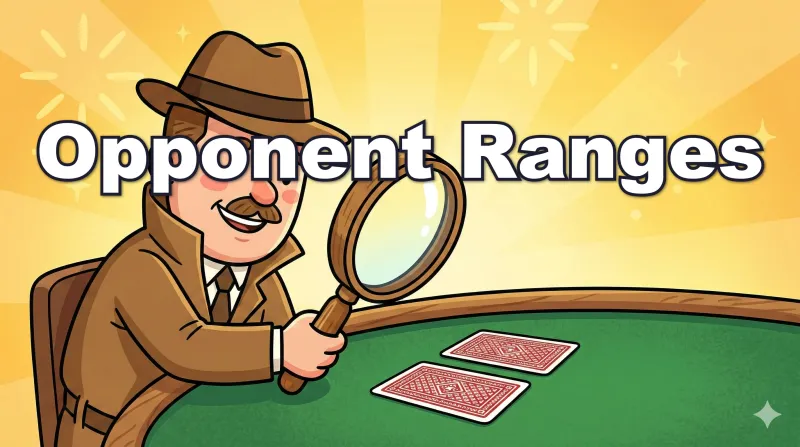
In the previous article, we covered the opening ranges for each position. Now let's flip the perspective and ask: "When my opponent open-raises, what are they likely holding?" You don't need to guess the exact hand — the goal is to develop the ability to picture the range of hands they could be playing.
What You'll Learn
- Why you should think in terms of "hand ranges" instead of pinpointing a single hand
- How to estimate your opponent's likely range based on their position
- A quiz on UTG opens to build your feel for narrow ranges
- A quiz on BTN opens to build your feel for wide ranges
🎯 Think "What Range Are They Playing?" Not "What Do They Have?"
It's impossible to pinpoint your opponent's exact hand. But you can estimate the range of hands they're likely playing.
For example, say someone open-raises from UTG. Recall the UTG range from the previous article (roughly the top 18%): AA through 88, all Ax suited from A2s to AKs, strong broadways like AKo through ATo, and so on. You can picture them entering the pot with something from that range.
That's what it means to "think in ranges."
🔴 UTG Opens — Picture a Narrow Range
UTG's range covers roughly the top 18% of hands. It's the tightest position at a 6-max table.
Let's review. The main hands UTG opens at 100% frequency:
- Pocket pairs: 88 and above
- Ax suited: A2s through AKs (all of them)
- Broadways: AKo through ATo, KQo through KJo
A narrow range = mostly strong hands. The proportion of premium holdings is high, and weak hands are almost completely absent.
Now let's test your feel with a quiz. "UTG opens. Could your opponent hold ____?" Answer with O (=Yes), △ (=Sometimes/Mixed), or X (=No).
Q1: AA — O or X?
Show answer
O (Yes) — AA is opened 100% of the time.
Q2: KQo — O or X?
Show answer
O (Yes) — KQo is opened 100% of the time.
Q3: T9s — O or X?
Show answer
△ (Sometimes) — UTG opens T9s only about 23% of the time. It's a low-frequency mixed strategy — most of the time it gets folded.
Q4: 66 — O or X?
Show answer
△ (Sometimes) — UTG opens 66 only about 26% of the time. Another low-frequency mixed strategy. UTG opens pocket pairs at 100% only from 88 and above.
Q5: ATs — O or X?
Show answer
O (Yes) — ATs is opened 100% of the time. All Ax suited hands are in UTG's opening range.
Q6: A5o — O or X?
Show answer
X (No) — UTG does not open A5o. Remember: weak offsuit aces are not part of UTG's range.
📝 If you got any of these wrong, head back to the UTG section in the previous article for a quick review.
🟢 BTN Opens — Picture a Wide Range
Now let's switch perspectives and picture the BTN range (roughly the top 44%).
The main hands BTN opens at 100% frequency:
- Pocket pairs: 33 and above
- Ax suited: All
- K suited: All (K2s through KQs)
- Suited connectors: Many, including 86s, 76s, 65s
- Broadways: Down to K9o, Q9o, J9o, T9o
A wide range = a mix of all sorts of hands. Premiums are in there, but so are a lot of medium and weaker holdings.
Same quiz format. "BTN opens. Could your opponent hold ____?"
Q1: 75s — O or X?
Show answer
O (Yes) — BTN opens 75s about 84% of the time. A hand that UTG would never open is perfectly normal on the BTN.
Q2: K2o — O or X?
Show answer
X (No) — BTN does not open K2o. Having a King doesn't matter when the kicker is too weak and it's offsuit. Even though BTN is wide, not every Kx hand makes the cut.
Q3: 44 — O or X?
Show answer
O (Yes) — BTN opens 44 at 100% frequency. Using the "players behind + 2" rule: 2 + 2 = 4, so 44 and above are in.
Q4: J9o — O or X?
Show answer
O (Yes) — BTN opens J9o at 100% frequency. Mid-rank offsuit broadways are comfortably in the range. This is a hand UTG would never play.
Q5: 86o — O or X?
Show answer
X (No) — BTN does not open 86o. 86s (suited) is opened at 100%, but 86o doesn't make it in. The gap between suited and offsuit is significant.
Q6: Q3s — O or X?
Show answer
O (Yes) — BTN opens Q3s at 100% frequency. Almost all Q suited hands are in (even Q2s gets opened about 90% of the time).
📝 If you got any of these wrong, head back to the BTN section in the previous article for a quick review.
Comparing UTG and BTN
See how the same action — "open-raise" — means completely different things depending on position?
- UTG open = narrow and strong. Mostly premium hands — a scary opponent
- BTN open = wide and mixed. Strong hands are in there, but so are plenty of weaker ones
The difference is crystal clear when you compare the range grids side by side.
UTG (top ~18%)
BTN (top ~44%)
This feel for how "ranges differ by position" will fundamentally change the way you make decisions at the table.
💡 Whenever an opponent enters the pot preflop, practice picturing the range grid in your head: "From that position, their range is roughly this wide." With repetition, it becomes second nature.
🧠 Why Thinking in Ranges Leads to Better Decisions
When you pin your opponent on a single hand, your decisions become extreme.
- "They have AA!" → You over-fold out of fear
- "They're bluffing!" → You over-call or over-raise
But when you think in ranges, you stay level-headed.
For example, when UTG opens, you might think: "Sure, they could have AA. But AA is just a tiny fraction of the entire UTG range. The bulk of their range is hands like AKs, AQo, 88, KQo, and so on." That kind of thinking keeps you from overreacting in either direction.
🎓 Practice Scenarios
Q1: UTG opens. Could your opponent hold K9o?
Show answer
X (No) — UTG does not open K9o. Even with a King, a weak offsuit kicker doesn't make it into UTG's narrow range.
Q2: CO opens. Could your opponent hold K9o?
Show answer
△ (Sometimes) — CO opens K9o about 41% of the time. It's a mixed-strategy hand — sometimes they have it, sometimes they've folded it.
Q3: BTN opens. Could your opponent hold K9o?
Show answer
O (Yes) — BTN opens K9o at 100% frequency. The same hand is X from UTG, △ from CO, and O from BTN. Position alone completely changes the answer.
⚠️ Common Misconceptions
"I need to memorize the exact range before I can estimate anything"
Even a rough sense of "UTG = narrow, BTN = wide" will dramatically improve your decisions. You can learn the precise numbers later. Start by building the intuition: position → range width.
🎯 Summary
- Recall your opponent's opening range based on their position — that's their "hand range"
- UTG/HJ opens = narrow, strong ranges. BTN opens = wide, mixed ranges
- Don't pin your opponent on a single hand — it leads to extreme decisions
- Make it a habit: check your opponent's position, then picture their range!
Across these three articles, you've learned how to read range charts, each position's opening range, and how to estimate your opponent's range. With this foundation, you should feel confident in your preflop decisions. Next up, learn how to make mathematically sound calls with What Are Pot Odds? The Basics.
Found this helpful?
Bookmark this page to revisit anytime!
Ctrl+D (Mac: ⌘+D)
Found an error or have a question about this article? Let us know.
✉️ Contact Us