GTO Strategy: IP 3bet Pot Fundamentals | UTG vs. BTN 3bet Pot | Dry Q-high Board
A GTO breakdown of IP 3bet pot fundamentals (xbc-xx-x?) on the Q♠8♥2♦6♠A♠ board in UTG vs. BTN 3bet pot, analyzed street by street using GTOWizard solutions.
📝 Article level: Advanced | Assumes full understanding of all basics and intermediate content.
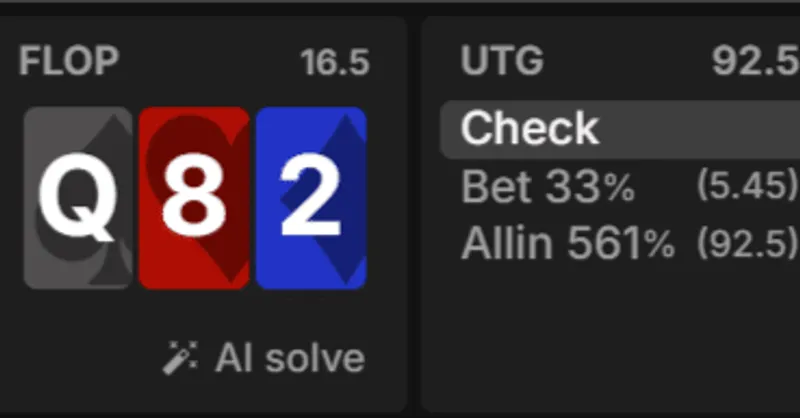
This article uses GTOWizard solutions to break down the IP 3bet pot fundamentals (node: xbc-xx-x?) on the Q♠8♥2♦6♠A♠ board in UTG vs. BTN 3bet pot. We analyze and verbalize each street's strategy from a GTO perspective.
📝 Settings: GTOWizard NLH cash game 6max 100bb 50nl 2.5X-GTO
What You'll Learn
- Flop Q♠8♥2♦ — Donk strategy, CB strategy, and response to CB
- Turn Q♠8♥2♦6♠ — Donk strategy, DB strategy, and response to DB
- River Q♠8♥2♦6♠A♠ — Probe strategy and bet to missed probe strategy
🃏 Flop Q♠8♥2♦ — Donk Strategy
UTG vs. BTN 3BP node : ?
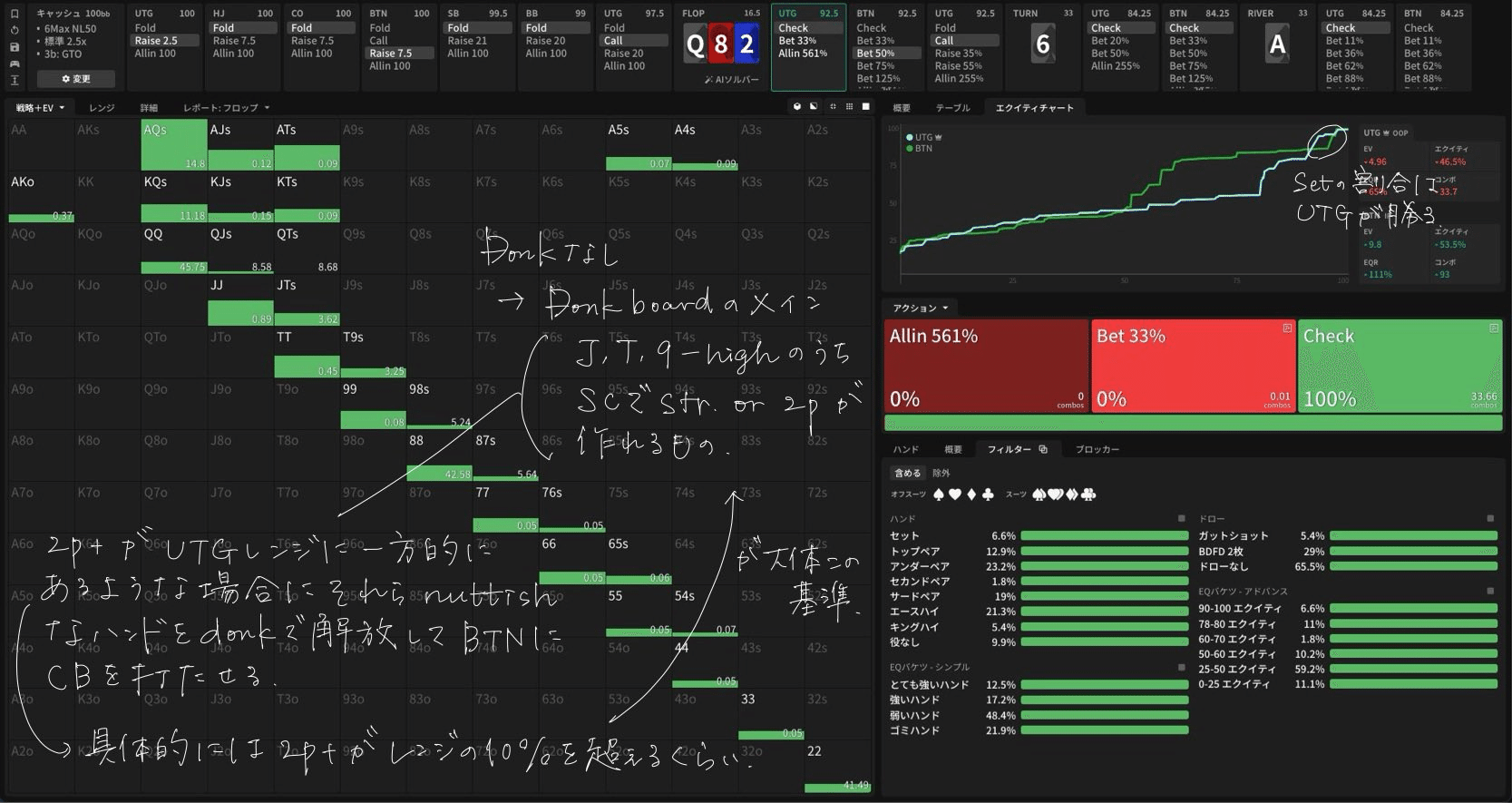
【GTO】
No donk → Donk boards are mainly J, T, 9-high boards where SCs can make straights or 2p.
When 2p+ exists exclusively in UTG's range, those nuttish hands are released via donk to let BTN fire a CB. Specifically, when 2p+ exceeds about 10% of the range.
UTG has more straight combos.
🃏 Flop Q♠8♥2♦ — CB Strategy
UTG vs. BTN 3BP node : x?
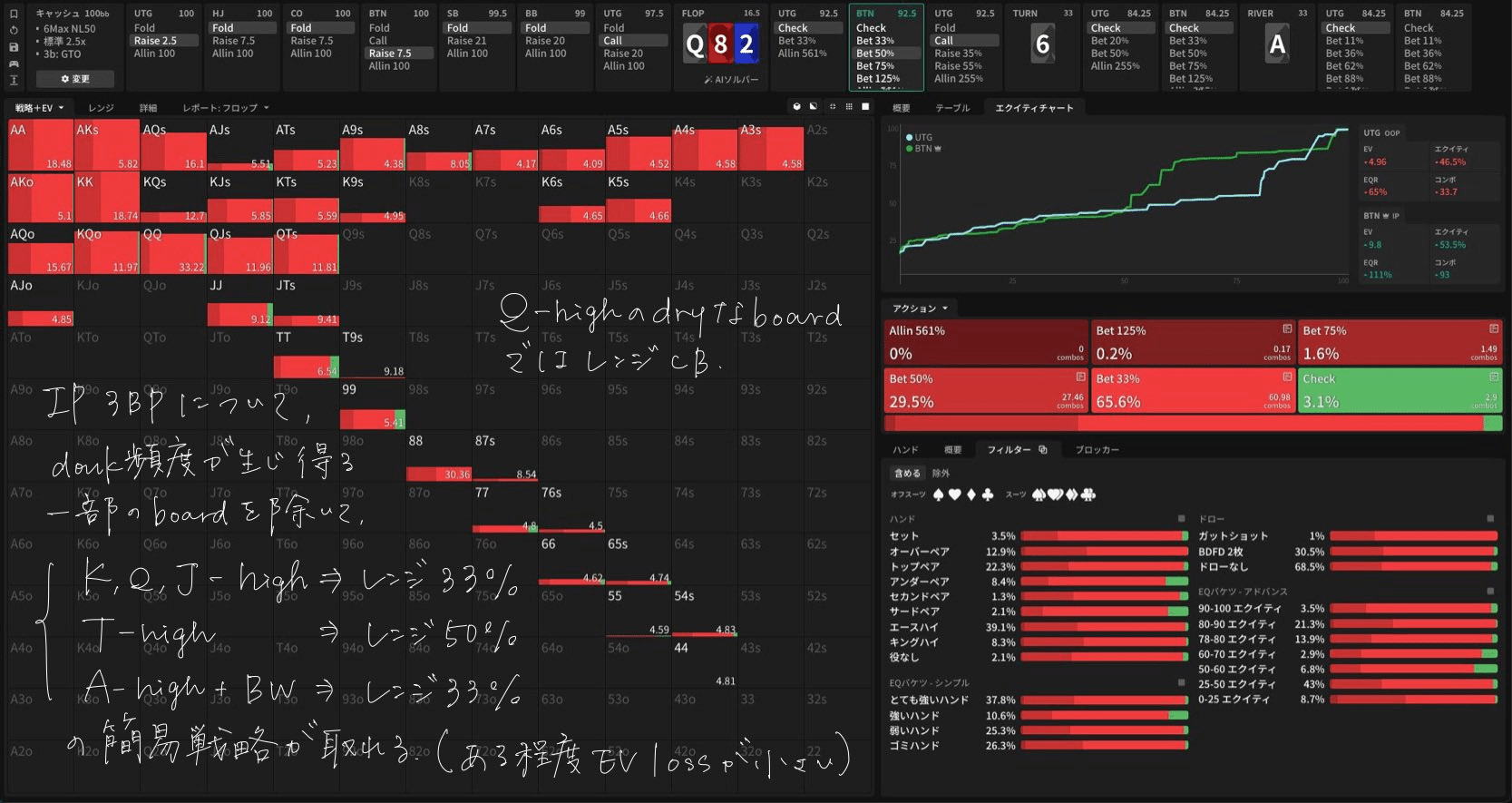
【GTO】
On dry Q-high boards, use a range CB.
For IP 3BP, excluding certain boards where donk frequency arises, the following simplified strategies can be used (with relatively small EV loss):
- A-high + BW → Range 33%
- K, Q, J-high → Range 33%
- T-high → Range 50%
🃏 Flop Q♠8♥2♦ — Response to CB
UTG vs. BTN 3BP node : xb?
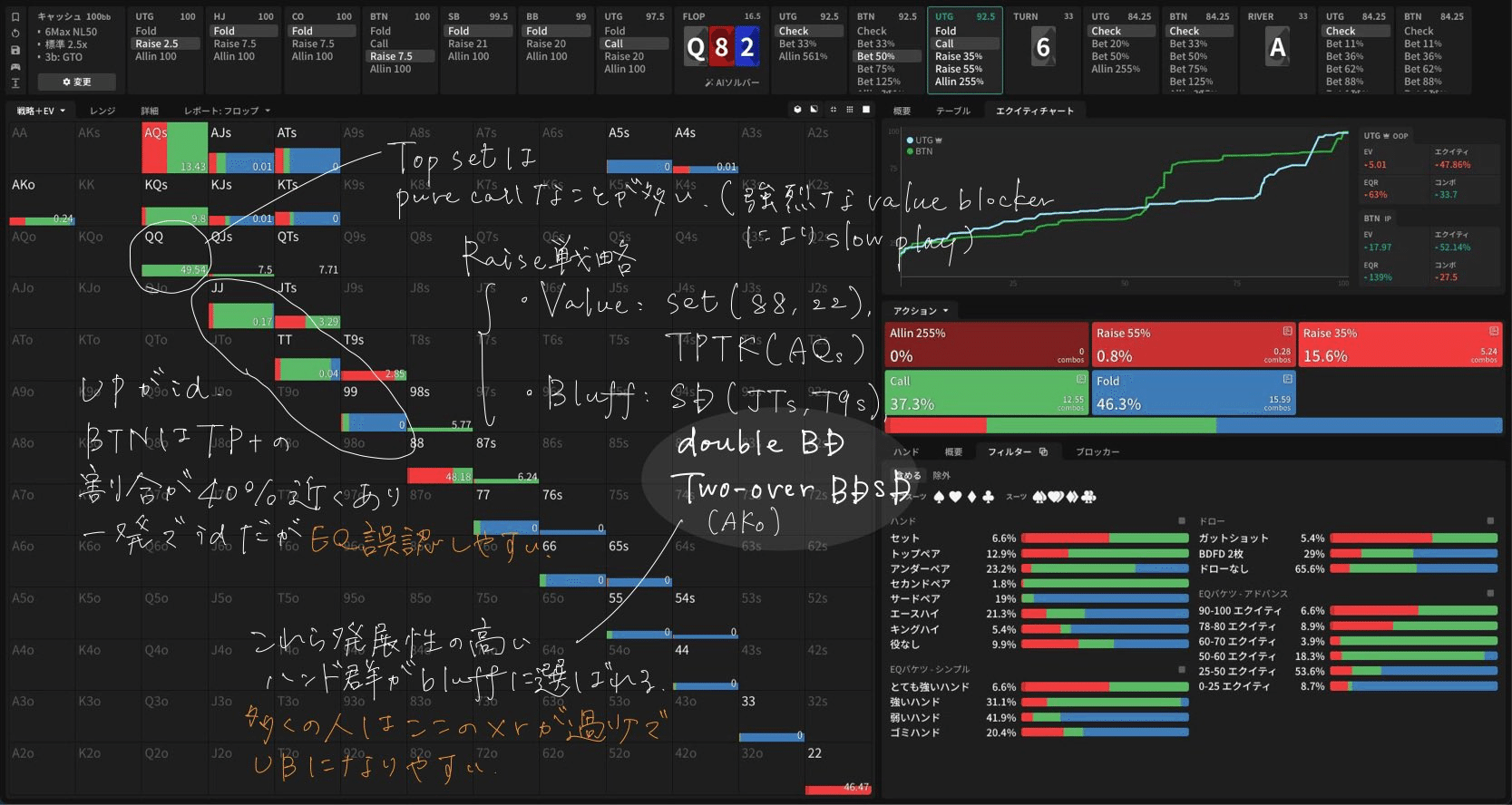
【GTO】
BTN has nearly 40% TP+ hands, making UP immediately id.
Raise strategy:
- Value: set (88, 22), TPTK (AQs)
- Bluff: SD (JTs, T9s)
Top set is often a pure call (slow play due to strong value blockers).
High-potential hand groups like double BD and two-over BDSD are chosen as bluffs.
【exploit】
UP's EQ is easily misjudged.
BD and BDSD tend to be underbluffed in xr spots.
🃏 Turn Q♠8♥2♦6♠ — Donk Strategy
UTG vs. BTN 3BP node : xbc-?
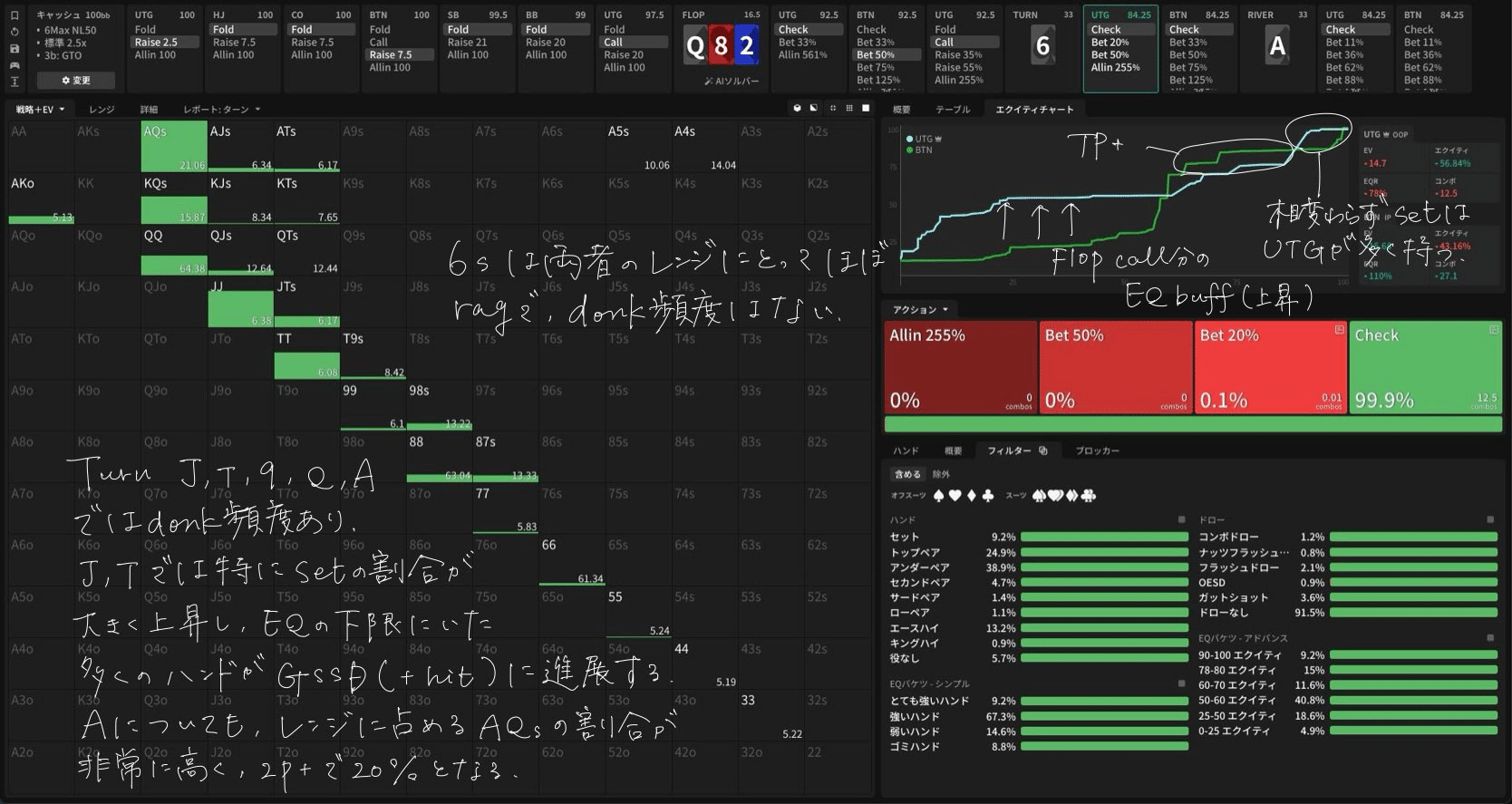
【GTO】
UTG continues to hold more sets.
6♠ is essentially a rag for both ranges, so there is no donk frequency.
On Turn J, T, 9, Q, A there is donk frequency. On J and T in particular, set proportions increase significantly, and many hands at the bottom of the EQ range develop into GSSD (+hit). For A, the proportion of AQs in the range is very high, with 2p+ making up 20%.
🃏 Turn Q♠8♥2♦6♠ — DB Strategy
UTG vs. BTN 3BP node : xbc-x?
【GTO】
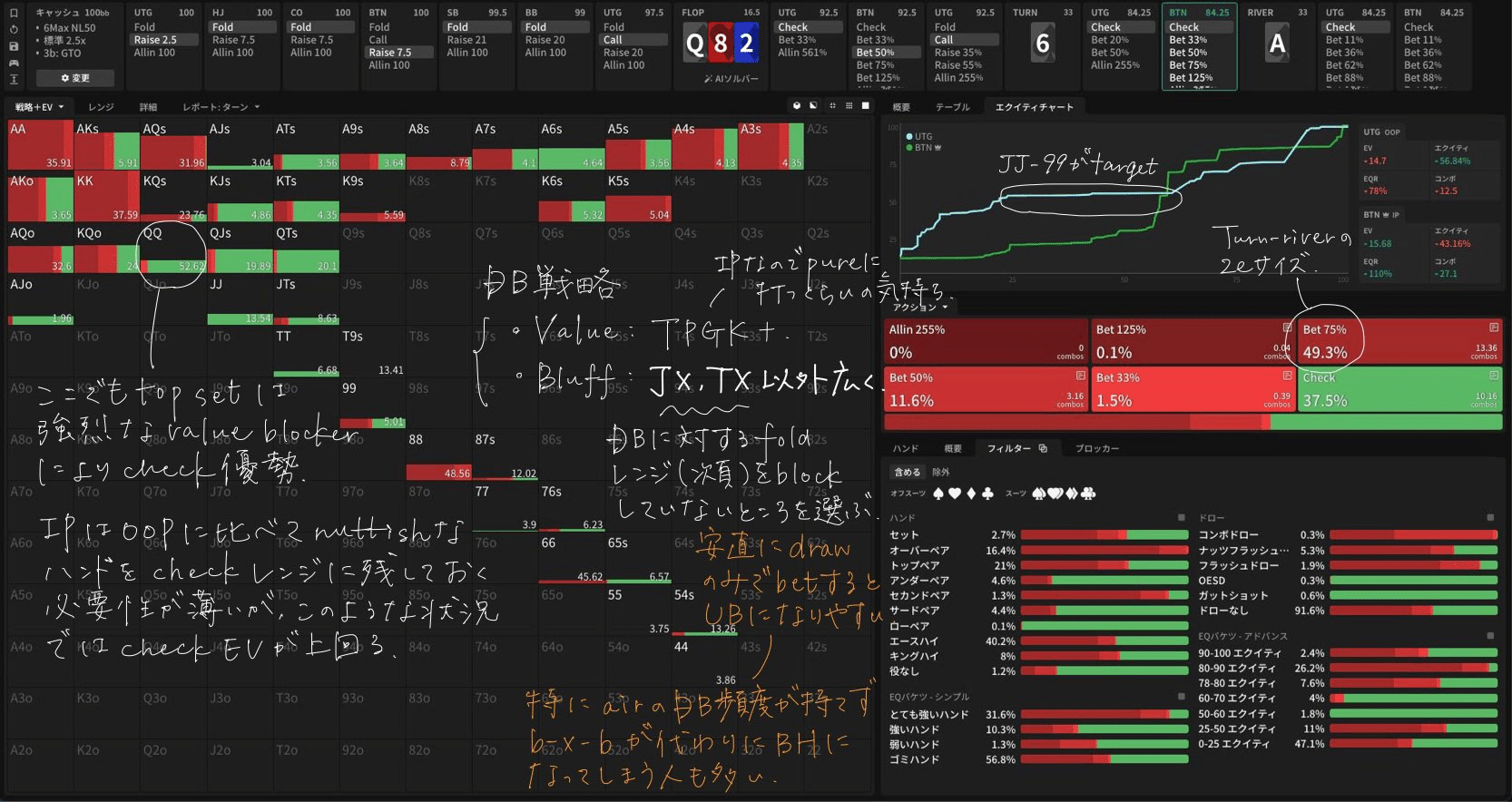
The main size is the 2e (two-street geometric) size of 75% bet for turn-river.
JJ-99 are the target.
DB strategy:
- Value: TPGK+ (being IP, bet nearly pure)
- Bluff: Broadly, excluding JX and TX
Here too, top set favors checking due to strong value blockers. While IP has less need to retain nuttish hands in the check range compared to OOP, in this situation check EV is higher.
Bluff hands are chosen from those that don't block the fold range against DB.
【exploit】
Betting only draws naively leads to underbluffing. Many players in particular cannot maintain DB frequency, ending up bluff-heavy with b-x-b lines instead.
🃏 Turn Q♠8♥2♦6♠ — Response to DB
UTG vs. BTN 3BP node : xbc-xb?
【GTO】
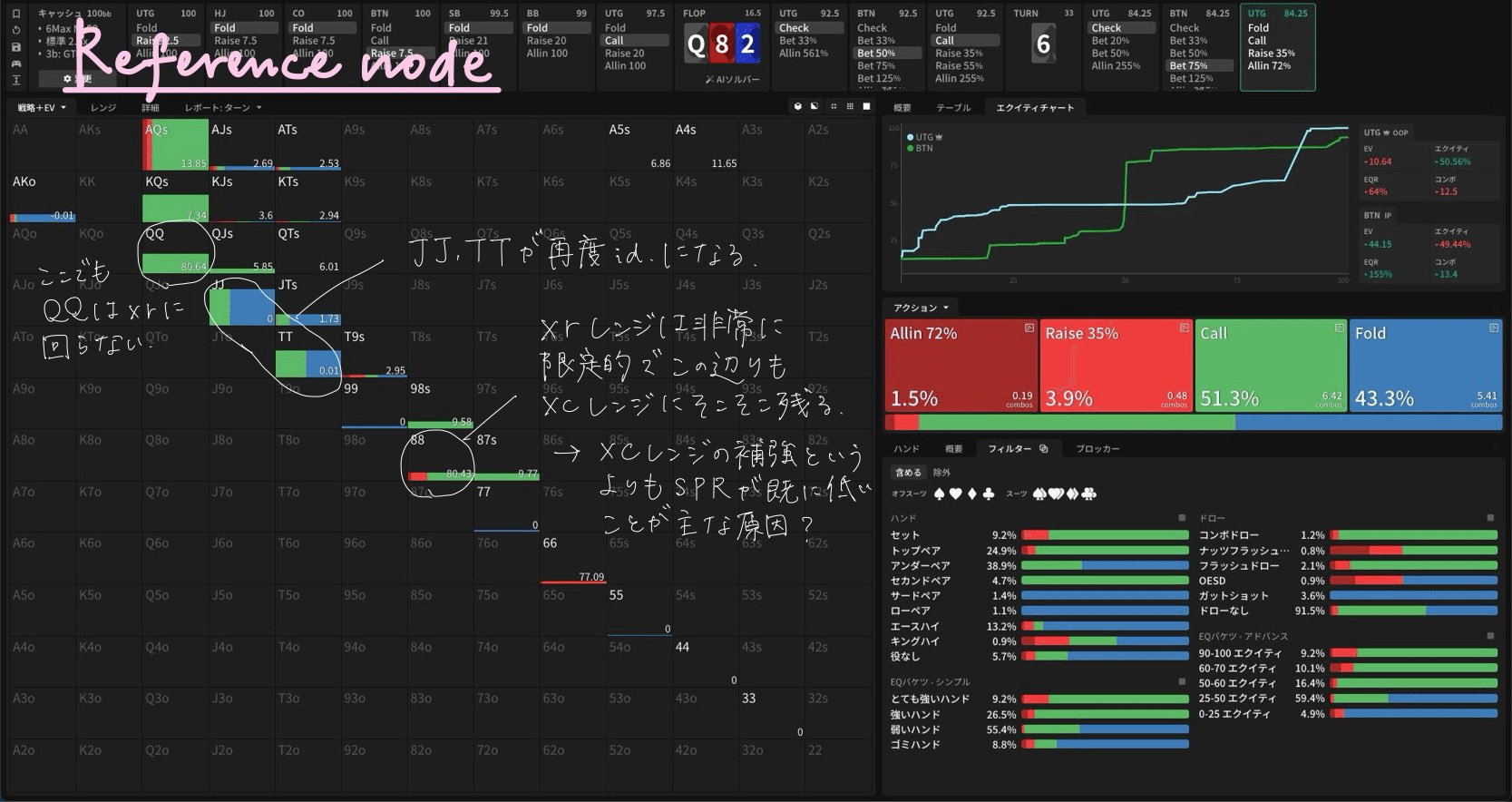
QQ still does not go to xr.
JJ and TT become id again.
The xr range is very limited, and these hands remain substantially in the xc range → Rather than reinforcing the xc range, the primary reason is that the SPR is already low?
🃏 River Q♠8♥2♦6♠A♠ — Probe Strategy
UTG vs. BTN 3BP node : xbc-xx-?
【GTO】
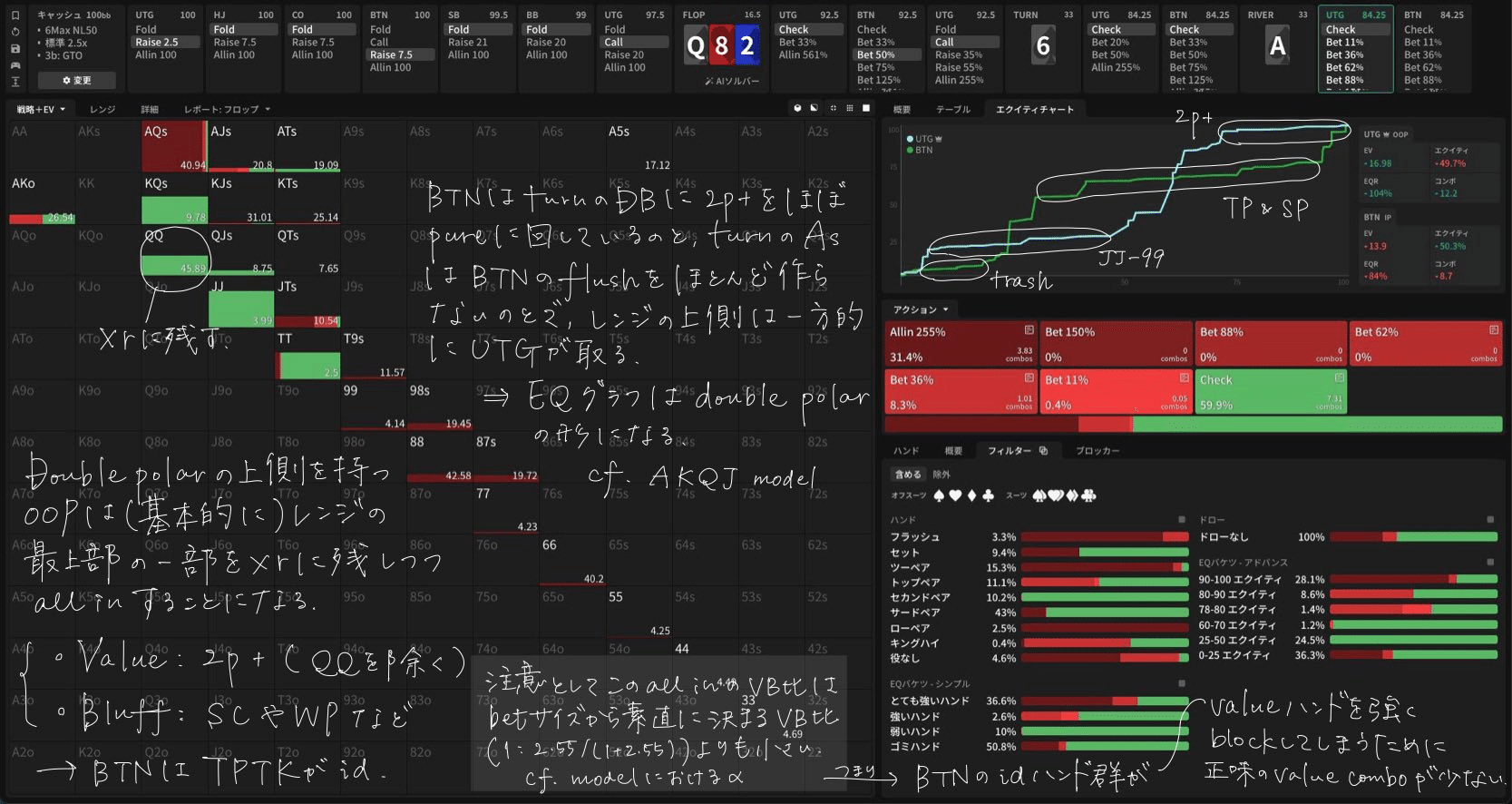
Since BTN routes 2p+ almost purely to the turn DB, and the turn A♠ barely completes any flushes for BTN, UTG exclusively captures the upper end of the range. → The EQ graph takes a double polar shape. cf. AKQJ model
OOP holding the upper side of a double polar distribution will (fundamentally) go all-in while retaining a portion of the range's very top for xr.
- Value: 2p+ (excluding QQ)
- Bluff: SC, WP, etc.
BTN's TPTK becomes id.
QQ is reserved for xr.
Note that this all-in's VB ratio is smaller than the VB ratio straightforwardly determined by bet size (1:2.55 / (1+2.55)). cf. α in the model. In other words, BTN's id hands heavily block value hands, so the net value combos are fewer.
🃏 River Q♠8♥2♦6♠A♠ — Bet to Missed Probe Strategy
UTG vs. BTN 3BP node : xbc-xx-x?
【GTO】
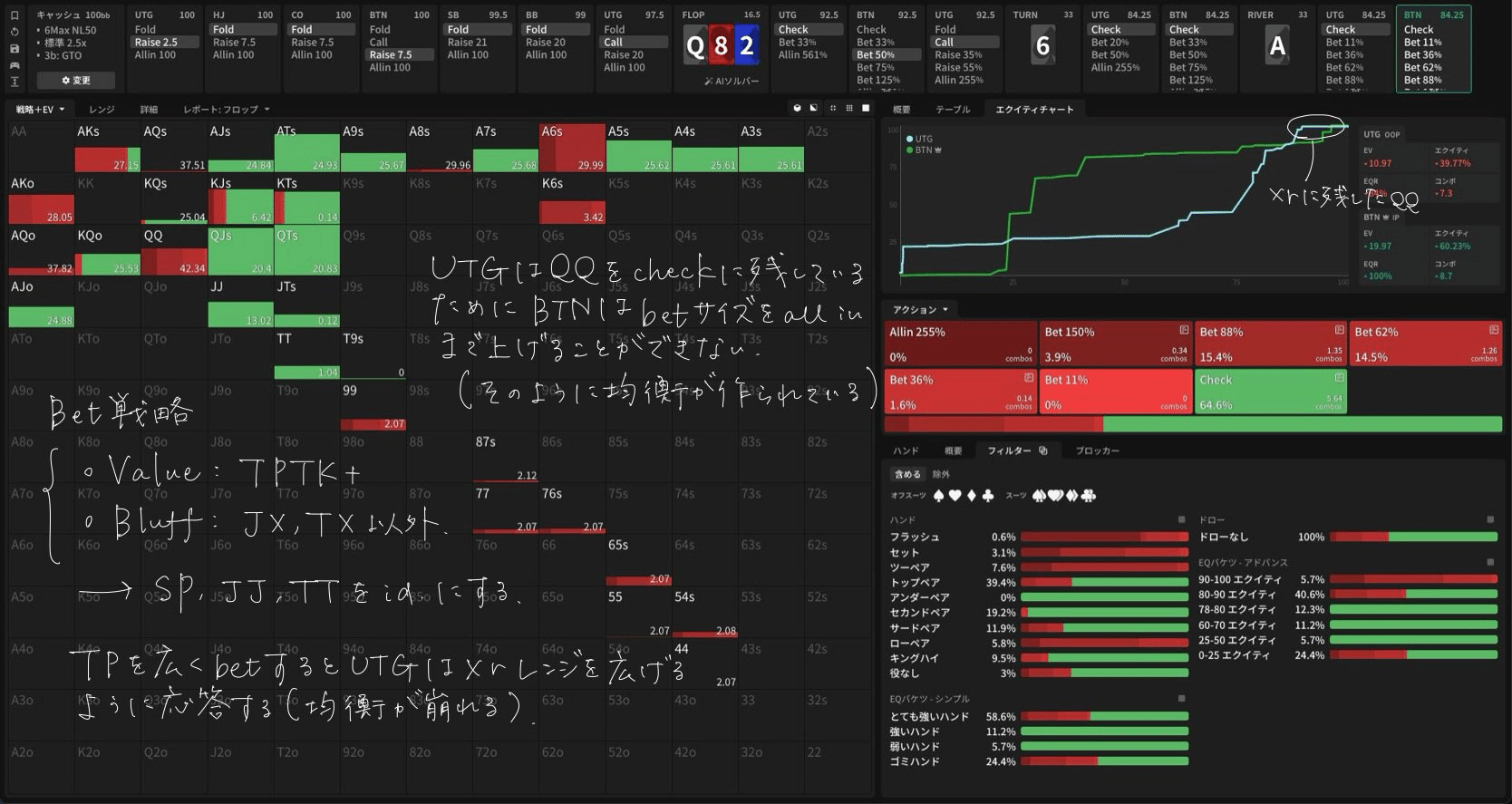
Bet strategy:
- Value: TPTK+
- Bluff: Excluding JX and TX
Makes SP, JJ, TT indifferent.
If TP bets widely, UTG responds by expanding its xr range (the equilibrium breaks).
UTG keeps QQ in the check range, which prevents BTN from sizing up to all-in. (The equilibrium is constructed this way.)
📖 Abbreviations
| Abbr. | Meaning |
|---|---|
| SC | Suited connector |
| 2p | Two pair |
| str | Straight |
| TP | Top pair |
| TPTK | Top pair top kicker |
| TPGK | Top pair good kicker |
| SP | Second pair |
| WP | Weak pair |
| UP | Under pair |
| BW | Broadway |
| BD | Backdoor |
| BDSD | Backdoor straight draw |
| SD | Straight draw |
| FD | Flush draw |
| GSSD | Gut-shot straight draw |
| DB | Double barrel |
| CB | Continuation bet |
| VB | Value bet ratio |
| xr | Check-raise |
| xc | Check-call |
| id | Indifferent |
| UB | Under-bluff |
| BH | Bluff-heavy |
| SPR | Stack-to-pot ratio |
| EQ | Equity |
Found this helpful?
Bookmark this page to revisit anytime!
Ctrl+D (Mac: ⌘+D)
Found an error or have a question about this article? Let us know.
✉️ Contact Us