Play Basics | Hand Selection, Betting & Flop Decisions
Essential skills for real poker play. Learn starting hand selection, preflop strategy, flop evaluation, value bets vs bluffs, bet sizing, and facing bets — step by step.
Once you know the rules, it's time to build the decision-making skills you need in real play.
This page covers 6 essential skills in order. Which hands to play, how to evaluate the flop, how much to bet — master the fundamentals that come up in every hand.
These Six Topics Are One Hand, in Order
The six sections aren't separate pieces of knowledge. Play a single hand to the end and they come up in exactly this order.
- Two cards are dealt → which hands do you play? (1)
- You decide to play → how do you enter? (2)
- The flop comes → how strong are you right now? (3)
- You consider betting → what is the bet for? (4)
- You decide to bet → how much? (5)
- Your opponent bets → fold or call? (6)
That is why the order is worth following. Skip 3, the strength read, and memorise 5, sizing, and you still cannot choose a number — nothing has told you what the bet is supposed to achieve.
When you get stuck, work out which of the six you are actually stuck on before going further. More often than not, the cause sits one item earlier.
1. Know Your Starting Hands
In Texas Hold'em, you decide whether to play based on the strength of your 2 hole cards (starting hand). Learn the classifications — pocket pairs, suited connectors, broadways — and their relative strength.
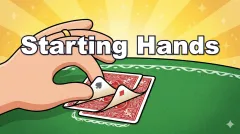
Where beginners go wrong — overvaluing suited hands. A holding like J♠7♠ makes a flush less than one time in ten. Decide whether to play based on the two cards themselves and your position first; treat "suited" as a nudge toward playing, not a reason on its own.
2. How to Enter the Pot
Once you know which hands are strong, learn how to enter the pot. Understand open raises and 3-bets, sizing guidelines, and why limping should be avoided.

Why limping is discouraged — raising keeps two paths open: everyone folds and you take the pot now, or you get called and make money with a strong hand later. Limping narrows both, and it hands a difficult decision back to you when someone behind raises. If you are playing, come in raising.
3. Evaluating the Flop
When the flop is revealed, evaluate your hand strength. Understand the difference between made hands (top pair, two pair, etc.) and draws (flush draws, straight draws).
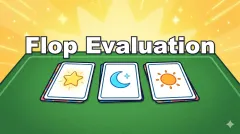
A way to keep it straight — sort made hands and draws by "strong now" versus "could become strong." Top pair is strong now; a flush draw is weak now with room to grow. They can both feel like promising hands, and they play completely differently from here.
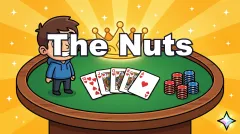
Once you can evaluate your hand on the flop, learn to identify the nuts — the strongest possible hand on any given board.
4. Value Bets and Bluffs
There are two main types of bets: value bets (betting with a strong hand for profit) and bluffs (betting with a weak hand to make opponents fold). Understanding these two makes the purpose of every bet clear.

Ask yourself every time — before betting, decide whether this is value or a bluff. A bet you cannot classify is a bet without a purpose. When you cannot answer, checking usually works out better.
5. Bet Sizing
"How much should I bet?" is the most frequent decision in poker. Learn pot-relative sizing and how to fix common sizing mistakes.
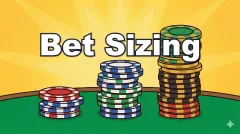
Do not learn sizes as amounts — think "half pot" or "two-thirds pot," never "1,000 chips." Ratios carry across stakes unchanged, and they feed directly into the pot odds calculations you will meet in the next step.
6. Facing a Bet
When your opponent bets, deciding whether to call or fold is the toughest spot for beginners. Learn how to respond based on bet size and the thinking behind call/fold decisions.
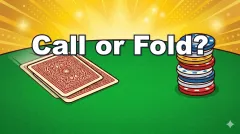
This is where probability and math meet — "should I call?" really means "how much equity does calling need?" That instinct settles once you have worked through probability and pot odds. For now just hold on to the direction: bigger bets demand more equity.
One Hand, All Six Decisions
Here is how the six connect in practice. Six-handed, everyone 100BB deep.
Preflop — You are on the CO (one seat before the button) with A♥J♥. The first three players fold. The hand is strong enough to play and only two players remain behind you, so you raise (items 1 and 2). Only the BB calls.
Flop — J♣7♦3♠. Top pair with an ace kicker. Right now you are near the top of what you could have. This is a finished hand, not one that needs to improve (item 3).
Deciding the purpose — Worse jacks, pairs of sevens and threes, and straight draws can all call you. So this is a value bet (item 4).
Choosing a size — Not much connects with this board and your opponent will not fold often, so you bet around half the pot (item 5). The BB calls.
Turn — 2♣. Nothing changed, so you bet for the same reason again. This time the BB raises.
Fold or call — Item 6. Against that raise, you now need to work out whether you have the equity to continue. Top pair is a strong hand, but raising ranges here contain plenty of sets and two pair. This is the exact moment a number becomes necessary — which is what probability and math give you next.
Every hand asks these six questions in this order. Leave one out and everything after it becomes guesswork.
FAQ
Q1: Should I learn all six before I start playing?
Show answer
No — start playing once you have read 1 and 2.
With a preflop starting standard in place, the game works. Items 3 onward land better once you have hit a spot at the table where you genuinely did not know what to do.
Q2: Do I have to memorise which hands to play?
Show answer
Use a chart at first. Before memorising anything, absorb the principle: the fewer players left to act behind you, the wider you can play.
Fewer players behind means fewer chances that someone still to act holds something strong. Understand that and you will not be far off, chart or no chart.
Q3: How many bet sizes do I need?
Show answer
Two is plenty to start: half pot and two-thirds pot.
Add more only once you can explain why a given size fits a given spot. Using the same size consistently in the same situation also makes your own play far easier to review later.
Next Step
Now that you've mastered the play basics, it's time to learn poker probability. You'll be able to make decisions based on numbers rather than gut feeling.
Found this helpful?
Bookmark this page to revisit anytime!
Ctrl+D (Mac: ⌘+D)
Found an error or have a question about this article? Let us know.
✉️ Contact Us