What Are the Nuts in Poker? How to Identify the Best Hand
Learn what 'the nuts' means in poker and how to identify it. Covers dry, monotone, connected, and paired boards with a quiz to practice nut identification on different board textures.
📝 Where this article fits: Read Flop Hand Evaluation and Hand Rankings first for the best experience.
What You'll Learn
- What "the nuts" means and where the term comes from
- A step-by-step method to identify the nuts on any board
- How the nuts differs by board texture
- How the nuts changes from street to street
- Practice quiz to sharpen your nut-identification skills
What Are the Nuts?
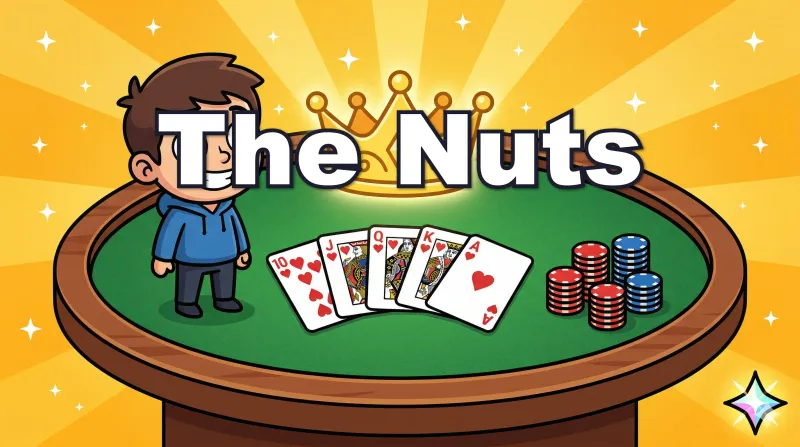
The nuts is the strongest possible hand on a given board.
If you hold the nuts, you cannot lose at showdown. The second-strongest hand is called the second nuts, and the third-strongest is the third nuts.
📝 Origin of the term: The story goes back to the American Wild West. Poker players would place the nut — a metal bolt that held a wagon wheel in place — on the table as proof they wouldn't run away from the bet. Over time, "the nuts" came to mean the absolute best hand.
🔍 How to Identify the Nuts
When looking at a board, check for the strongest possible hand in this order. It follows the hand rankings from top to bottom.
| Step | Check for | Condition |
|---|---|---|
| 1 | Straight flush | Can five same-suit consecutive cards be made? |
| 2 | Four of a kind | Is there a pair on the board? |
| 3 | Full house | Is there a pair on the board? |
| 4 | Flush | Are there 3+ cards of the same suit? |
| 5 | Straight | Can five consecutive cards be made? |
| 6 | Three of a kind (set) | If none of the above are possible |
Work from the top down — the first hand that's possible is the nuts.
A Concrete Example
Board K♦ 9♣ 4♥
- Straight flush? → All different suits → ❌
- Four of a kind? → No pair on board → ❌
- Full house? → No pair on board → ❌
- Flush? → No three cards of the same suit → ❌
- Straight? → K-9-4 are too far apart → ❌
- Set → Holding K♠K♣ makes a set of Kings = the nuts!
🎯 On a dry board where no straight or flush is possible, a set (three of a kind) is the nuts.
🃏 The Nuts by Board Texture
The type of board (board texture) determines which hand is most likely to be the nuts.
For a deeper look at board types, check out this article:
| Board Type | Likely Nuts | Example |
|---|---|---|
| Dry (disconnected, rainbow) | Set | K♦9♣4♥ → KK is the nuts |
| Monotone (3 of one suit) | Flush (check for SF first) | T♥6♥3♥ → Holding A♥ is the nuts |
| Connected (consecutive cards) | Straight | 9♠8♦7♣ → JT is the nuts |
| Paired | Full house / Four of a kind | Q♣Q♥5♦ → QQ and Q5 are the nuts |
Monotone Boards
Board T♥ 6♥ 3♥
With three hearts on board, first check for a straight flush. T-6-3 can't form a consecutive sequence, so no straight flush is possible. Next, check for a flush — the A♥ flush is the strongest.
- Nuts: A♥K♥ (ace-high flush)
- Second nuts: K♥ + another ♥ (without A♥) = king-high flush
⚠️ On monotone boards, always check for a straight flush first, then a flush. Sets and straights lose to a flush.
Connected Boards
Board 9♠ 8♦ 7♣
Three consecutive cards mean a straight is possible. The highest straight is the nuts.
- Nuts: J♥T♦ (J-T-9-8-7 = jack-high straight)
- Second nuts: T♥6♠ (T-9-8-7-6 = ten-high straight)
Paired Boards
Board Q♣ Q♥ 5♦
A pair on the board means full houses and quads are possible.
- Nuts: Q♠Q♦ (quad Queens) and Q♠5♣ (Queens full of Fives)
🎯 When you see a pair on the board, always consider full houses and quads. Flushes and straights are never the nuts on paired boards.
🔄 The Nuts Changes
This is a key point that beginners often miss: the nuts can change on every street. Let's walk through an example where the nuts shifts three times in a single hand.
Set → Straight → Quads
Flop: K♠ 9♣ 4♥
- Rainbow and disconnected — no straight or flush possible → Nuts = set of Kings (KK)
Turn: K♠ 9♣ 4♥ J♠
The board now has K-J-9, and Q♥T♦ completes K-Q-J-T-9 — a straight!
- Nuts changed from KK (set) → QT (straight)!
River: K♠ 9♣ 4♥ J♠ 4♠
The 4♠ hits the river. Let's break down the new board.
- Three spades (K♠J♠4♠) → a flush is now possible!
- A pair of 4s (4♥4♠) → full houses and quads are now possible!
So what's the nuts?
- Holding A♠ gives you an ace-high flush — strong! …but
- Holding K♦K♥ gives you Kings full of Fours — a full house that beats any flush
- But holding 4♦4♣ gives you quad Fours — beating even the full house!
- Nuts = 44 (quads)
⚠️ Having the nuts on the flop doesn't mean you'll still have it on the river. Re-evaluate "what's the nuts?" every time a new card appears.
🧩 Nuts Identification Quiz
Put your knowledge to the test! Look at each board, figure out the nuts, then reveal the answer.
Q1: Dry Board
Board A♦ 8♣ 3♥
What's the nuts?
Reveal Answer
Nuts: A♠A♣ (set of Aces)
A rainbow, disconnected dry board. No straight or flush is possible, so a set of the highest board card — Aces — is the nuts.
Second nuts: 8♠8♥ (set of Eights)
Q2: Monotone Board
Board J♠ 7♠ 2♠
What's the nuts?
Reveal Answer
Nuts: A♠ + another ♠ (e.g., K♠) = ace-high flush
Three spades on a monotone board. A straight flush is impossible (J-7-2 can't form a sequence). The A♠ flush is the strongest.
Second nuts: K♠ + another ♠ (without A♠) = king-high flush
Q3: Connected Board
Board T♥ 9♣ 8♦
What's the nuts?
Reveal Answer
Nuts: Q♠J♥ (Q-J-T-9-8 = queen-high straight)
With T-9-8 on board, the highest possible straight uses QJ. That's the nuts.
Second nuts: J♦7♣ (J-T-9-8-7 = jack-high straight)
Q4: Paired Board
Board 9♥ 9♦ K♣
What's the nuts?
Reveal Answer
Nuts: 9♠9♣ (quad Nines)
With a pair of 9s on the board, holding the remaining two 9s gives you four of a kind — the nuts.
Second nuts: K♠K♥ (Kings full of Nines)
Q5: Changing Nuts
Flop: J♥ T♦ 4♣
What's the nuts on the flop? And how does it change on the turn?
Turn: J♥ T♦ 4♣ Q♠
Reveal Answer
Flop nuts: J♠J♣ (set of Jacks)
No straight or flush is possible on the flop (J-T-4 is too disconnected, all different suits). A set of Jacks is the nuts.
Turn nuts: A♥K♣ (A-K-Q-J-T = Broadway straight)
The Q♠ creates Q-J-T on the board, and AK completes Broadway — the highest possible straight.
🔄 JJ was the nuts on the flop but got overtaken by a straight on the turn.
🎯 Summary
Key Takeaways:
- The nuts = the strongest possible hand on a given board
- Identification order: straight flush → four of a kind → full house → flush → straight → set
- Board texture determines the nuts:
- Dry → sets are often the nuts
- Monotone → a flush is the nuts (check for straight flushes too)
- Connected → a straight is the nuts
- Paired → full houses and quads are the nuts
- The nuts changes on every street — the flop nuts may not survive to the river
- Always ask yourself: "What's the best possible hand on this board?"
Now that you understand what the nuts is, it's time to learn when to bet and when to fold.

Found this helpful?
Bookmark this page to revisit anytime!
Ctrl+D (Mac: ⌘+D)
Found an error or have a question about this article? Let us know.
✉️ Contact Us