Starting Hand Types and Terminology
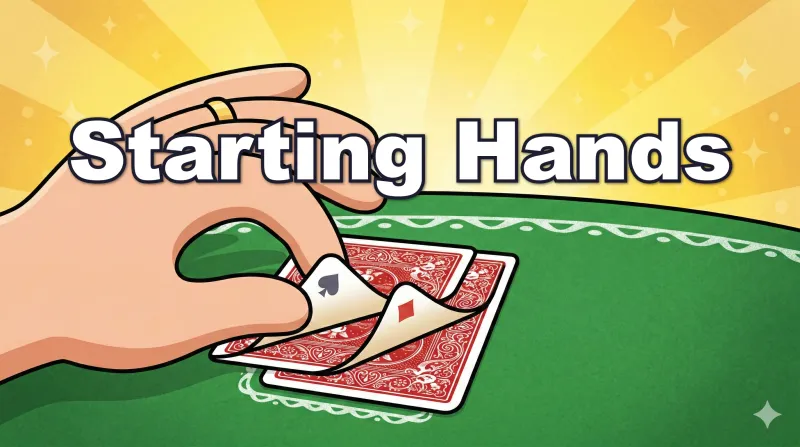
Learn about the 2 cards you're dealt in poker (your starting hand). This beginner guide covers the 4 hand categories — Pocket Pairs, Connectors, Suited, and Broadway — plus how to read hand notation.
📝 Where this article fits: Reading Positions and Hand Rankings first will help you get the most out of this article.
Starting Hand Types and Terminology
What You'll Learn
- What a starting hand is
- How to read hand notation (AKs, AKo, 77)
- The 4 hand categories (Pocket Pairs, Connectors, Suited, Broadway)
- Why your position changes which hands you should play
🃏 What Is a Starting Hand?
In Texas Hold'em, you're dealt 2 cards to start. These 2 cards are called your starting hand.
As you learned in Game Flow, during the preflop (the first betting round), you look at just these 2 cards to decide whether to play or fold.
🎯 Key Point
Starting hand = the 2 cards you're dealt at the beginning. These 2 cards are the foundation of everything in poker.
There are 1,326 possible combinations when choosing 2 cards from a 52-card deck. But don't worry — you don't need to memorize them all. By categorizing hands into "types," everything becomes much more manageable.
📝 How to Read Hand Notation
In the poker world, there's a shorthand system for writing hands. Learning it will let you quickly understand information from books and websites.
| Notation | How to Read It | Meaning |
|---|---|---|
| AA | Aces (Pocket Aces) | A pair of Aces |
| 77 | Sevens (Pocket Sevens) | A pair of 7s |
| AKs | Ace-King suited | A and K of the same suit |
| AKo | Ace-King offsuit | A and K of different suits |
💡 s = suited = same suit (e.g., A♠ K♠)
o = offsuit = different suits (e.g., A♠ K♥)
Paired numbers = pocket pair (e.g., 77 = a pair of 7s)
Note that 10 is written as T (from "Ten").
This notation omits the specific suits (♠♥♦♣). When more detail is needed, you may see suits specified like "A♦A♣."
🎴 The 4 Hand Categories
Starting hands can be grouped into 4 main types. Let's learn what makes each one special.
→ Aim for a set
→ Aim for a straight
→ Aim for a flush
→ Aim for top pair
1. Pocket Pair
A hand with two cards of the same rank. Examples: AA, KK, QQ, 77, 22.
Characteristics:
- You already have one pair the moment you're dealt your cards.
- If a matching card appears on the board, you make three of a kind (a "set"). Sets are incredibly valuable because they're hard for opponents to detect. For instance, if you hold 77 and a 7 appears on the board, opponents rarely suspect you're holding two 7s.
- However, small pocket pairs (22-66) can be difficult to play after the flop if they don't improve to a set.
📝 You'll be dealt a pocket pair about 6% of the time (roughly once every 17 hands). From there, the chance of flopping a set is about 12% (roughly 1 in 9).
2. Connector
A hand with two cards of consecutive ranks. Examples: JT, 98, 54.
Characteristics:
- Depending on the community cards, you can make a straight (5 cards in sequence).
- Middle-ranked connectors (67, 78, 89) can complete straights in both directions, giving them more possible straight combinations.
- Low connectors (32, 43) have fewer straight possibilities, making them less valuable.
3. Suited
A hand where both cards share the same suit (♠♥♦♣).
Characteristics:
- If 3 more cards of the same suit appear on the board, you complete a flush (5 cards of the same suit).
- Suited hands have a 2-3% higher win rate compared to their offsuit counterparts.
- Ace-high suited hands (A5s, A3s, etc.) are especially valuable because when they make a flush, it can be the nut flush (the strongest possible flush).
- With offsuit hands, you can't chase flushes, which means you'll end up folding more often after the flop.
💡 "Just 2-3%?" you might think. But poker is a game where you play hundreds of hands. This small edge adds up to a significant difference in long-term profits.
4. Broadway
A hand with two cards ranked T (10) or higher. The 5 cards — T, J, Q, K, and A — are called "Broadway cards."
Examples: AK, AQ, KQ, KJ, QJ, JT, etc.
Characteristics:
- Even without pairing, they frequently make top pair (a pair using the highest card on the board) when combined with community cards.
- There's also potential to complete the strongest straight, the "Broadway straight" (T-J-Q-K-A).
- Hands like AK and AQ are called "premium hands" and can be played from most positions.
📝 "Broadway" originally refers to the best possible straight: A-K-Q-J-T. The term was then extended to describe T-or-higher cards and hands made from them.
🔀 Combination Hands
In practice, many hands belong to more than one of the categories above.
| Name | Meaning | Example |
|---|---|---|
| Suited Connector | Same suit + consecutive ranks | 8♠7♠, J♥T♥ |
| Broadway Suited | Two T+ cards + same suit | A♠K♠, Q♦J♦ |
🎯 Key Point
Suited connectors can make both straights and flushes, so they punch above their weight. They're also easy to play because you can fold cleanly when you miss.
📍 Position Changes Hand Value
As you learned in Positions, later positions (like BTN and CO) have an advantage.
This directly affects which hands you should play:
- Early position (UTG, etc.): Many players still act after you. It's safest to only play strong hands.
- Late position (BTN, CO, etc.): Fewer players left to act. You can play somewhat weaker hands.
📝 For example, "K9o (King-Nine offsuit)" is too weak to play from UTG, but it's playable from the BTN. The same hand changes in value depending on your position.
A chart that maps out which hands to play from each position is called a hand range chart. We'll cover how to use hand range charts in a future article.
❌ Common Beginner Mistakes
Getting Fooled by One High Card
"A2o (Ace-Two offsuit)" looks strong because it has an Ace. But it's actually a tricky hand to play. The two cards are far apart in rank and different suits, so you can't easily make straights or flushes. Even when you pair your Ace, the other card (a 2) often leads to kicker problems (when two players have the same pair, the winner is decided by their other card), making it hard to win big pots.
Playing Too Many Hands
It's natural to want to play every hand you're dealt, but even pros only play about 20-30% of their hands. Playing weak hands will steadily drain your chips.
⚠️ When in doubt, fold. This is the single best rule for protecting beginners.
🎯 Summary
🎯 Key Takeaways
- Starting hand = the 2 cards you're dealt at the beginning
- Reading notation: s = suited (same suit), o = offsuit (different suits), paired numbers = pocket pair
- The 4 categories:
- Pocket Pair (same rank x2) → Sets are hidden and powerful
- Connector (consecutive ranks) → Can make straights
- Suited (same suit) → Can make flushes; Ace-suited is especially valuable
- Broadway (two T+ cards) → AK, KQ, QJ, etc.
- Position changes hand value: Later positions allow you to play more hands
- When in doubt, fold is the beginner's golden rule
🚀 Next Steps
Now that you can identify your hand type, it's time to learn how to actually enter the pot preflop. Once you understand "open raises" and "3-bets," your hand selection will become much more practical!
Found this helpful?
Bookmark this page to revisit anytime!
Ctrl+D (Mac: ⌘+D)
Found an error or have a question about this article? Let us know.
✉️ Contact Us