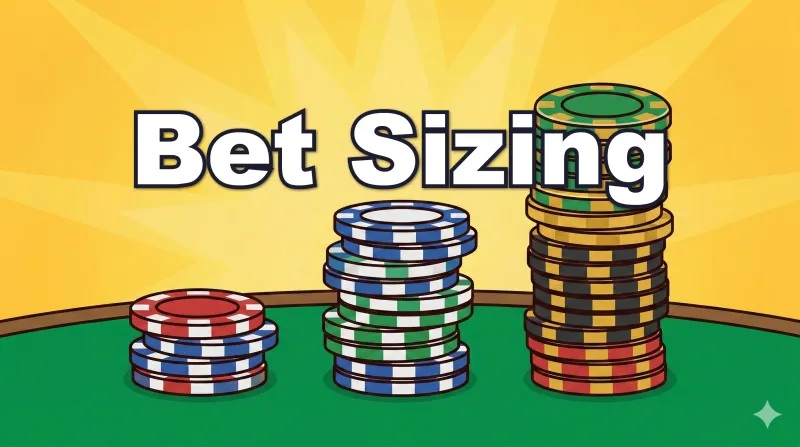
Bet Sizing Basics — How Much Should You Bet?
How do you decide the right bet or raise amount? Learn pot-ratio sizing, how to adjust based on hand strength, and the most common sizing mistakes — all explained in simple terms.
📝 Where this article fits: It helps to read Value Bets and Bluffs first.
Bet Sizing Basics
In the previous article, you learned that there are only two reasons to bet: value and bluffs. Now comes the next question — "How much should I bet?" It turns out there's a logical framework for bet sizing. Too big or too small and you're making a mistake. This article covers the fundamentals of sizing that any beginner can start using right away.
What you'll learn
- The benchmark for bet sizing is "pot size"
- How different sizes work — using large and small bets
- Mix value bets and bluffs at every size
- When in doubt, 1/2 pot is fine
📏 The benchmark for sizing is the pot
Bet amounts are measured as a percentage of the pot (the total chips in the middle).
For example, with a pot of 100 chips:
| Size name | Amount (with a 100-chip pot) |
|---|---|
| 33% | 33 chips |
| 75% | 75 chips |
| 100% (pot-sized) | 100 chips |
| 150% (overbet) | 150 chips |
| All-in | Your entire stack |
📝 An overbet is a bet larger than the pot (over 100%).
The sizes in the table above are the most commonly used. When betting, aim to choose from these standard sizes.
🎯 Instead of thinking "how many chips should I bet?", think "what percentage of the pot should I bet?" Building this habit is the first step to good bet sizing.
💡 If the math feels hard, just use 50% (half-pot). For beginners, this alone is perfectly fine.
🎯 How different sizes work
The larger the bet, the more your opponent will fold weak hands. In other words, opponents who call a large bet tend to have strong hands.
Understanding this principle unlocks how to use different sizes.
The stronger your hand, the bigger you can go
| Hand strength | Recommended size |
|---|---|
| Very strong (set, two pair or better) | 33–150% |
| Strong (top pair, good kicker) | 33–100% |
| Medium (middle pair, weak top pair) | 33–75% |
| Bluff | 33–150% |
Large sizes (75%–150%)
- Large bets fold out your opponent's weak hands
- The opponents who do call will have strong hands, so you need a hand that can beat those
- You should also mix in bluffs — if large bets are never bluffs, your opponents will know "large bet = strong hand" and simply fold
Example: Board is K♦8♠4♣, pot is 100 chips
Value hand: 8♥8♣ (set = three of a kind) Bet 75% (75 chips). The opponents calling will have hands like a pair of kings (KQ, KJ, etc.) or two pair. A set of 8s beats almost all of these, so betting big is fine.
Bluff hand: 5♣6♣ (straight draw — a 7 completes 4-5-6-7-8) Bet the same 75%. From your opponent's perspective, all they see is "a 75% bet" — they can't tell if you have 88 or 56.
Small sizes (33%)
- Small bets don't make opponents fold very much
- The hands that call won't be as strong, so even medium-strength hands can work as value bets
Example: Board is J♦7♥2♠, pot is 100 chips
Value hand: J♠T♣ (top pair of jacks, ten kicker) Bet 33% (33 chips). Opponents who call might have a pair of 7s, a pair of 2s, or ace-high. JT beats all of these, so this works as a value bet.
Bluff hand: 5♦4♦ (complete miss) Bet the same 33%. Even getting opponents with six-high or better to fold is a win.
🎯 The stronger your hand, the higher the size ceiling you can use. However, betting small with a strong hand is also fine. This prevents opponents from reading "small bet = always a weak hand."
⚠️ Mix value bets and bluffs at every size
The biggest trap beginners fall into is using different sizes for value bets and bluffs.
The bad pattern
- Value bet (you think you're winning) → Bet big
- Bluff (you want them to fold) → Bet small
If you do this, your opponents can read your hand just from your bet size.
"A big bet came in = strong hand. I'll fold." "A small bet came in = probably a bluff. I'll call."
The result? Your value bets never get called, and your bluffs get caught.
As shown in the examples above, the set of 88 and the bluff with 56 should both be bet at the same size. From your opponent's perspective, the size alone tells them nothing about whether it's value or a bluff.
🎯 It's NOT "big because it's value" and "small because it's a bluff." Every size should contain both value bets and bluffs. This is the most fundamental principle of bet sizing.
🎓 Practice scenarios: Sizing decisions
Situation 1: Pot is 200 chips. Your hand is K♠K♥, board is K♣9♦3♠. You've flopped a set (three of a kind).
Q1: If you're going to bet, what size would you choose?
See the answer
Answer: 33%–150% — any size works.
Reasoning: A set is a "very strong" hand. A large bet can extract lots of chips from king-pair or nine-pair hands, while a small bet gets calls from a wide range of opponents. Any size you choose will be profitable, so pick based on your read of the opponent or your personal preference.
Situation 2: Pot is 100 chips. Your hand is T♥9♠, board is T♦5♣2♥. You have top pair, but with a nine kicker.
Q2: If you're going to bet, what size would you choose?
See the answer
Answer: 33%–75% is recommended.
Reasoning: You have top pair but a weak kicker, making this a "medium" strength hand. A smaller size lets you get calls from weaker pairs and ace-high. Betting too large means only hands stronger than yours will call.
Situation 3: You've been watching player A. Whenever they make a large bet, they always show a strong hand. Whenever they make a small bet, they always show a bluff.
Q3: What is player A's weakness?
See the answer
Answer: It's obvious that large bets are value bets and small bets are bluffs.
Reasoning: You can fold to A's large bets and call their small bets — easy. The lesson: mix value bets and bluffs at every size so opponents can't read your hand from the size alone.
❌ Common mistakes
Extremely small or large bets
Betting 10 into a pot of 100, or betting 100 into a pot of 10 — sizes that are wildly disproportionate to the pot are bad plays. Too small and your bluffs won't work while your value bets don't earn enough. Too large and mistakes become very costly.
🎯 Summary
Key takeaways:
- Bet sizes are based on a percentage of the pot
- Larger sizes mean callers tend to be stronger; smaller sizes keep a wider range of opponents in
- The stronger your hand, the higher the size ceiling you can use
- Mix both value bets and bluffs at every size — don't give away your hand through sizing
- When in doubt, use 50% (half-pot)
Now that you understand how to size your bets, it's time to learn what to do when your opponent bets at you. Call or fold? The next article, Facing a Bet, covers how to make decisions from the defending side.
Found this helpful?
Bookmark this page to revisit anytime!
Ctrl+D (Mac: ⌘+D)
Found an error or have a question about this article? Let us know.
✉️ Contact Us