Types of Poker | A Complete Guide to Game Variants and Formats
A complete guide to types of poker from two perspectives: game variants (Texas Hold'em, PLO, Stud, etc.) and play formats (Ring Games, Tournaments, SNG, Satellites). Learn the differences and find the right style for you.
"Types of Poker" — Two Meanings
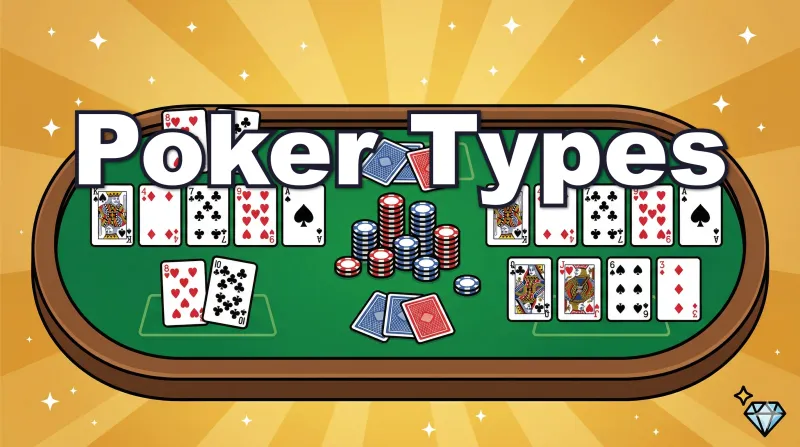
When people say "types of poker," there are actually two meanings:
- Game Variants — Different games with different rules, such as Texas Hold'em, Omaha, and Stud
- Play Formats — Different ways to enjoy the same game, such as Ring Games (Cash Games), Tournaments, and SNG
For example, "a Texas Hold'em Tournament" means the game variant is "Texas Hold'em" and the format is "Tournament." This article covers both meanings in full.
Part 1: Game Variants — What Poker Games Exist?
Poker games fall into three main categories based on how cards are dealt:
- Flop Games — Community cards are placed in the center of the table (Texas Hold'em, Omaha, etc.)
- Draw Games — Players exchange cards from their hand to make the best hand (Five Card Draw, etc.)
- Stud Games — Some of each player's cards are dealt face-up (Seven Card Stud, etc.)
Texas Hold'em
The most widely played poker game in the world. Each player receives 2 hole cards and shares 5 community cards, making the best 5-card hand from those 7 cards.
- Simple rules but deeply strategic
- By far the largest player pool, both online and live
- The game you'll find at most amusement poker venues in Japan
Want to learn the full rules of Texas Hold'em?
Pot-Limit Omaha (PLO)
The second most popular poker game after Texas Hold'em. Each player receives 4 hole cards and must use exactly 2 of them to make a hand.
- More hole cards mean stronger hands are more common, leading to more action-packed play
- "Pot-Limit" means the maximum bet is the size of the pot
- Popular among high-stakes professionals
Short Deck (6+ Hold'em)
A Hold'em variant played with a 36-card deck (2s through 5s are removed from the standard 52-card deck).
- Fewer cards mean stronger hands appear more often
- Some hand rankings change — for example, a Flush beats a Full House
- Has surged in popularity in high-stakes cash games in recent years
Pineapple Variants
Hold'em-based variants where players are dealt extra hole cards and must discard some during the hand. More hole cards mean more connections with the board, leading to bigger action.
| Game | Hole Cards | When to Discard |
|---|---|---|
| Pineapple | 3 | Discard 1 before the flop |
| Crazy Pineapple | 3 | Discard 1 after the flop |
| Watermelon | 4 | Discard 1 preflop, then 1 more after the flop |
Crazy Pineapple is the most popular variant, as seeing the flop before choosing which card to discard adds a strategic layer. Watermelon combines the mechanics of both Pineapple and Crazy Pineapple.
Super Hold'em
A Hold'em variant where players receive 3 hole cards instead of 2. Players must use exactly 2 of their 3 cards to make their hand (similar to PLO's "must use exactly 2" rule).
The extra card raises the baseline hand strength, making flushes and straights more common.
Stud Poker
A poker format with no community cards, where some of each player's cards are dealt face-up. The most well-known variant is Seven Card Stud, where 7 cards are dealt (3 face-down, 4 face-up), and players make their best 5-card hand.
- A unique dynamic of reading hands based on opponents' visible cards
- Was the most popular poker game in America before Texas Hold'em took over
- Razz is a Stud variant where the lowest hand wins (a lowball game)
Draw Poker
The most classic form of poker, where players exchange cards to build their hand. The "deal 5 cards and swap some" image many people have of poker is this type.
- Five Card Draw: A simple format where you can exchange any number of your 5 cards
- 2-7 Triple Draw: A lowball game with 3 draw rounds, where the weakest hand wins
- Rarely seen as a standalone game today, but remains a staple in Mixed Games
Mixed Games
A format where multiple poker variants are played in rotation, switching every set number of hands.
- HORSE: Rotates through 5 games — Hold'em → Omaha Hi-Lo → Razz → Stud → Stud Eight-or-Better
- 8-Game Mix: An advanced format rotating through 8 different poker games
- Tests "total poker ability" as players must be skilled in every game
Game Variants — Comparison Table
| Game | Category | Hole Cards | Community Cards | Key Feature |
|---|---|---|---|---|
| Texas Hold'em | Flop | 2 | 5 | Most popular. Simple yet deep |
| PLO | Flop | 4 | 5 | Action-heavy. Must use 2 hole cards |
| Short Deck | Flop | 2 | 5 | 36-card deck. Some rankings changed |
| Pineapple variants | Flop | 3–4 | 5 | Hold'em with extra cards, discard mid-hand |
| Super Hold'em | Flop | 3 | 5 | 3 hole cards, must use exactly 2 |
| Seven Card Stud | Stud | 7 | None | Some cards dealt face-up |
| Five Card Draw | Draw | 5 | None | Exchange cards. Most classic |
| Mixed Games | Mixed | — | — | Rotate through multiple variants |
Part 2: Play Formats — How Can You Enjoy Poker?
Even with the same Texas Hold'em rules, the experience changes completely depending on the play format.
Ring Game (Cash Game)
A format where you can join and leave at any time. The defining feature is that chips have direct monetary value.
- Blinds (forced bets) are fixed and don't change
- You can leave the table whenever you want
- Play at your own pace, whether for a short or long session
- The format most beginners start with
Tournament (MTT)
Players pay an entry fee and all start with the same chip stack, competing until one player remains. MTT stands for Multi Table Tournament.
- Blinds increase over time, ramping up the pressure as the tournament progresses
- You can win prizes worth tens or hundreds of times your entry fee
- Unlike ring games, there is no rake (house fee). Instead, antes (a small amount every player pays each hand) are added on top of the blinds
- Major world events (WSOP, WPT, etc.) use this format
Satellite
Unlike a regular tournament, the prize is a seat in a larger tournament rather than cash. The key difference is that there is no single winner — the tournament ends when the field has been reduced to the predetermined number of qualifying spots.
- For example, a 100 tournament
- A route to step up to bigger events with minimal investment
- Since you only need to make the qualifying spots, the strategy differs significantly from a standard tournament
Sit & Go (SNG: Sit and Go)
A mini-tournament that starts as soon as a set number of players (e.g., 6 or 9) are seated.
- Shorter than a full tournament (typically 30 minutes to 1 hour)
- With fewer players, interpersonal skills become more important
- Great for beginners to get a feel for tournament play
Spin & Go / Jackpot Format
An ultra-fast 3-player SNG where the prize pool is determined randomly.
- A roulette wheel at the start decides the prize multiplier (2x to 1,000x+)
- Each game takes only about 5–10 minutes
- A unique blend of skill and luck, great for casual play
Play Formats — Comparison Table
| Format | Players | Duration | Chip Value | Best For |
|---|---|---|---|---|
| Ring Game | 2–10 | Flexible | Real money | Playing at your own pace |
| Tournament (MTT) | Dozens–thousands | Hours–days | Entry fee only | Chasing big wins |
| Satellite | Varies | Varies | Tournament seat | Stepping up on a budget |
| SNG | 6–9 | 30 min–1 hr | Entry fee only | Quick competition |
| Spin & Go | 3 | 5–10 min | Random prize | Quick, casual fun |
Why Texas Hold'em Is the Go-To Choice
With so many types to choose from, why is Texas Hold'em so overwhelmingly popular?
- Simplest rules: The 2 hole cards + 5 community cards structure is easy to learn
- Deepest strategy: Endless depth of play within a simple framework
- Largest player pool: Easy to find opponents both online and live
- Most learning resources: Books, videos, and training tools are most abundant for Hold'em
This site focuses on Texas Hold'em, offering systematic guides on rules, strategy, and probability.
Recommended Steps for Beginners
If you're just getting started with poker, here's a recommended path:
- Learn Texas Hold'em rules first — Knowing Hold'em gives you a foundation for almost every other variant
- Practice at amusement venues — Get a feel for the game without risking real money
- Try real-money games at overseas casinos — Experience cash games and tournaments firsthand
If you don't know the rules yet, start here:
Summary
"Types of poker" has two meanings: game variants (Hold'em, Omaha, Stud, etc.) and play formats (Ring Games, Tournaments, SNG, etc.).
Start by learning the rules of Texas Hold'em, then practice at amusement venues to build your skills. Once you're comfortable, try branching out into PLO or tournaments to experience the full breadth of what poker has to offer.
Found this helpful?
Bookmark this page to revisit anytime!
Ctrl+D (Mac: ⌘+D)
Found an error or have a question about this article? Let us know.
✉️ Contact Us