What Is VPIP in Poker? Optimal Values, Position Guide & Opponent Reads
Learn what VPIP means, how to calculate it, optimal values by position and format, how to classify opponents using VPIP and PFR, and how to adjust your strategy accordingly.
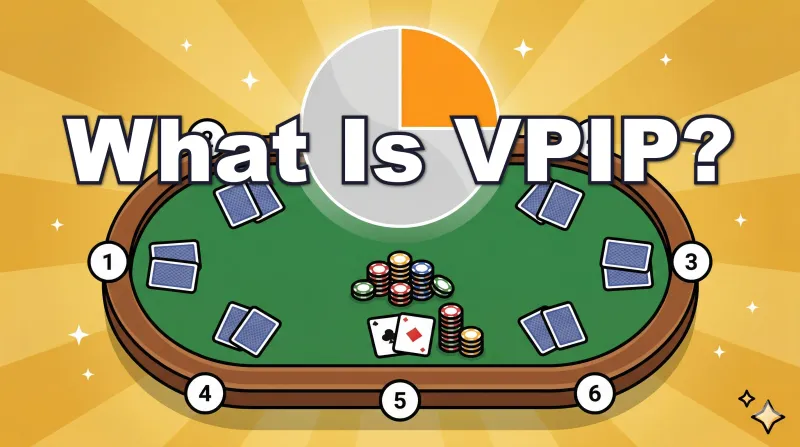
What Is VPIP?
VPIP (Voluntarily Put In Pot) is a stat that shows the percentage of hands in which a player voluntarily puts chips into the pot. It is also known as the "participation rate."
VPIP = Hands where chips were voluntarily contributed ÷ Total hands dealt
For example, if you are dealt 100 hands and voluntarily enter 25 of them by calling or raising, your VPIP is 25%.
The key word is "voluntarily." When the BB (big blind) is forced to post chips and the hand checks around with no raise, it is not counted.
However, if the BB calls or raises against an opponent's raise, that counts as a voluntary action and is included.
Optimal VPIP Values
Here are the general benchmarks for 6-handed tables (6-max):
| Category | VPIP | Tendency |
|---|---|---|
| Tight | Below 18% | Only plays strong hands. Easy to read |
| Standard | 20–27% | Balanced participation rate |
| Loose | Above 30% | Plays a wide range including weak hands |
Most winning players fall in the 20–25% range. However, this is just an overall average — as we'll see in the next section, the optimal VPIP varies significantly by position.
VPIP by Position
Optimal VPIP varies greatly depending on your position. Looking at overall VPIP alone doesn't tell the full story.
Position Benchmarks for 6-Max
| Position | VPIP Range | Notes |
|---|---|---|
| UTG | 10–15% | The most disadvantaged seat. Five players left to act, so stick to strong hands |
| HJ | 15–20% | One seat better than UTG. Slightly wider range |
| CO | 22–28% | Late position. Only BTN and blinds behind you, so you can open much wider |
| BTN | 35–45% | The best position. You act last postflop, allowing a significantly wider range |
| SB | 35–45% | Wide opening range when folded to, but you act first postflop — raise-heavy strategy recommended |
| BB | High | Good pot odds make the calling range wide. Defending (calling opponent raises) naturally inflates VPIP |
Sources: SplitSuit, PokerCoaching, BlackRain79
VPIP by Game Format
Optimal values also change depending on the game format.
| Format | Optimal VPIP | Reason |
|---|---|---|
| 6-Max Cash | 20–27% | Standard environment |
| Full Ring (9–10 players) | 14–20% | More players means a higher chance of running into a stronger hand |
| Heads-Up (1v1) | 40–50%+ | With only two players, ranges must expand dramatically |
| Tournament (Early) | 15–20% | Deep stacks; no need to force action |
| Tournament (Mid–Late) | Increases | Rising blinds and antes force wider participation |
Classifying Players with VPIP × PFR
VPIP alone tells you whether an opponent is tight or loose. But combining it with "PFR (Preflop Raise percentage)" reveals much more detailed player types.
For a deeper look at PFR, check out the complete stats guide:

Player Type Quick Reference
| Type | VPIP / PFR | Gap | Characteristics |
|---|---|---|---|
| Nit | 13 / 9 | 4 | Only plays premium hands. Very likely to hold a monster when raising |
| TAG | 19 / 17 | 2 | Almost always raises when entering. The standard winning style |
| Regular | 24 / 20 | 4 | Slightly wider but balanced. Typical solid 6-max regular |
| LAG | 28 / 24 | 4 | Wide range with aggressive play. An advanced style |
| Fish | 45 / 15 | 30 | Enters many pots by calling. Lots of limping (entering for the minimum) |
| Calling Station | 52 / 5 | 47 | Calls almost everything. Bluffs don't work, but great target for value bets |
Sources: Poker Copilot, BlackRain79
Focus on the VPIP–PFR Gap
The "gap" between VPIP and PFR is the key to measuring preflop aggression.
- Small gap (2–5) → Almost always raises when entering. Aggressive and common among winning players
- Large gap (10+) → Enters pots by calling rather than raising. Passive and a significant weakness
A healthy balance is PFR ≈ 75–90% of VPIP. For example, if your VPIP is 24%, your PFR should ideally be around 18–21%.
Sources: Poker Copilot, BlackRain79
Adjusting to Your Opponent's VPIP
Once you've read your opponent's VPIP, the next step is to adjust your strategy accordingly.
Against High-VPIP Opponents (40%+)
High-VPIP opponents hold many weak hands. They are the most profitable opponents to play against.
- Isolation raise to get heads-up — When a high-VPIP opponent limps in, raise to fold out other players and create a one-on-one situation with position
- Reduce bluffs and increase value bets — These opponents call frequently, making bluffs less effective. In return, you can value bet profitably with medium-strength hands
Against Low-VPIP Opponents (Below 15%)
Low-VPIP opponents only enter with premium hands.
- Steal frequently — When they're in the blinds, raise with a wide range to take the chips
- Be cautious when they raise — A raise from a low-participation opponent almost certainly means a strong hand. Fold weak holdings immediately
Improving Your Own VPIP
Check whether your own VPIP falls outside the optimal range.
If Your VPIP Is Too High (Above 30%)
Common leaks among players with high VPIP:
- Overvaluing suited trash (J♦3♦, etc.) just because they share a suit
- Playing too many dominated offsuit aces (A♠5♥, etc.) — kicker losses add up significantly
- Increasing cold calls widens the gap between VPIP and PFR
How to fix it:
- Tighten your range from early positions (UTG and HJ)
- Fold more often when facing a 3-bet
- Ask yourself before every hand: "Do I have a clear reason to play this hand?"
If Your VPIP Is Too Low (Below 15%)
Common leaks among players with low VPIP:
- Your range is too narrow and easy to read. Opponents fold to your raises too often
- You're missing profitable opportunities from BTN and CO
- You're not stealing blinds often enough
How to fix it:
- Widen your opening range from BTN and CO
- Add suited connectors (e.g., 8♥7♥) in late position
- Be more conscious about blind stealing
If you're unsure about your opening ranges, check this guide for the specific hands to play from each position:
VPIP Sample Size
How much you can trust a VPIP reading depends on the number of hands you've observed against that player.
| Hands | Reliability | Usage |
|---|---|---|
| 20–30 | Rough estimate | Basic "tight or loose" judgment only |
| 100 | Decent | Preliminary player type classification |
| 300 | Reliable | Fairly accurate range estimation |
| 1,000+ | High precision | Position-specific VPIP becomes trustworthy |
Sources: BlackRain79, Smart Poker Study
Summary
VPIP is the most fundamental poker stat. But when used effectively, it becomes a powerful tool for reading opponents and adjusting your strategy.
- Check your own VPIP — 20–27% is the benchmark for 6-max
- Look at it by position — UTG should be 10–15%, BTN should be 35–45%. This variation is normal
- Read your opponent's VPIP — Classify player types by the gap between VPIP and PFR
- Adjust your play — Against high-VPIP opponents, focus on value. Against low-VPIP opponents, focus on steals
Now that you understand VPIP, the next step is to learn other stats as well. Combining multiple stats gives you a much more accurate read on your opponents.
To check the optimal opening ranges and 3-bet hands for each position, try exploring GTO Wizard:

Found this helpful?
Bookmark this page to revisit anytime!
Ctrl+D (Mac: ⌘+D)
Found an error or have a question about this article? Let us know.
✉️ Contact Us