
How to Study Poker | 5 Steps to Improve Fast
Not sure where to start studying poker? This roadmap covers rules, play basics, probability, key concepts, and math in 5 clear steps — the fastest path to getting better at Texas Hold'em.
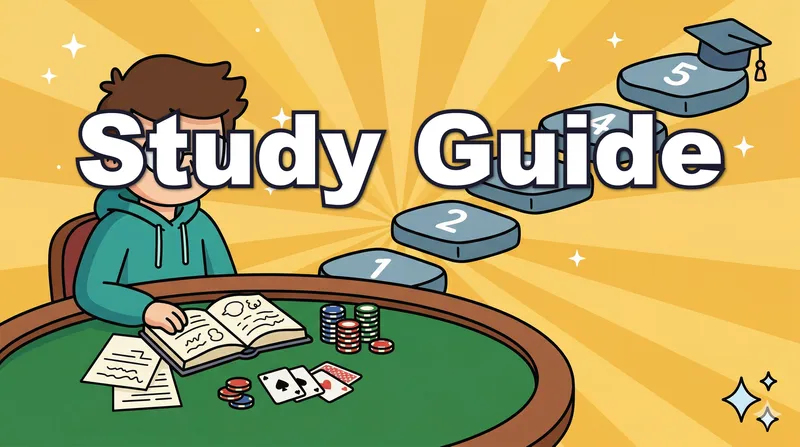
Poker (Texas Hold'em) has a lot to learn, and most beginners don't know where to start studying to get better.
This roadmap presents 5 steps to improve at poker as fast as possible. Complete each step and you'll be ready for the next.
Each step links to a detailed guide with further articles. Dive into any topic that interests you.
Why the Order Matters
Poker knowledge builds on itself. To use pot odds well you need a feel for equity (your share of the pot), and to estimate equity you need to know how often hands and draws actually come in. Skip the foundation and you end up in a familiar place: you can recite the formula but never know when to apply it.
Work through it in order and each step hands you the vocabulary for the next one. Take a sentence like "this board is wet, so lower your c-bet frequency." Understanding it requires board texture and c-betting (Step 4) plus draw completion rates (Step 3).
The five steps split into two halves:
- Steps 1–2: what makes the game playable — without this you cannot sit down
- Steps 3–5: what makes your decisions defensible — without this you are only guessing
The Full Picture
| Step | What you gain | Rough time | You're ready to move on when… |
|---|---|---|---|
| 1. Rules | Hand rankings, game flow, positions, actions | 2–3 hours | You can rank hands without hesitating and read the action order from the button |
| 2. Play basics | Which hands to play, why you're betting | 1–2 weeks | You can explain a fold in your own words |
| 3. Probability | Hand frequencies, draw completion rates | 3–5 hours | You can estimate a flush draw's odds in your head |
| 4. Fundamentals & concepts | Ranges, board texture, betting actions | 2–4 weeks | You can say an opponent's range out loud as a range, not a hand |
| 5. Math | Pot odds, outs, alpha, MDF | 1–2 weeks | You can work out the equity a call needs on the spot |
These estimates assume a few hours a week. Steps 2 and 4 take longer because reading alone isn't enough — you need table time to test what you've learned.
Step 1. Learn the Rules
Start by understanding the basic rules of Texas Hold'em. Once you know hand rankings, game flow, positions, and the types of actions, you can jump into a game right away.
You're ready to move on when — you can build your best five cards out of the seven in front of you, and you can name the action order just by looking at where the button is. That's enough. You don't need every hand ranking memorised; consulting a chart while you decide is fine at this stage.
Step 2. Master the Play Basics
Once you know the rules, build the decision-making skills you need in real play. Learn which hands to play, how to evaluate the flop, and the fundamentals of betting.
You're ready to move on when — you can explain why you folded in one sentence. Not "it was weak," but "it's too weak to play from this position against an UTG open." Once position and your opponent's action are both part of the explanation, it has sunk in.
Step 3. Understand Probability
Poker is a game of probability. Knowing the odds of making hands and completing draws lets you make decisions based on numbers, not gut feeling.
You're ready to move on when — you can roughly state how often a flopped flush draw gets there by the river. You don't need decimals; "about a third of the time" arriving instantly is plenty for real play.
Step 4. Learn Fundamentals & Concepts
Range reading, IP/OOP advantages, board textures, c-bets, barrels, and donk bets — systematically learn the foundational knowledge and concepts of poker.
You're ready to move on when — you can describe what your opponent likely holds as a range rather than a single hand. Not "maybe AK," but "AK down through middle pair." Saying it out loud is the habit that matters.
Step 5. Master Poker Math
Pot odds, outs, equity, alpha, MDF — learn the math behind poker step by step. Once you can calculate, you'll make decisions based on logic, not guesswork.
You're ready to move on when — facing a two-thirds pot bet, the equity you need to call comes to you immediately. From here you can settle close spots with a number instead of a feeling.
Three Common Detours
1. Starting with GTO
A solver's output assumes your opponent is also playing perfectly. At beginner tables opponents deviate heavily, so sharpening your basic decisions gains more than raising your GTO accuracy.
GTO will still be there after Step 5. Open a solver before then and you'll be memorising frequencies without being able to read why they are what they are.
2. Memorising range charts
Position-based open charts are useful, but pure memorisation stalls the moment you're off the chart. After facing a 3-bet, with a short stack, with or without antes — most real spots are off the chart.
Only by understanding why a hand is in the range does it transfer. Treat the chart as an answer key for checking your reasoning, not as something to learn by heart.
3. Grinding volume without review
Hands you never look at again don't accumulate into experience. Three hands per session is enough: note the spots where you weren't sure, then work through them later. That review habit sets your actual rate of improvement.
Balancing Study and Play
Study alone won't make you a player; play alone stops paying off. A workable split is 30% study, 70% play.
Change that split for one week after learning something new. That week, pay attention only to the spots where the new concept shows up — c-bet spots the week you learn c-betting, close call-or-fold spots the week you learn pot odds. Try to hold everything in mind at once and none of it sticks.
Reviewing in one weekend block is the easiest routine to maintain. Look back at the week's notes on hands you weren't sure about and work through two or three of them properly. Going deep on one hand beats skimming ten.
FAQ
Q1: How long does it take to get good?
Show answer
It depends what you mean by good, but working through Steps 1–5 takes roughly two to three months at a few hours per week.
By that point you can give a reason for every action you take. Progress becomes gradual from there, and the difference comes down to volume and how well you review.
Q2: Books or websites?
Show answer
Either works. What matters is picking one path and finishing it.
Reading several sources in parallel means slightly different definitions and recommended sizings competing in your head. Finish one, then read a second on your next pass — at that point the differences themselves become useful.
Q3: Do I need paid tools?
Show answer
Not through Step 4. Free articles and range charts cover it.
Once you've finished the math in Step 5 and want to measure how far your decisions sit from the theoretical baseline, a solver starts earning its cost.
What's Next?
After completing all 5 steps, take your game to the next level.
- Advanced GTO Strategy — Study board-specific GTO analysis (Advanced articles)
- Columns — Deep dives into theory and casino experiences (Columns)
Found this helpful?
Bookmark this page to revisit anytime!
Ctrl+D (Mac: ⌘+D)
Found an error or have a question about this article? Let us know.
✉️ Contact Us