
Poker Rules | A Complete Guide to Texas Hold'em Basics
A complete beginner's guide to poker (Texas Hold'em) rules. Learn hand rankings, game flow, 6 actions, positions, and etiquette — everything you need to know in one page.
What Is Poker? Texas Hold'em Basics
Poker is a card game where you combine the cards you're dealt with the cards on the table to make the best hand, competing for chips. It's not just about luck — it also requires the ability to read your opponents and make strategic bets.
Today, when people say "poker," they almost always mean Texas Hold'em. Nearly every tournament on TV and online uses these rules, so this article explains the rules of Texas Hold'em.
Key Features of Texas Hold'em
- Each player is dealt 2 hole cards (face down)
- 5 community cards are revealed in the center of the table in stages
- From the 7 total cards (2 hole + 5 community), you make the best 5-card combination
- There are 4 betting rounds where players decide to bet or fold
This is different from traditional "5-card draw poker" where you exchange cards. In Texas Hold'em, you can't swap your cards — instead, community cards are revealed one by one as you make decisions.
Poker Hand Rankings | All 10 Hands in Order
In Texas Hold'em, you select the best 5 cards from 7 to make a "hand." Hands are ranked by strength, and the player with the strongest hand wins the chips.
Here are all 10 hands ranked from strongest to weakest:
| Rank | Hand | Description | Example |
|---|---|---|---|
| 1 | Royal Flush | A, K, Q, J, 10 of the same suit | A♠ K♠ Q♠ J♠ 10♠ |
| 2 | Straight Flush | 5 consecutive cards of the same suit | 9♥ 8♥ 7♥ 6♥ 5♥ |
| 3 | Four of a Kind (Quads) | 4 cards of the same rank | K♠ K♥ K♦ K♣ 2♣ |
| 4 | Full House | 3 of a kind + a pair | J♥ J♠ J♣ 4♦ 4♠ |
| 5 | Flush | 5 cards of the same suit (not sequential) | A♦ J♦ 8♦ 5♦ 3♦ |
| 6 | Straight | 5 consecutive cards (any suit) | 10♠ 9♥ 8♣ 7♦ 6♠ |
| 7 | Three of a Kind (Trips/Set) | 3 cards of the same rank | 7♥ 7♠ 7♣ A♦ 2♠ |
| 8 | Two Pair | 2 different pairs | A♥ A♣ 9♠ 9♦ 5♥ |
| 9 | One Pair | 2 cards of the same rank | Q♠ Q♥ 10♣ 6♦ 3♣ |
| 10 | High Card | None of the above | A♥ J♣ 8♦ 5♠ 2♥ |
How Are Ties Broken?
When two players have the same hand type, the winner is determined by card rank:
- One Pair vs One Pair → Higher pair wins. If pairs are equal, compare remaining cards (kicker)
- Two Pair vs Two Pair → Compare the higher pair first. If equal, compare the lower pair, then kicker
- Full House vs Full House → Compare the three-of-a-kind portion
Learn more about hand rankings with detailed explanations and practice exercises:
Game Flow | From Preflop to River
A single hand of Texas Hold'em progresses through 4 rounds. Community cards increase each round, and players choose their actions.
| Round | Community Cards | What Happens |
|---|---|---|
| Preflop | None | Decide based on your 2 hole cards. SB and BB post forced bets |
| Flop | 3 revealed | 3 community cards are revealed at once |
| Turn | 4th revealed | 1 additional community card |
| River | 5th revealed | Final community card |
Each round, players take turns choosing actions. Once all actions are complete, the next round begins. If 2 or more players remain at the end, a showdown (revealing hands) determines the winner.
Walking Through a Hand Step by Step
- Game starts — SB (Small Blind) and BB (Big Blind) post forced bets
- Cards dealt — Each player receives 2 face-down cards
- Preflop — Look at your cards and decide whether to play or fold
- Flop — 3 cards appear on the table. Check your hand with the community cards
- Turn — 4th card revealed. Consider how the board changes your hand
- River — 5th card revealed. Final round of action
- Showdown — Remaining players reveal their hands; the strongest hand wins the pot (total chips bet)
If everyone folds except one player, that player wins the pot without a showdown. This is why bluffing works in poker.
6 Actions | Check, Bet, Call, Raise, Fold, All-In
There are 6 possible actions in each round:
| Action | Meaning | When Can You Use It? |
|---|---|---|
| Fold | Discard your hand and quit | Anytime |
| Check | Pass without betting | When no one has bet before you |
| Bet | Place chips | When no one has bet before you |
| Call | Match the previous bet | After someone has bet |
| Raise | Bet more than the previous player | After someone has bet |
| All-In | Bet all your chips | Anytime (even if you don't have enough) |
Action proceeds clockwise around the table. Preflop starts from UTG (left of BB), and from the flop onward, it starts from SB.
How Blinds and the Pot Work
What Are Blinds?
Blinds are forced bets that specific players must post at the start of each hand. This ensures there are always chips in the pot, giving everyone an incentive to play.
| Type | Amount | Who Posts? |
|---|---|---|
| SB (Small Blind) | Half the BB | Player to the left of the Button |
| BB (Big Blind) | The table's standard bet | Player to the left of SB |
For example, at a "1/2 blinds" table, SB posts 1 chip and BB posts 2 chips.
What Is the Pot?
All chips bet by players collect in the center of the table as the pot. The winner of the hand takes the entire pot. As rounds progress, the pot grows larger, making later decisions more significant.

Position Basics | How Seating Affects Your Results
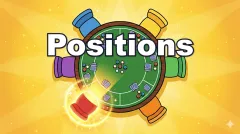
In Texas Hold'em, where you sit at the table matters a lot. Players who act later have an advantage because they can observe others' actions before making their own decision.
Here are the 6 basic positions at a 6-handed table:
| Position | Abbreviation | Key Feature |
|---|---|---|
| Under the Gun | UTG | Acts first. Least information, disadvantaged |
| Hijack | HJ | Slightly better than UTG |
| Cutoff | CO | Right of the Button. Fewer players behind, advantaged |
| Button | BTN | Acts last post-flop. The most advantaged seat |
| Small Blind | SB | Acts first post-flop. Disadvantaged |
| Big Blind | BB | Acts after SB. Gets to act last preflop |
What to Focus on After Learning the Rules
Once you understand the rules, start thinking about "which hands to play" and "what to do when community cards appear."
Choosing Starting Hands
Your 2 hole cards are called your starting hand. The basic principle is to only play strong hands rather than entering every pot.
Hand groups beginners should know:
| Group | Examples | Strategy |
|---|---|---|
| Premium Hands | A♥A♠, K♣K♦, A♥K♠ | Play from any position |
| Strong Hands | A♠10♣, K♥Q♠, J♥10♥ | Play from most positions |
| Medium Hands | J♣10♥, A♥9♣, 8♠8♦ | Play from good positions (CO/BTN) |
Learn more about starting hand categories:
How to Enter the Pot
When you decide to play a hand, the basic approach is to put in chips yourself rather than just matching what others have bet. Remember: raising (betting more) tends to lead to better outcomes than just calling (matching the bet).

Thinking After the Community Cards Appear
Once the community cards (flop) are revealed, check whether you've made a hand combined with your hole cards:
- Made a hand → Bet to extract more chips from your opponents
- One card away from completing a hand → Weigh the chances of completing it and decide whether to continue or fold
- Nothing → Don't force it — fold
Learn more about post-flop decision making:

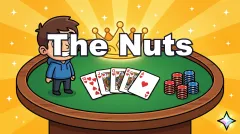
Learn how to identify the strongest possible hand (the nuts) on any board:
Poker Etiquette and Manners
Poker has unwritten rules and etiquette. Not knowing them can disrupt the game or result in penalties. For a detailed guide on rule violations and bad manners like string bets and slow rolls, check out the article below.
How to Get Started | Ways to Play
There are several ways to start playing poker:
| Method | Features | Cost Estimate |
|---|---|---|
| Poker rooms / Card rooms | Buy chips and play live. No real-money cashout at amusement venues | $20–50/session |
| Online apps | Practice easily on your phone. Many free options | Free and up |
| Home games with friends | Buy a chip set and you're ready to play | Chip set $15–25 |
Recommended Steps to Get Started
- Practice on a free app — Learn the rules and flow through experience
- Play a home game with friends — Get comfortable with real cards and chips
- Visit a poker room — Join a beginner-friendly tournament
- Join a poker community — Find fellow players on social media or Discord

If you want to play poker at a real casino, check out our guide covering casino-specific rules and the full process.
Frequently Asked Questions (FAQ)
How long does it take to learn poker rules?
You can understand the basic Texas Hold'em rules (hand rankings, game flow, actions) in 30 minutes to 1 hour. However, mastering positions and strategy takes days to weeks of practice. Start by reading about hand rankings and game flow — then you'll be ready to play.
What's the difference between Texas Hold'em and regular poker?
Unlike traditional "5-card draw poker" where you're dealt 5 cards and exchange some, Texas Hold'em gives you only 2 hole cards. Five community cards are revealed on the table, and all players use them to make their best hand. Instead of exchanging cards, you make decisions as community cards are gradually revealed. Nearly all modern casinos and tournaments use Texas Hold'em.
What is the strongest poker hand?
The Royal Flush (A, K, Q, J, 10 of the same suit) is the strongest hand. However, it occurs with a probability of only about 0.00015%. Common strong hands you'll see in real games include full houses and flushes. Check out the hand rankings article for all 10 hands.
What are blinds?
Blinds are forced bets posted by the SB (Small Blind) and BB (Big Blind) players at the start of each hand. They ensure there are always chips in the pot, giving everyone an incentive to play. Learn more in How Blinds and the Pot Work.
Is poker a game of luck or skill?
In the short term, luck plays a big role. But over the long run, skill determines results. The fact that professional poker players consistently win over extended periods proves this. There are many learnable skills: hand selection, position play, bet sizing, and more. Learn more in What Is Poker?.
What are the best online poker apps for beginners?
For beginners, PokerStars Play and WSOP Poker are great options. Both are free to play and let you practice Texas Hold'em rules in a realistic setting. Check our Getting Started Guide for more app recommendations.
What should a beginner learn first?
Start with these 3 things: ① The 10 hand rankings, ② How a hand plays out, ③ The 6 actions. Once you know these three, you can join a game right away. The fastest way to improve from there is simply to play.
Summary
This article covered all the essential rules of Texas Hold'em poker.
Learning path:
- Hand rankings → Know which hands beat which
- Game flow → Understand what happens and when
- Actions → Know what you can do on your turn
- Positions → Know when to play aggressively
- Basic strategy → Make better hand selection and betting decisions
- Play! → Experience is the best teacher
Poker is often described as "a game that takes minutes to learn but a lifetime to master." Start with a free app or a home game with friends.
If you want to build a solid foundation, we recommend starting with What Is Poker? The Appeal of Texas Hold'em and working through the articles in order.
Found this helpful?
Bookmark this page to revisit anytime!
Ctrl+D (Mac: ⌘+D)
Found an error or have a question about this article? Let us know.
✉️ Contact Us