Playing Poker in Tokyo | A Complete Beginner's Guide
A complete guide for beginners who want to play poker in Tokyo. Learn how amusement poker works, typical costs, how to choose a venue, what to expect on your first visit, and common beginner mistakes.
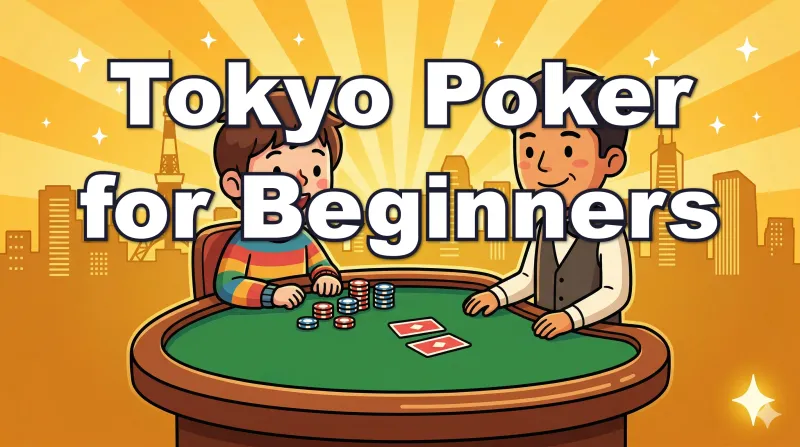
What Is Amusement Poker in Tokyo?
"Isn't poker gambling?" — you might think so, but most poker venues in Tokyo are amusement (recreational) facilities.
The concept is simple: you buy chips and play poker at a table. Think of it like arcade tokens — chips cannot be exchanged for cash. Since no real money is wagered, it's completely legal.
Typical Costs
Most venues operate on a chip purchase + 1 drink order model. Entry is usually free, and beginner lessons are also free at almost every venue.
- Chip purchase: ¥3,000–5,000
- One drink (including alcohol): up to ¥700 or so
For a total of ¥4,000–6,000 you can play for 2–3 hours — about the same as a movie or karaoke. Some venues may charge an additional facility fee, so check their official website beforehand.
If you want to enter a tournament (competition format), entry fees range from ¥1,000 to ¥30,000.
3 Things to Know Before You Go
1. Knowing Hand Rankings Makes Everything Smoother
Just knowing hand rankings (which hands beat which) beforehand makes a huge difference in how comfortable you feel. If you can answer "Is one pair or two pair stronger?", you'll be able to follow the game much more easily.
2. Learn the Basic Flow of a Hand
"You get 2 cards, then 5 cards appear on the table" — even just knowing this basic flow will help you absorb the beginner lesson much faster.

3. Don't Worry If the Above Didn't Fully Click
Almost every poker venue in Tokyo offers free beginner lessons (30–60 minutes). A dealer (the staff member who runs the game) will teach you the rules from scratch, so being a complete beginner is no problem at all. You can walk in with zero preparation.
How to Choose a Poker Venue in Tokyo
Tokyo has over 100 poker venues, but what matters for beginners is finding the right one for you, not browsing all of them.
What to Prioritize
Everyone has different criteria for a "good" venue. Figure out what matters most to you.
- Close to home — Convenience is key. It's best if you don't have to worry about the last train
- Affordable — Low chip and drink prices make it easy to visit regularly
- Friendly dealers — A welcoming atmosphere can make all the difference
- Helpful regulars — Venues where experienced players are kind to beginners help you improve faster
Checklist Before You Visit
Once you've narrowed down your priorities, check these four things.
- Beginner lessons available? — Most venues offer them, but confirm on their official website or social media
- Clear pricing? — Venues that list chip prices and drink costs on their website are a safe bet
- Hours of operation — Many venues are open from evening to late night. Earlier hours tend to have better staff support, so visiting right when they open is ideal for your first time
- Atmosphere — Check the venue's social media (X / Instagram) to get a feel for the crowd and vibe
Beginner-Friendly Recommended Venues
Here are two venues frequented by the Seeker Start team and members of our Discord server — both are welcoming to beginners.
What to Expect on Your First Visit
Your first time at a poker venue can be nerve-wracking. Knowing what to expect will help you relax and enjoy the experience.
Step 1: Arrival
Most venues don't require reservations, but booking a beginner lesson in advance is recommended. This ensures they'll have time set aside for you.
Step 2: Check-in
When you walk in, tell the staff "It's my first time." You may be asked to show an ID. They'll explain how the venue works and you'll buy chips.
For your first visit, ¥3,000–5,000 worth of chips is plenty. You can always buy more, so there's no need to start big.
Step 3: Beginner Lesson
Most venues offer a free 30–60 minute lesson covering:
- Hand rankings (which hands beat which)
- Game flow (preflop through river)
- How to handle chips
- Basic actions (fold, call, raise, etc.)
Don't hesitate to ask questions. No one will judge you — everyone started at the same place.
Step 4: Join a Ring Game
After the lesson, you'll join a table with other players. A ring game is a regular poker game where you can sit down and leave whenever you want.
The dealer runs the game, so if you're ever unsure, just ask "What should I do?" — they're happy to help.
Step 5: Leaving
When you're ready to leave, tell the dealer "I'm heading out." You can usually store your remaining chips for next time (they cannot be exchanged for cash).
4 Common Beginner Mistakes
Here are some common mistakes first-timers make. Knowing these in advance will save you some awkward moments.
1. Not Knowing How to Place Chips
When betting, avoid tossing or shoving your chips forward — that can cause confusion. Place your chips neatly in front of you. If you're unsure about the amount, just say the number out loud and the dealer will help.
2. Forgetting to Announce Your Action
In poker, verbal declarations take priority. Say "call" or "raise" before putting your chips forward. If you push chips in silently, it might be interpreted as a different action than what you intended.
If you can't remember the action names, just say the amount you want to bet — that works too.
3. Looking at or Touching Other Players' Cards
Your cards are for your eyes only. Peeking at your neighbor's cards or touching the community cards on the table is a breach of etiquette.
4. Using Your Phone While in a Hand
Having your phone on the table is fine, but using it while you're in a hand (in play) is a breach of etiquette. It slows down the game and can raise suspicion of cheating.
FAQ
Q. Is it okay to go alone? Absolutely. In fact, most people come to poker venues solo. Conversations happen naturally at the table, so going alone can actually lead to more new connections.
Q. Is it safe for women? Tokyo poker venues have been adapting to the growing number of female players, with ladies' plans and female dealers becoming more common.
Q. What's the difference between a tournament and a ring game? At check-in, you may be asked "Ring game or tournament?" As a beginner, choose ring game. It's the standard format where you can join and leave at any time.
Your Post-Debut Improvement Roadmap
Once you've made your Tokyo poker debut, it's time to level up. Our site has articles to help you learn poker step by step.
Step 1: Solidify the Rules
Start by getting a firm grasp of the basics — hand rankings, game flow, and what each action means. This alone will reduce confusion at the table.

Step 2: Study and Get Stronger
Once you're comfortable with the rules, deepen your knowledge through study. Learning in the right order will dramatically speed up your improvement.

Step 3: Try a Tournament
As you continue studying, give a tournament a try. Tokyo hosts beginner-friendly small-scale tournaments almost every day.
Step 4: Play at an Overseas Casino
Once you've honed your skills at Tokyo's amusement venues, real casino poker abroad becomes an exciting next step.
Summary
Tokyo is one of the best cities in the world for poker beginners. With over 100 venues and free beginner lessons at nearly every one, the barrier to entry is incredibly low.
You might imagine poker venues as intimidating or exclusive, but the reality is the opposite. Solo players, women, and complete beginners are all welcome.
Poker isn't just about the strategy and mind games. Sit down at a table and you'll find yourself in a genuine competition with people you'd never meet in everyday life — that's an experience unique to poker.
Start by learning hand rankings and game flow, then pick a venue and go for it.

Found this helpful?
Bookmark this page to revisit anytime!
Ctrl+D (Mac: ⌘+D)
Found an error or have a question about this article? Let us know.
✉️ Contact Us