Oryuin University Poker Department Entrance Exam: Answer Key
Sigma Prep School: Sigma (Twitter: @sigm_4)

Sigma Prep School: Sigma (Twitter: @sigm_4)
This article provides the answer key for the Oryuin University Poker Department Entrance Exam. If you haven't attempted the problems yet, please look at the questions first.
Question 1
In the Nash equilibrium of the AKQ game defined below with a bet size of 500%, find how many times more QQ is included compared to AA in OOP's betting range.
[AKQ Game]
- The initial pot is 1. The bet size is 5.
- OOP holds AA and QQ each with 50% probability, and IP holds KK with 100% probability.
- OOP can choose to bet or check.
- IP can choose to call or fold against OOP's bet.
- If IP folds, OOP wins the entire pot at that point.
- If OOP checks, or if IP calls OOP's bet, a showdown occurs and the winner takes the entire pot. The showdown result is determined solely by the hand strength of each player's holdings.
~ Answer ~
Answer: 5/6 times
This is a classic AKQ game problem. In an AKQ game with bet size $B$, bluff hands are bet at a ratio of ${\alpha = \frac{B}{1+B}}$ relative to value hands. Computing this for $B=5$, we get 5/6.
The ratio $\alpha$ between value hands and bluff hands is derived from the condition that makes IP's KK indifferent between calling and folding against OOP's bet. When KK calls a $B=5$ bet, it loses 5 against AA and wins 6 (=1+5) against QQ. Therefore, if the number of times KK wins against QQ equals 5/6 of the times it loses to AA, KK's call EV becomes 0, making call and fold indifferent.
Question 2
In the Nash equilibrium of the AQQ game defined below with a bet size of 500%, find how many times more QQ is included compared to AA in OOP's betting range.
[AQQ Game]
- The initial pot is 1. The bet size is 5.
- OOP holds AA with 1% probability and QQ with 99% probability, and IP holds QQ with 100% probability.
- OOP can choose to bet or check.
- IP can choose to call or fold against OOP's bet.
- If IP folds, OOP wins the entire pot at that point.
- If OOP checks, or if IP calls OOP's bet, a showdown occurs and the winner takes the entire pot. The showdown result is determined solely by the hand strength of each player's holdings.
~ Answer ~
Answer: 10 times
The difference from Question 1 is that IP's hand changed from KK to QQ. While KK served as a bluff catcher that loses to AA but beats QQ, in this AQQ game IP's QQ chops with OOP's bluff hand. Qualitatively, since the amount IP gains from calling a bet drops dramatically, OOP needs to increase the proportion of QQ in the bet range. Specifically, when IP's QQ calls a $B=5$ bet, it loses 5 against AA and chops for 1/2 against QQ. Therefore, if chopping with QQ occurs 10 times as frequently as facing AA, IP's call EV becomes 0 and call/fold become indifferent.
Question 3
Consider the following situation.
On a K♤Q♤J♡T♢ board, OOP is about to go all-in for 500% pot. OOP's all-in range consists of A♤9♤ at a proportion of $x$ and A♡9♡ at a proportion of $1-x$, while IP always holds A♢9♢.
Find the value of $x$ that makes IP's A♢9♢ indifferent to OOP's all-in.
You may assume that the probability of a ♤ card appearing on the river is 2% per remaining ♤ card.
~ Answer ~
Answer: ${x=\frac{50}{99}}$
At the turn, both hands are nut straights. Only when a ♤ comes on the river does OOP's As9s make a flush and beat Ad9d. Therefore, most rivers result in a chop, and IP only loses when OOP bets with As9s and hits the flush. When OOP makes a $B=5$ bet, IP gains 1/2 from a chop when calling, and loses 5 when losing. Therefore, from Question 2's result, IP can lose at a frequency of $\frac{1}{11}\times 100\%$ (1 loss for every 10 wins).
On the other hand, the case where IP loses is when OOP bets with As9s and completes the flush on the river, so that probability is $x\cdot18\%$ (there are 9 remaining ♤ cards, and each appears with 2% probability by assumption).
Therefore, solving ${18x=\frac{100}{11}}$ we get ${x=\frac{100}{198}\sim 0.5050}$.
In conclusion, OOP should bet 500% with FD-holding As9s at 50.50% and non-FD Ah9h at 49.49%.
Question 4
Consider the following spot in a NL50 cash game with an effective stack of 100bb.
UTG vs. BB SRP
Preflop
UTG: Raise 2.5bb
BB: Call
Flop: K♤Q♤J♡ (Pot = 5.5bb)
BB: Check
UTG: Bet 1.8bb
BB: Raise 6.35bb
UTG: Call
Turn: T♢ (Pot = 18.2bb)
BB: All-in
UTG: ?
In Nash equilibrium, it is known that BB's all-in at this spot is performed only with A9s, and UTG does not call this all-in with anything other than A9s.
Estimate how many times more non-A♤9♤ suited A9s are included compared to A♤9♤ in BB's all-in range.
~ Answer ~
Answer: Approximately 38%
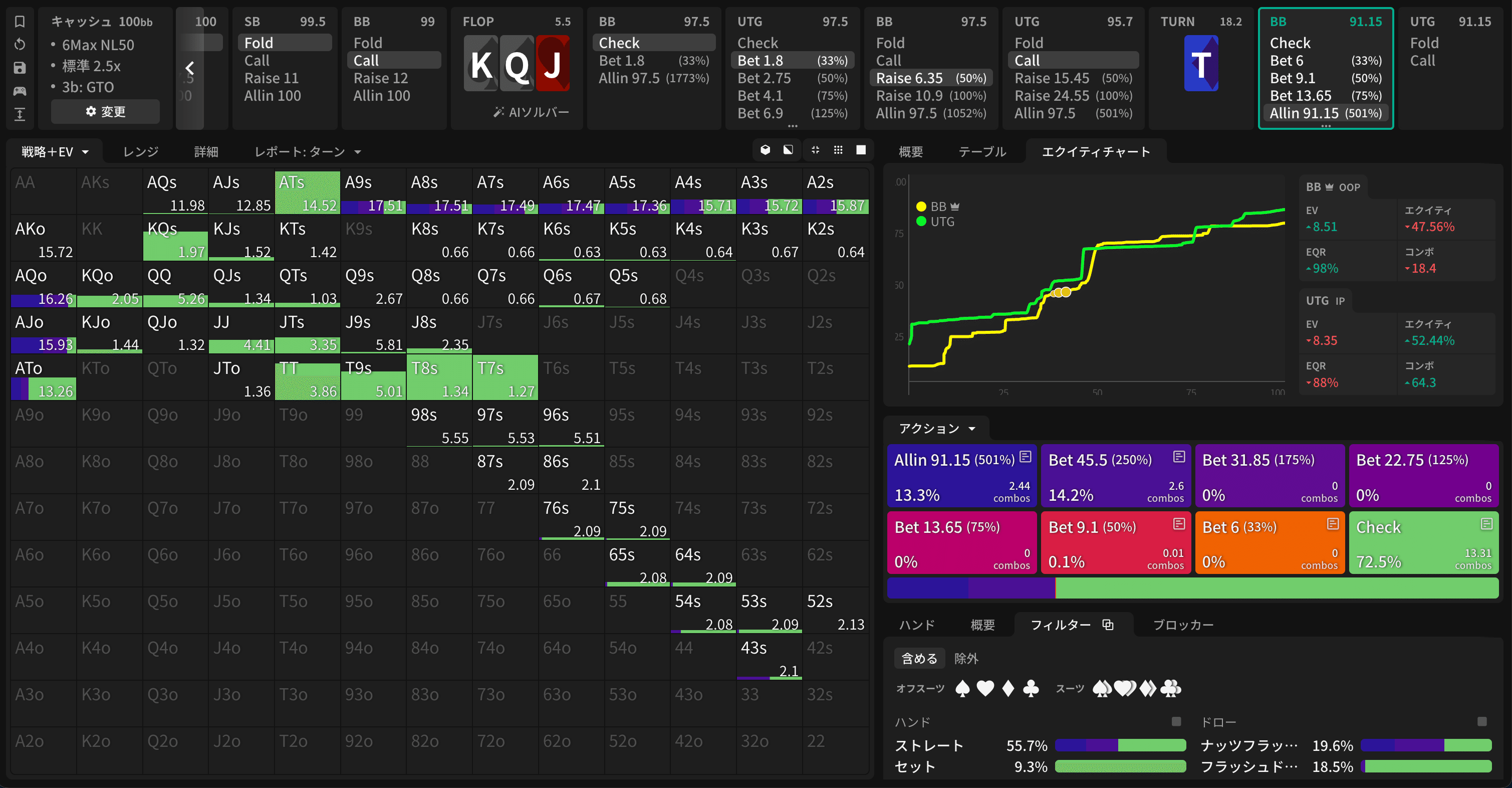
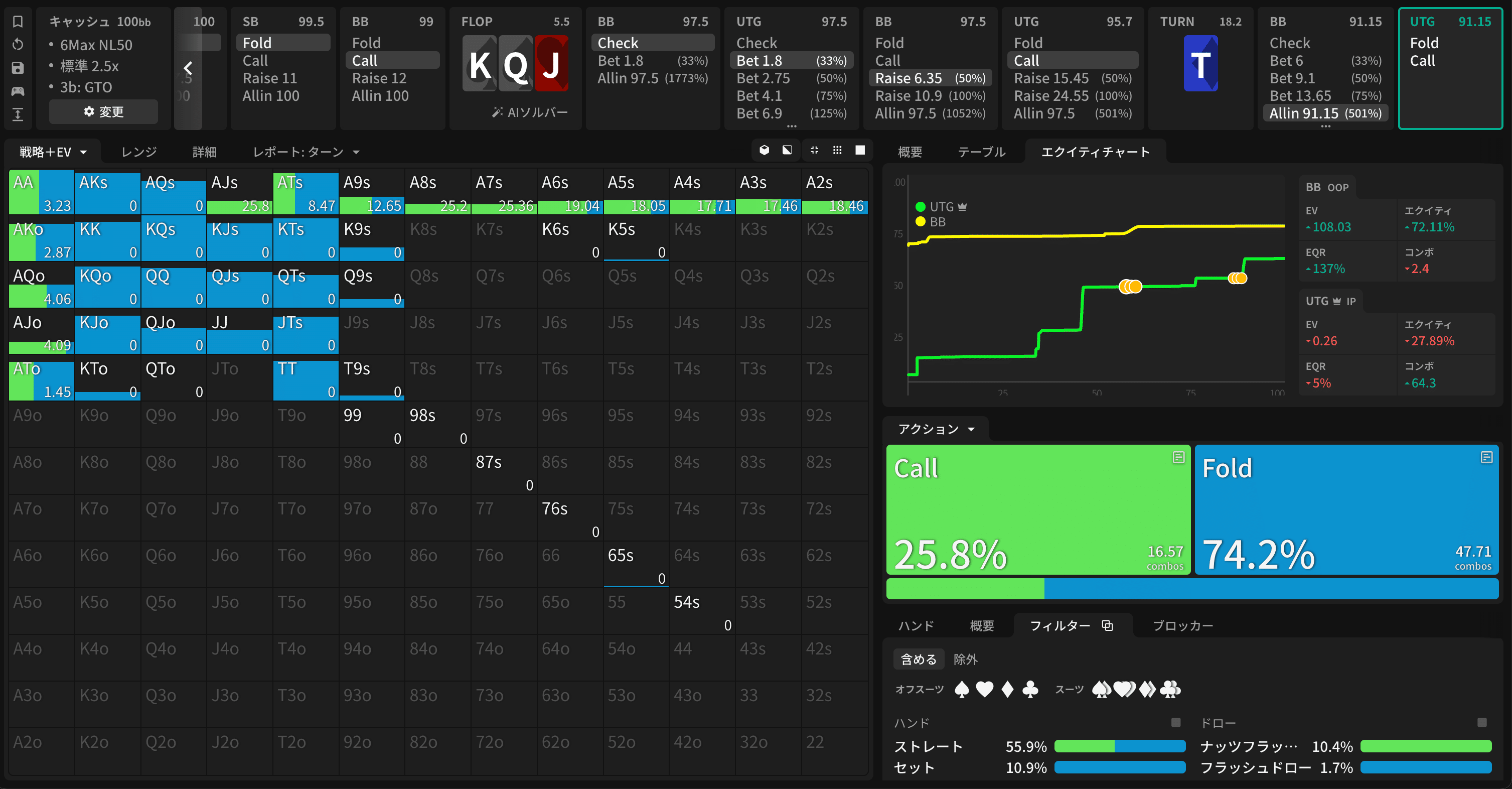
BB goes all-in (b 501%) only with nut straights using AX. The situation is nearly identical to Question 3, but in Question 4 we need to consider blocker effects. Specifically, UTG's non-FD-suit straight blocks the non-FD-suit portion of BB's all-in range. A rough estimate shows that when UTG's straight holds a non-FD-suit Ace, the proportion of FD straights in BB's range increases from 1/4 to 1/3 (increasing the probability of losing). Therefore, we modify the equation from Question 3 to ${18x\times\frac{4}{3}=\frac{100}{11}}$ and solve, obtaining $x\sim0.3788$.
* Note: The all-in size is 500% in Question 3 and 501% in Question 4, but this difference is not large enough to significantly affect the rough estimate above (answers are rounded to 2 significant figures).
Checking the actual spot in GTO Wizard [Figure 1 & 2], we can see that some of the nut straights going all-in on the turn do have flush draws, and that proportion is approximately 38%. This aligns very well with the estimate above. UTG calls this all-in only with nut straights using AX, and non-FD-suit nut straights become indifferent (or fold).
Found this helpful?
Bookmark this page to revisit anytime!
Ctrl+D (Mac: ⌘+D)
Found an error or have a question about this article? Let us know.
✉️ Contact Us
![288 Hours of Poker in Las Vegas: My Dream Come True [4th MUSAPO US Internship]](/images/note/n93de852b5847_c7602cb8112dc9c6c97783a1d3b55392.png)