Preflop Situations Explained | Steal, Squeeze, Isolate & Walk
Learn four key preflop situation terms in poker. This beginner guide explains what steal, squeeze, isolate, and walk mean — with concrete examples and a comparison chart.
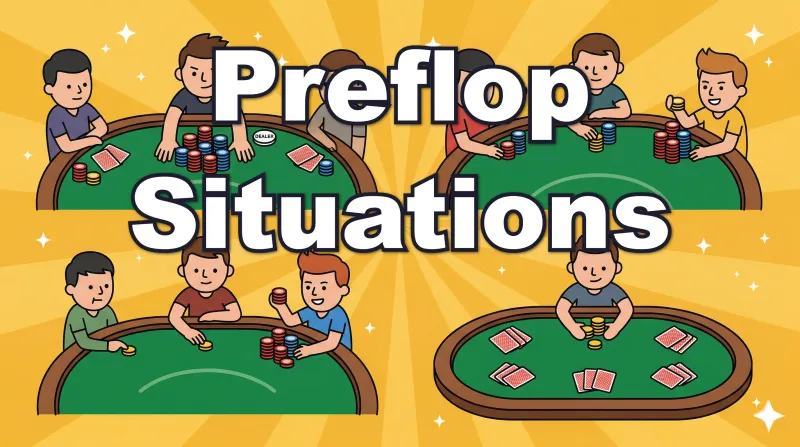
Understanding Preflop "Situations"
What You'll Learn
- What a Steal is and when it happens
- What a Squeeze is and how it differs from a regular 3-bet
- What an Isolate is and how to respond to limps
- What a Walk is
- A side-by-side comparison of all four terms
Let's start with the big picture.
| Term | Situation | Result |
|---|---|---|
| Steal | Open raise → everyone folds | Win the blinds |
| Squeeze | Open raise + call(s) → 3-bet | Pressure both raiser and caller |
| Isolate | Limp → raise | Force a heads-up pot |
| Walk | Everyone folds | BB wins the pot automatically |
Now let's look at each one with a concrete example.
🎯 Steal
When you open raise and everyone folds, winning the blinds uncontested — that's a "steal."
Example
Blinds 1/2. 6-handed.
- UTG → Fold
- HJ → Fold
- CO → Fold
- BTN (you) → Open raise to 5 chips with K♠ 9♥
- SB → Fold
- BB → Fold
No one called your raise, so you win the blinds (SB 1 + BB 2 = 3 chips). That's a successful steal.
A steal can happen from any position, but it occurs most often from late position (CO, BTN, SB) because fewer players remain to act, making it more likely that everyone folds.
💡 Stealing is not "cheating." It's a fundamental strategy that leverages positional advantage. If you're in the blinds, make sure to defend appropriately against steal attempts.
🔥 Squeeze
When someone open raises, one or more players call, and then you 3-bet — that's a "squeeze." The English word "squeeze" captures the image of putting pressure on both the raiser and the caller(s) from both sides.
Example
Blinds 1/2. 6-handed.
- UTG → Fold
- HJ → Open raise to 5 chips
- CO → Fold
- BTN → Calls HJ's raise (5 chips)
- SB (you) → 3-bet to 25 chips with A♠ K♦ ← This is a squeeze!
- BB → Fold
- HJ → Fold
- BTN → Fold
You win the pot (HJ's 5 + BTN's 5 + SB's 1 + BB's 2 = 13 chips).
Squeeze vs. Regular 3-Bet
| Regular 3-Bet | Squeeze | |
|---|---|---|
| Situation | 3-bet vs. an open raise | 3-bet vs. open raise + caller(s) |
| Difference | Facing one opponent (the raiser) | Facing two or more (raiser + caller) |
Why Does a Squeeze Work?
The caller chose to flat rather than raise, which typically means they hold a "decent but not strong" hand. When a large re-raise comes in, the caller is usually forced to fold.
The open raiser also faces a tough spot — there's still a caller behind them, making it harder to continue without a strong hand. As a result, both opponents fold at a high rate.
💡 Squeeze sizing is larger than a regular 3-bet. A common guideline is 4–5 × the open raise (go bigger with more callers). In the example above, SB is out of position, so the sizing is 5× (25 chips). As a beginner, just knowing that "squeeze" exists as a concept is enough for now.
🎪 Isolate
When a player limps in (enters by just calling the big blind) and you raise to play heads-up against them — that's an "isolate." The word means to separate one player from the rest of the field.
Example
Blinds 1/2. 6-handed.
- UTG → Fold
- HJ → Calls 2 chips (limps in)
- CO → Fold
- BTN (you) → Raise to 8 chips with A♦ J♠ ← This is an isolate!
- SB → Fold
- BB → Fold
- HJ → Calls
Everyone else folded, leaving you heads-up with the limper (HJ). That's a successful isolate.
Why Does Isolating Work?
As covered in Preflop Play — Open Raises and 3-Bets, players who limp are saying "I don't have a strong enough hand to raise, but I don't want to fold." In other words, limpers tend to have weak to mediocre hands.
If you just call behind, other players can also see the flop cheaply, creating a multiway pot. The more players in the pot, the lower your chance of winning.
That's why raising to isolate the weak limper into a heads-up situation is the correct play.
🎯 Against a limp, the default play is to isolate (raise). Calling behind (overlimping) just creates more opponents and puts you at a bigger disadvantage.
Isolate Sizing
A common guideline is 3–4 BB + 1 BB per limper.
- 1 limper → 3BB + 1BB = 4 BB (8 chips at 1/2)
- 2 limpers → 3BB + 2BB = 5 BB (10 chips at 1/2)
💡 The exact sizing matters less than the decision itself. What's far more important is choosing to raise instead of call when facing a limp. Build that habit first.
🚶 Walk
When every player folds preflop and the big blind wins the pot without taking any action — that's a "walk."
Example
Blinds 1/2. 6-handed.
- UTG → Fold
- HJ → Fold
- CO → Fold
- BTN → Fold
- SB → Fold
- BB (you) → Automatically win the pot (SB's 1 chip)
BB doesn't need to act — they simply collect the small blind's chip and the hand ends. That's a "walk."
When Does a Walk Happen?
The tighter the table (players folding more often), the more likely a walk becomes. In practice, though, the BTN and SB will usually attempt a steal, so walks don't happen very often.
💡 A walk isn't something you can create on purpose. Just know that the term exists — it'll help you follow commentary and hand reviews without confusion.
🔄 Comparing All Four Terms
| Term | Who? | Against what? | Goal |
|---|---|---|---|
| Steal | Open raiser | Blinds | Win the blinds uncontested |
| Squeeze | 3-bettor | Raiser + caller(s) | Pressure both into folding |
| Isolate | Raiser | Limper(s) | Play heads-up vs. weak hand |
| Walk | BB (passive) | Everyone folds | BB wins automatically |
❌ Common Beginner Mistakes
Over-defending against steals (as BB)
When the BTN keeps open raising, it's tempting to think "Stop stealing my blinds!" and fight back with everything. But 3-betting or calling with weak hands costs you more in the long run. BB does get favorable pot odds to defend a wide range, but fighting back with any two cards is a losing strategy. Balance your hand strength against your positional disadvantage.
Confusing a squeeze with a regular 3-bet
Both involve 3-betting after an open raise. The key difference is whether there's a caller in between. If no one called the open, it's just a regular 3-bet, not a squeeze.
Calling behind a limper instead of raising
"They called, so I'll call too" is a trap. It creates a multiway pot and lowers your win rate. When facing a limp, the default play is to isolate with a raise — not to call.
🎯 Summary
🎯 Key Takeaways
- Steal = Open raise that folds out everyone and wins the blinds
- Squeeze = 3-bet after an open raise + call, pressuring both opponents
- Isolate = Raise over a limper to force a heads-up pot
- Walk = Everyone folds and BB wins the pot automatically
- These are not "actions" — they're names for situations that arise preflop
To learn about the preflop actions themselves (open raise, 3-bet, call, and limp), check out this article:

For a refresher on positions, see:

Found this helpful?
Bookmark this page to revisit anytime!
Ctrl+D (Mac: ⌘+D)
Found an error or have a question about this article? Let us know.
✉️ Contact Us