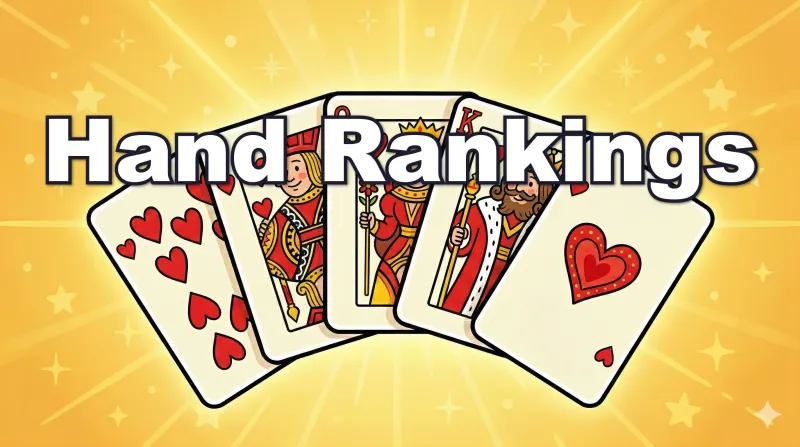
Poker Hand Rankings | All 10 Hands & Card Strength Explained
All 10 poker hands ranked from strongest to weakest, plus the card number hierarchy from Ace to 2. Visual guide with examples for beginners.
📝 Where this article fits: If you don't know the rules of poker at all, we recommend reading What Is Poker? The Appeal of Texas Hold'em first.
Knowing the "hands" (card combinations) is the first step to playing poker.
Have you ever been in a game and wondered, "Do I even have a hand right now?" or "Wait, is a Flush stronger than a Straight?" After reading this article, you'll never have to guess again.
What You'll Learn
- All 10 poker hands and their rankings
- Card number strength from Ace to 2
- Card examples for each hand (with diagrams)
- How ties between the same hand type are broken
- What a "kicker" is
- Practice problems to test yourself
🃏 What Are Hand Rankings?
A poker "hand" is a specific combination pattern made from 5 cards.
As we learned in the previous article, in Texas Hold'em you pick the best 5 cards from your 2 hole cards plus 5 community cards (7 total). The "hand" those 5 cards make determines who wins.
📊 Hand Rankings (All 10)
Listed from strongest to weakest. The lower the number, the stronger the hand.
| Rank | Hand | Description | Probability |
|---|---|---|---|
| 1 | Royal Flush | 10-J-Q-K-A of the same suit | 0.00015% |
| 2 | Straight Flush | 5 consecutive cards of the same suit | 0.00139% |
| 3 | Four of a Kind | 4 cards of the same rank | 0.024% |
| 4 | Full House | Three of a Kind + One Pair | 0.14% |
| 5 | Flush | 5 cards of the same suit | 0.20% |
| 6 | Straight | 5 consecutive cards (any suits) | 0.39% |
| 7 | Three of a Kind | 3 cards of the same rank | 2.11% |
| 8 | Two Pair | 2 different pairs | 4.75% |
| 9 | One Pair | 2 cards of the same rank | 42.26% |
| 10 | High Card | No hand at all | 50.12% |
These 10 hands assume a 52-card deck with the jokers removed. Add a joker and an eleventh hand — five of a kind — appears on top, but the ranking order itself starts to break down. See Do You Use Jokers in Poker? for the full picture.
Now let's look at each hand in detail, starting from the weakest.
🃏 A Closer Look at All 10 Hands
High Card (Nothing)
When your 5 cards don't form any combination at all. It's the weakest "hand," but it actually occurs about 50% of the time.
One Pair
Two cards of the same rank. With about a 42% chance of making it, this is the most common hand you'll see.
Two Pair
Two different pairs. One step stronger than One Pair.
Three of a Kind
Three cards of the same rank. Also commonly called "trips" or "a set."
Straight
Five cards in sequential rank. Suits don't matter.
⚠️ The Ace can only be used at the ends! An Ace works at the top (10-J-Q-K-A) or at the bottom (A-2-3-4-5). K-A-2-3-4 (wrapping around) does not count as a Straight. Note: A-2-3-4-5 is called the "wheel" and is the weakest possible Straight.
Flush
All 5 cards are the same suit. The ranks don't matter.
Full House
A combination of Three of a Kind + One Pair. It's named after the three-of-a-kind portion (e.g., "Sevens full of Kings").
Four of a Kind
Four cards of the same rank. Also known as "quads."
Straight Flush
Five cards in sequence, all of the same suit. It meets both Straight and Flush requirements simultaneously.
Royal Flush
10-J-Q-K-A all of the same suit. The strongest hand in poker — a once-in-a-lifetime dream hand. Most players may never see one in their entire career.
💡 Four of a Kind and above are extremely rare. You'll seldom see them in actual games, but make sure you can recognize them when they do appear.
🃏 Suits Have No Ranking
The four suits — Hearts, Spades, Diamonds, and Clubs — are called suits.
In poker, suits have no inherent ranking. The A♠ is exactly as strong as the A♥.
📝 Some side rules (like determining seating order) may use suit rankings, but in normal gameplay, suits don't matter.
🔢 Card Number Rankings (Ace to 2)
While suits don't matter, card numbers (ranks) have a clear strength order. Knowing which numbers are strong is essential to understanding who wins.
| Rank | Card | Name |
|---|---|---|
| 1 (Strongest) | A | Ace — the strongest card |
| 2 | K | King — face card |
| 3 | Q | Queen — face card |
| 4 | J | Jack — face card |
| 5 | 10 | Ten |
| 6 | 9 | Nine |
| 7 | 8 | Eight |
| 8 | 7 | Seven |
| 9 | 6 | Six |
| 10 | 5 | Five |
| 11 | 4 | Four |
| 12 | 3 | Three |
| 13 (Weakest) | 2 | Deuce — the weakest card |
10, J, Q, K, and A are called "Broadway cards" and are considered the most valuable cards in poker. Among them, J, Q, and K are also known as "face cards."
⚠️ The Ace Exception: Straights The Ace is normally the strongest card, but when making a Straight (5 consecutive cards), it can also function as a "1." A-2-3-4-5 becomes the weakest Straight (called a "Wheel").
Card number strength is a key factor in determining who wins when players have the same hand. Let's see how it works in the next section.
🎯 When the Same Hand Clashes
When two players have the same type of hand, the winner is determined by the rank of the cards forming the hand. As we saw above, card strength goes from A (strongest) to 2 (weakest).
Let's look at a concrete example.
Both have One Pair, but K > 7, so Player A wins.
🔑 What Is a Kicker?
So what happens when both players have the same hand with the same rank? That's where the kicker comes in.
A kicker is the strongest card not used in the hand itself.
Both have a pair of Kings — same hand, same rank. Now it's kicker time! Player A's kicker is A, Player B's kicker is Q. Since A > Q, Player A wins.
💡 Why kickers matter It's surprisingly common for players to end up with the same hand. That's why "One Pair with an Ace kicker" is much more valuable than "One Pair with a 2 kicker."
📝 Practice Problems
Let's put your knowledge to the test with two quick problems.
Problem 1: Who Wins?
Both players have made a pair using the Q on the board. Who takes the pot?
👆 Click to reveal the answer
Player A wins! Both have a pair of Queens — same hand, same rank. Time for the kicker! A's kicker is J, B's kicker is 8 (the 8♦ from the board). Since J > 8, Player A takes it.
The 5 cards used (Player A):
Since players share the board cards, ending up with the same hand type is very common. Remember that kickers can be the deciding factor!
Problem 2: What Hand Do You Have?
This one's a bit trickier. Can you identify the hand?
👆 Click to reveal the answer
Full House! Your 9♠ 9♥ combined with the 9♦ on the board makes Three of a Kind (9s), and the K♣ K♥ on the board gives you a pair of Kings.
The 5 cards used:
Remember: When there's a pair on the board (KK), and you have three of a kind, you've got a Full House!
Summary
🎯 Key Takeaways
- There are 10 hands in total — Memorize the ranking order
- Flush beats Straight — An easy one to mix up, so watch out!
- Ace is strongest, 2 is weakest — J, Q, K are face cards stronger than 10
- Same hand? Compare card ranks — A > K > Q > ... > 2
- Same rank? The kicker decides — The strongest unused card breaks the tie
- Suits have no ranking — A♠ and A♥ are equally strong
🚀 Next Step
Now that you know the hands, it's time to learn how an actual game plays out. From the deal to the showdown, you'll experience the flow of a single hand step by step!
Found this helpful?
Bookmark this page to revisit anytime!
Ctrl+D (Mac: ⌘+D)
Found an error or have a question about this article? Let us know.
✉️ Contact Us