Poker Tournament Terms Explained | Re-entry, Rebuy, Add-on & Freezeout
A beginner-friendly guide to poker tournament terms: re-entry, late registration, rebuy, add-on, and freezeout. Includes a comparison table and tips on when to re-enter or add on.
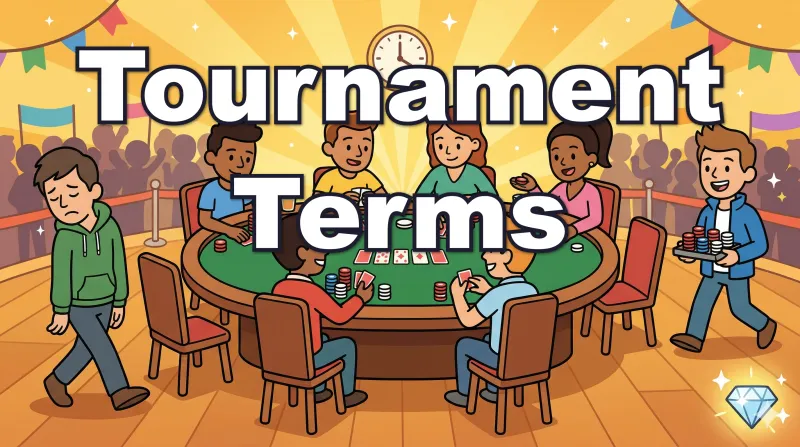
For tournament entry methods, costs, and major event listings, check out this guide.

When you enter a poker tournament, you'll come across terms like "re-entry," "late reg," "rebuy," "add-on," and "freezeout."
Each of these has different rules and cost implications. Showing up without knowing what they mean can lead to confusion — "Wait, I can get back in?" or "What do you mean I can buy more chips?"
This article starts with how a typical tournament works, then breaks down each term.
What You'll Learn
- How a standard tournament (re-entry format) works
- The meaning and differences between re-entry, late registration, rebuy, add-on, and freezeout
- When you should (or shouldn't) re-enter or add on
How a Typical Tournament Works
The most common tournament format features multi re-entry + late registration + no add-on. Major events like the WSOP, WPT, and EPT main events all use this structure.
Here's the basic flow:
- Everyone pays the same buy-in and receives the same starting stack
- If you lose all your chips, you're eliminated
- During the late registration period, you can pay the buy-in again and start fresh with a new stack (= re-entry)
- Once late registration closes, elimination is final. The last player standing wins
In other words, the first half of the tournament gives you a second chance through re-entry, while the second half is do-or-die.
Once you understand this basic structure, every other term is just a variation of it.
Re-entry
Re-entry has two meanings. A tournament that allows you to re-enter after busting is called a "re-entry tournament," and the act of re-entering is simply called "re-entering" or "taking a re-entry."
The standard tournament described above is exactly this — a re-entry format.
Re-entry Rules
| Item | Details |
|---|---|
| Condition | After elimination (chips reach zero) |
| Window | During the late registration period only |
| Times allowed | Multiple (varies by event) |
| Cost | Same as the original buy-in (sometimes cheaper at local venues) |
| Chips | Fresh starting stack |
| Seat | Assigned a new seat |
Re-entry means you leave, then come back as if you're a brand-new player. You get a new seat and start with a fresh stack.
Example: You enter a 50, get a new seat, and restart with 10,000 chips.
Should You Re-enter?
The decision is simple: do you still want to play, and do you want to win this tournament?
- If you're thinking about value for time, joining a new tournament that's about to start often gives you more play time than re-entering a tournament already in progress
- If you're thinking about value for money, some argue that late registration gives you a slight edge (more on this below)
Either way, decide how many re-entries your bankroll can handle before you start.
Late Registration
Late registration is a window after the tournament starts during which new players can still enter. It's commonly shortened to "late reg."
The late registration window is defined by blind levels (the incremental stages at which blinds increase), but event listings typically show it as a time — for example, "Late reg closes at 5:30 PM." As long as you arrive within this window, you can jump in even if you missed the start.
Example: A tournament starts at 2:00 PM with late registration until 4:00 PM. You arrive at 3:30 PM — still within the late reg window — so you're able to enter.
Late Registration and Re-entry
Re-entries are only allowed during the late registration window. Once it closes, no new entries or re-entries are accepted. From that point on, if you bust, you're out.
The longer the late registration period, the more chances you have to re-enter. It's worth checking this when choosing which event to play.
Rebuy
A rebuy, like re-entry, allows you to get back in after busting out. The term "rebuy" is used both as an action ("I'm going to rebuy") and to describe a tournament that allows it.
Rebuy vs. Re-entry
Strictly speaking, there's a difference between the two:
| Rebuy | Re-entry | |
|---|---|---|
| Seat & Table | Stays the same | Assigned a new seat |
| Treatment | Continue as the same player | Treated as a new player |
With a rebuy, you keep your seat and table information. With a re-entry, you're treated as if a completely new player just sat down.
In practice, however, many tournaments labeled as "rebuy" actually operate as re-entry. The terms are often used interchangeably, especially at local venues. If you're unsure, just ask the tournament director.
Example: A tournament is advertised as "1 rebuy allowed." In reality, after busting you go to the registration desk, pay another buy-in, and get assigned a new seat with a fresh starting stack — essentially re-entry.
Add-on
An add-on is an option to purchase extra chips even if you haven't busted. The act itself is also called "adding on."
Unlike re-entry or rebuy (which happen after you bust), an add-on lets every surviving player purchase chips once, regardless of their current stack size. It typically takes place during a break.
Example: You enter a 10 add-on option. At the break, you have 8,000 chips. You pay $10 for the add-on and receive 10,000 chips (the same as the starting stack), bringing your total to 18,000.
Should You Add On?
Opinions vary, but in general you don't need to.
In tournaments, doubling your chip stack doesn't double your chance of winning. As your stack grows, each additional chip is worth less in terms of tournament equity. Surviving matters more than accumulating chips, so paying extra to add chips has limited value.
That said, if the add-on offers a better chip-to-cost ratio than the original buy-in, it's worth taking. Also, if you're short-stacked, adding on can significantly improve your position. Weigh the cost against your current situation and decide accordingly.
Freezeout
A freezeout is a tournament type where no rebuys or re-entries are allowed. Once you lose all your chips, you're out — no second chances.
Since there are no additional costs, you only pay the initial buy-in. Without the option to rebuy or re-enter, every hand carries more weight.
On the other hand, if you lose all your chips due to bad luck or a single mistake early on, that's it. Some argue that re-entry formats better reflect true skill because they reduce the impact of short-term variance.
Example: You enter a $100 freezeout tournament. Early on, your pocket aces lose to pocket kings all-in. With no rebuy or re-entry option, you're eliminated on the spot.
Comparison Table
Here's a summary of all the terms covered in this article.
| Re-entry / Rebuy | Add-on | Freezeout | |
|---|---|---|---|
| Category | Action | Option / Action | Tournament type |
| What it does | Re-enter after busting | Purchase chips regardless of stack | No second chances |
| When | During late reg | During break | — |
| Times allowed | Multiple (with limits) | Once only | — |
| Cost | Same as buy-in | Around buy-in amount | Buy-in only |
| Seat change | Re-entry: yes / Rebuy: no | No | — |
Summary
- A typical tournament uses re-entry + late registration
- Re-entry / Rebuy lets you get back in after busting. In practice, the terms are often used interchangeably
- Late registration is the window during which you can enter or re-enter. Once it closes, elimination is final
- Add-on lets all surviving players purchase extra chips once, usually during a break
- Freezeout means no rebuys or re-entries — one shot only
- For both rebuys and re-entries, decide your limit before you start
New to poker rules? Start here.
Found this helpful?
Bookmark this page to revisit anytime!
Ctrl+D (Mac: ⌘+D)
Found an error or have a question about this article? Let us know.
✉️ Contact Us