
The Complete Guide to 3-Betting | Polar, Depolar, Linear, Super Polar [Ajo MTT Vol.2]
A GTO Wizard walkthrough of four 3-bet construction patterns in MTTs — polar (deep IP), depolar (short IP), linear (OOP), and super polar (from the BB) — covering LJ vs BTN at 80bb and 25bb, LJ vs SB at 40bb, and CO vs BB at 40bb. Vol.2 of Ajo's MTT Strategy Series.
Written by: Ajo (X: @AjoPoker)
Hi, I'm Ajo.
The theme of Vol. 2 is 3-betting. A lot of players only 3-bet with premiums like AA or AK, but 3-bet construction actually changes significantly depending on stack depth and position — there are four main patterns you should know.
In this article, we'll walk through polar / depolar / linear / super polar constructions, one spot at a time, using GTO Wizard's ChipEV solutions.
📌 The four spots we'll cover
| # | Construction | Situation | Stack |
|---|---|---|---|
| 1 | Polar | LJ vs BTN (Deep IP) | ES 80bb |
| 2 | Depolar | LJ vs BTN (Short IP) | ES 25bb |
| 3 | Linear | LJ vs SB (OOP) | ES 40bb |
| 4 | Super Polar | CO vs BB (from BB) | ES 40bb |
All solutions use ChipEV (no ICM consideration).
1. Polar 3-Bet | LJ vs BTN, ES 80bb (Deep IP)
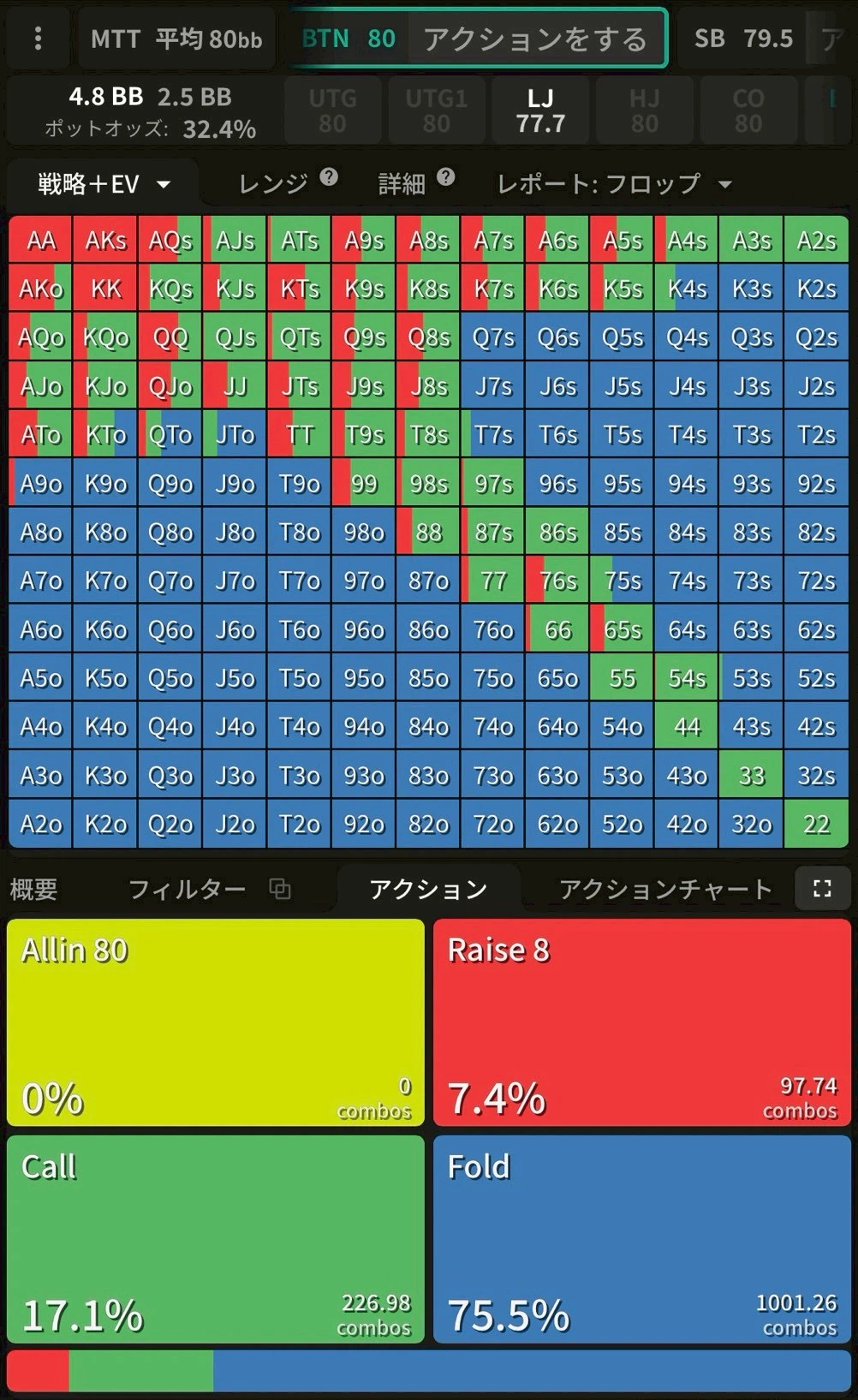
Deep-stacked and in position, 3-bets should be built polarized — strong hands and weak hands at the two extremes.
Value 3-bets
- AA, KK, AKs — 3-bet at 100% frequency (pure)
- JJ, QQ, AKo — mixed with a meaningful call frequency to protect the calling range
Bluff 3-bets
- Suited connectors, Kxs, and Axs used as bluffs
- Denying equity preflop is valuable, so marginal hands also get mixed into the 3-bet range
Construction principle
- 3-bet size: about 3.5x (3.5x the open)
- Key idea: build with hands you're happy to see a 4-bet and hands you're fine to fold to a 4-bet
- Middle-strength hands go into the calling range and play postflop in position
3-bet sizing
| Construction | Recommended size |
|---|---|
| Deep IP polar | About 3.5x the open |
2. Depolar 3-Bet | LJ vs BTN, ES 25bb (Short IP, 3-Bet All-In)
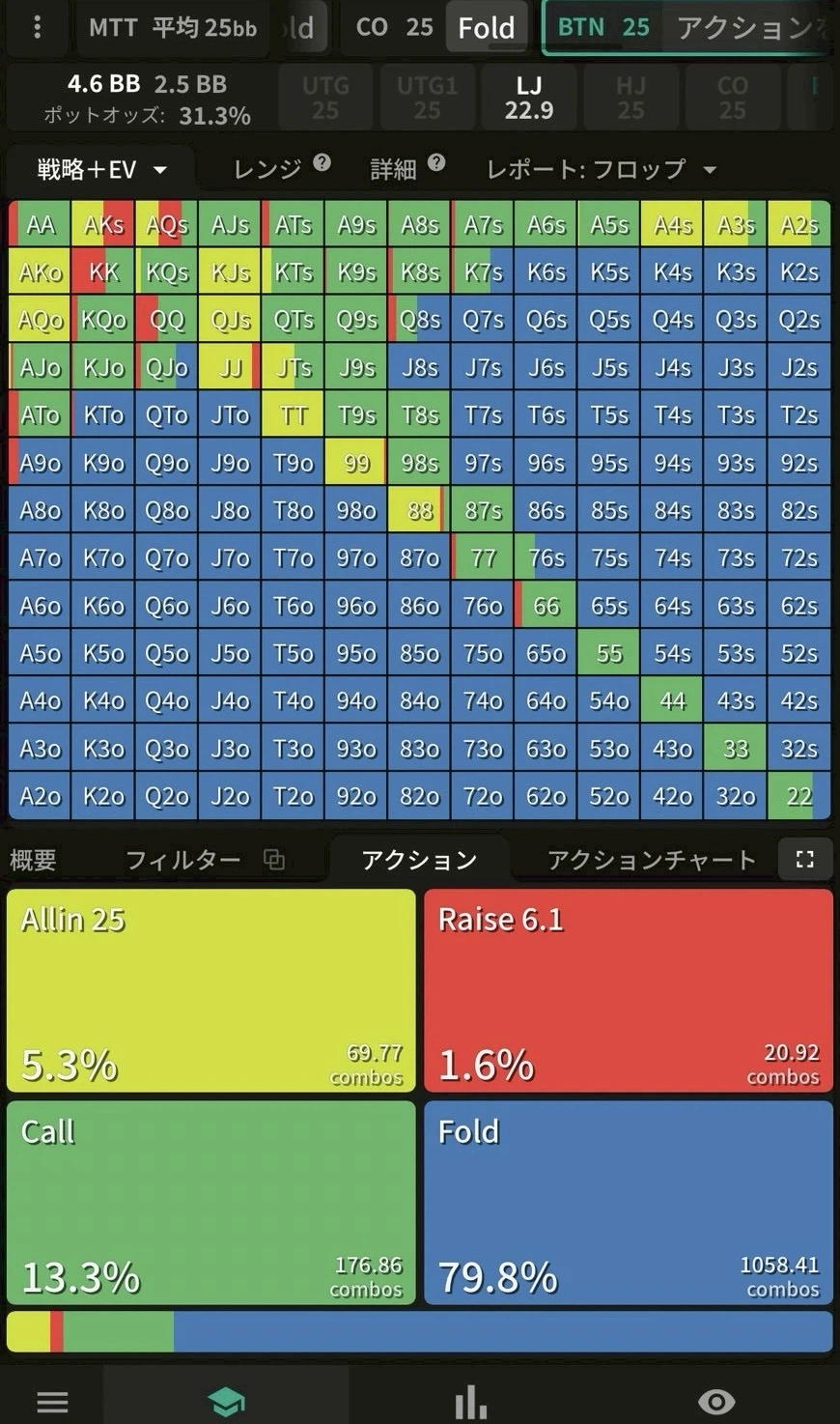
When stacks get shallow, the construction flips compared to deep stacks.
Hands that 3-bet all-in
- 88–JJ, AQ, AK mostly
- Reason: hands that do fine getting it in preflop but play awkwardly postflop
Hands that call or use a small 3-bet
- QQ+ (the true premium hands)
- ATo, Q8s-type hands that are barely playable but not strong enough to commit
How this differs from deep stacks
With deep stacks you polarize (strong OR weak to 3-bet); short-stacked it inverts:
- Elite hands → call or small 3-bet
- Middle-strength hands → 3-bet all-in
- Weak hands → call or fold
Short-stacked, the mindset is: "If my opponent wakes up with the nuts, so be it." Middle-strength hands want to ship and realize their equity preflop rather than navigate postflop with a short SPR.
3. Linear 3-Bet | LJ vs SB, ES 40bb (OOP)
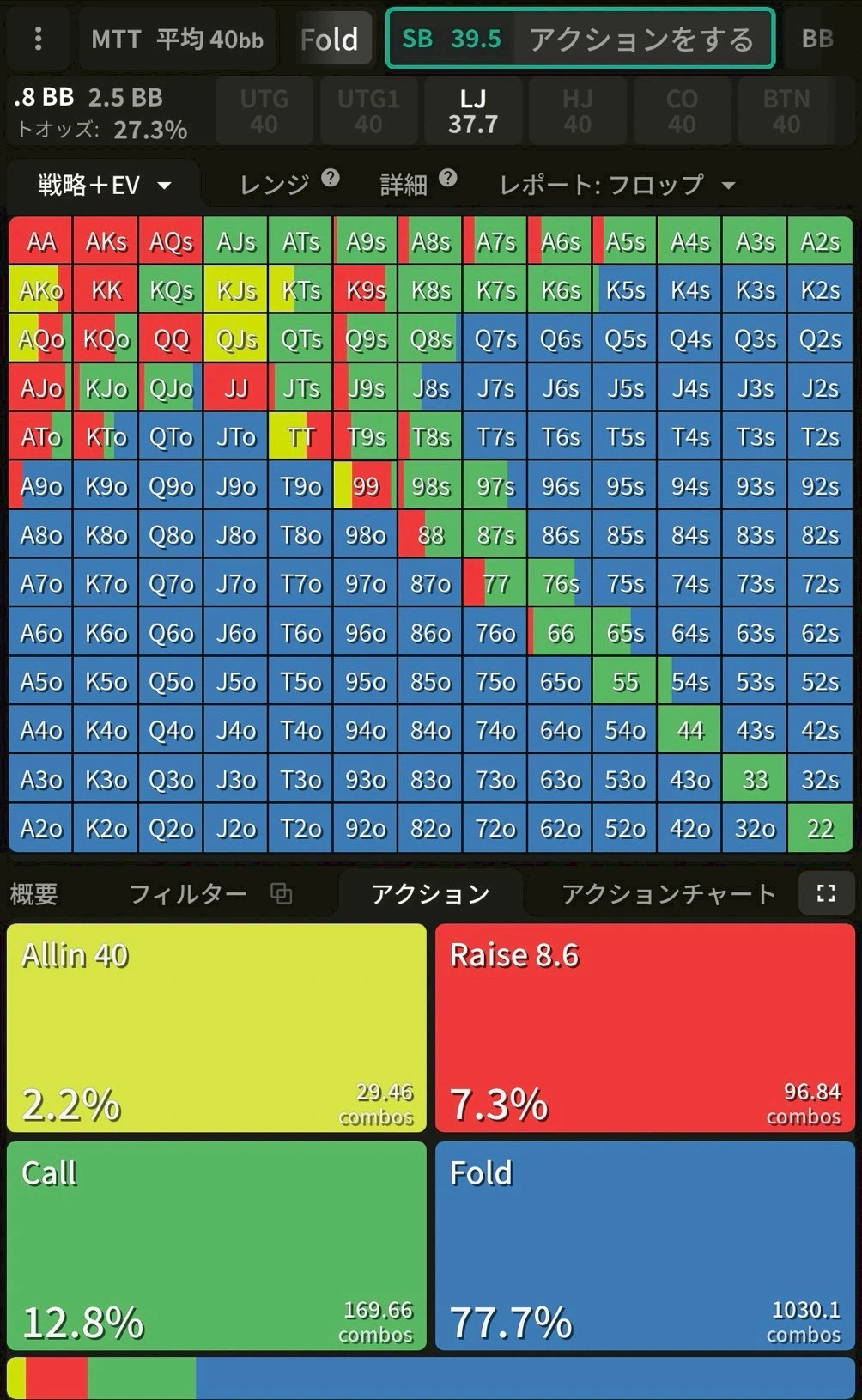
From out of position, 3-bets become linear — nearly all strong hands go into the 3-bet range.
Why linear?
Playing postflop OOP is structurally bad, so strong hands want to close the action preflop instead.
SB's calling range
Unlike ring games, tournaments have:
- No rake on the pot
- Antes → the pot starts larger
So the SB calls with a meaningful share of hands. Common callers include:
- ATs, KQs and other marginal suited hands
- Small pocket pairs (set-mining value)
3-bet size and all-ins
- 3-bet size: about 4x (4x the open)
- At 40bb, there's also a real frequency of 3-bet all-in — because the post-3-bet SPR is already shallow
4. Super Polar 3-Bet | CO vs BB, ES 40bb (From the BB)
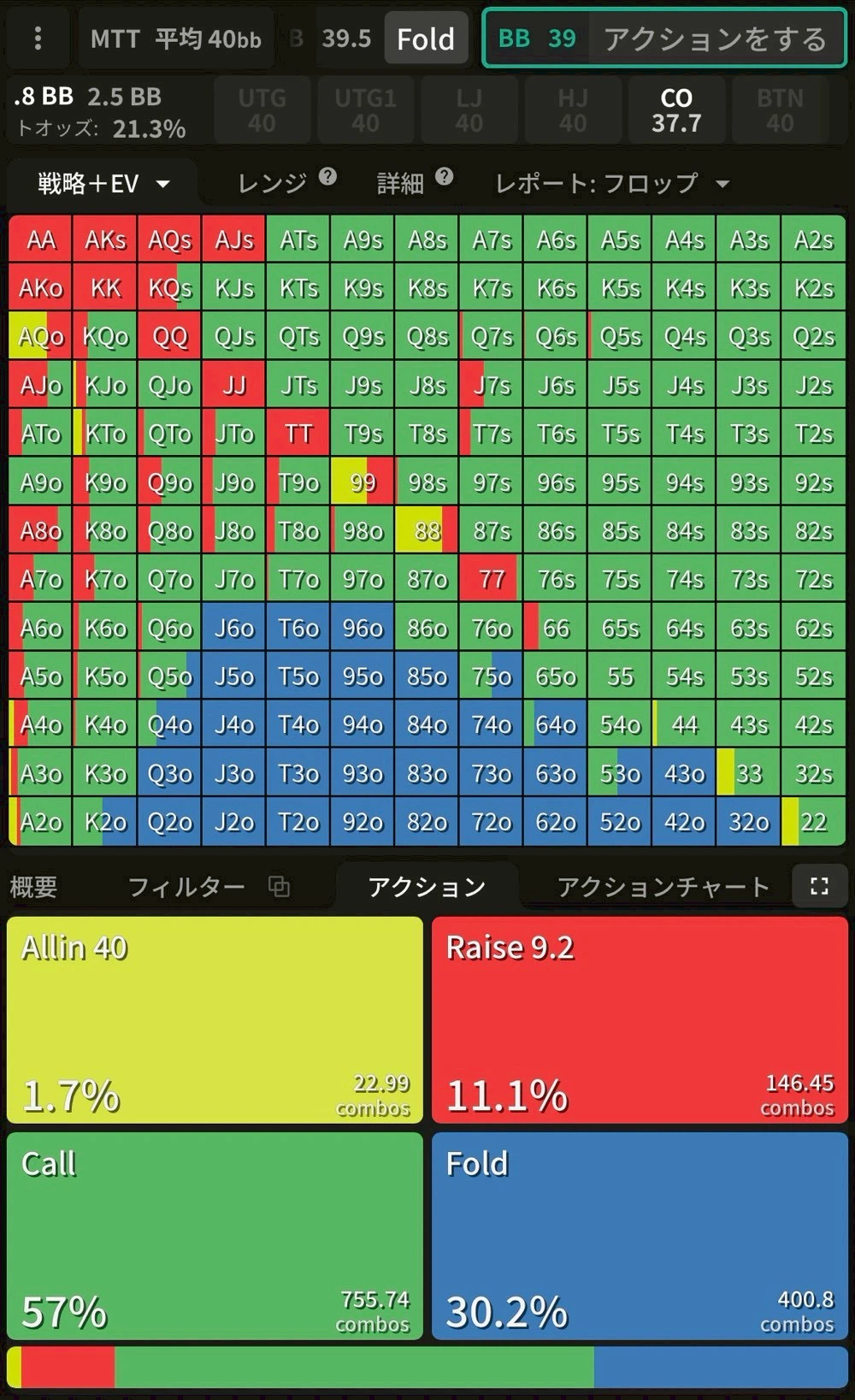
3-betting from the BB is the most polarized construction of all.
Value 3-bets
- 88+, AJs+ and similar premium hands
Bluff 3-bets (the defining feature of super polar)
- Axo, Kxo, Qxo, Jxo, J7s — hands that can snap-fold to a 4-bet
Hands that call instead
- K9s, A9s and similar hands that play well postflop but would be wasted facing a 4-bet
Construction principle
- 3-bet size: about 4x (4x the open)
- Split value and bluffs to the extremes; middle-strength hands call firmly
The exploit angle
📍 Most players severely under-bluff from the BB
The vast majority of opponents run a badly under-bluffed 3-bet range from the BB, which means their 3-bet actually represents a stronger value range than equilibrium suggests.
→ Against opponents who don't mix in enough bluffs, cut your 4-bet bluff frequency against BB 3-bets and respond primarily with call-or-fold.
Summary
3-bet construction breaks into four patterns based on stack depth × position:
| Stack | Position | Construction | Key feature |
|---|---|---|---|
| Deep (80bb) | IP | Polar | Value + suited-connector/Axs bluffs, 3.5x |
| Short (25bb) | IP | Depolar | Middle strength jams; premiums and weak hands call |
| Middle (40bb) | OOP | Linear | 3-bet nearly all strong hands, 4x + some jams |
| Middle (40bb) | BB vs CO | Super polar | Value + full bluffs; middle-strength hands all call |
The BB 3-bet in particular is hard to build correctly, which is where real skill gaps show up preflop. Keep these four patterns in mind and switch between them based on your opponent, stack, and position.
⚠️ A note on ICM
This article uses ChipEV (raw chip EV) solutions. When ICM is in play (on the money bubble, at the final table, etc.), short-stack 3-bet all-in frequencies and BB bluff 3-bet frequencies shift noticeably. Apply the ICM considerations we covered in Vol. 1 (blind battle at 25bb) when adapting these ranges for ICM spots.

Found this helpful?
Bookmark this page to revisit anytime!
Ctrl+D (Mac: ⌘+D)
Found an error or have a question about this article? Let us know.
✉️ Contact Us
![FT 20bb BB Defense Ranges | vs Open by Position [Ajo MTT Vol.5]](/images/thumbnails/article-mtt-ft-20bb-bb-defense-ranges-en-sm.webp)
![FT 20bb Open Ranges | Position-by-Position ICM Guide [Ajo MTT Vol.4]](/images/thumbnails/article-mtt-ft-20bb-open-ranges-en-sm.webp)
![Blind Heads-Up C-Bet Strategy on A-High Boards (Limp-Raise Line) [Ajo MTT Vol.6]](/images/thumbnails/article-mtt-blind-battle-25bb-a-high-cb-en-sm.webp)
This article includes solution screens from GTO Wizard. Copyright in those figures belongs to GTO Wizard.