
LJ vs BB SRP C-Bet Strategy | 30bb Board-by-Board Hit Chart [Ajo MTT Vol.3]
A GTO Wizard walkthrough of c-betting strategy in LJ vs BB SRPs at ES 30bb. Covers c-bet frequency tendencies by high card / suit / pairedness / connectedness, plus eight individual board breakdowns (A95, K95, KK5, K55, 777, 862). Vol.3 of Ajo's MTT Strategy Series.
Written by: Ajo (X: @AjoPoker)
Hi, I'm Ajo.
The theme of Vol. 3 is c-bet strategy from an early position (LJ) vs BB in single-raised pots. BTN vs BB c-bets have been covered widely, but the LJ vs BB version is rarely studied in depth.
In this article, with ES 30bb as our framework, we'll work through board-by-board c-bet decisions — using the question "will the opponent's small pocket pair tough-call or over-fold?" as our exploit anchor.
📌 Setup
- Spot: LJ vs BB SRP (LJ opens, BB calls, heads-up to the flop)
- Stack: ES 30bb
- Solution: GTO Wizard ChipEV (no ICM)
- Range tables: LJ (IP) on the left, BB (OOP) on the right
Preflop Ranges
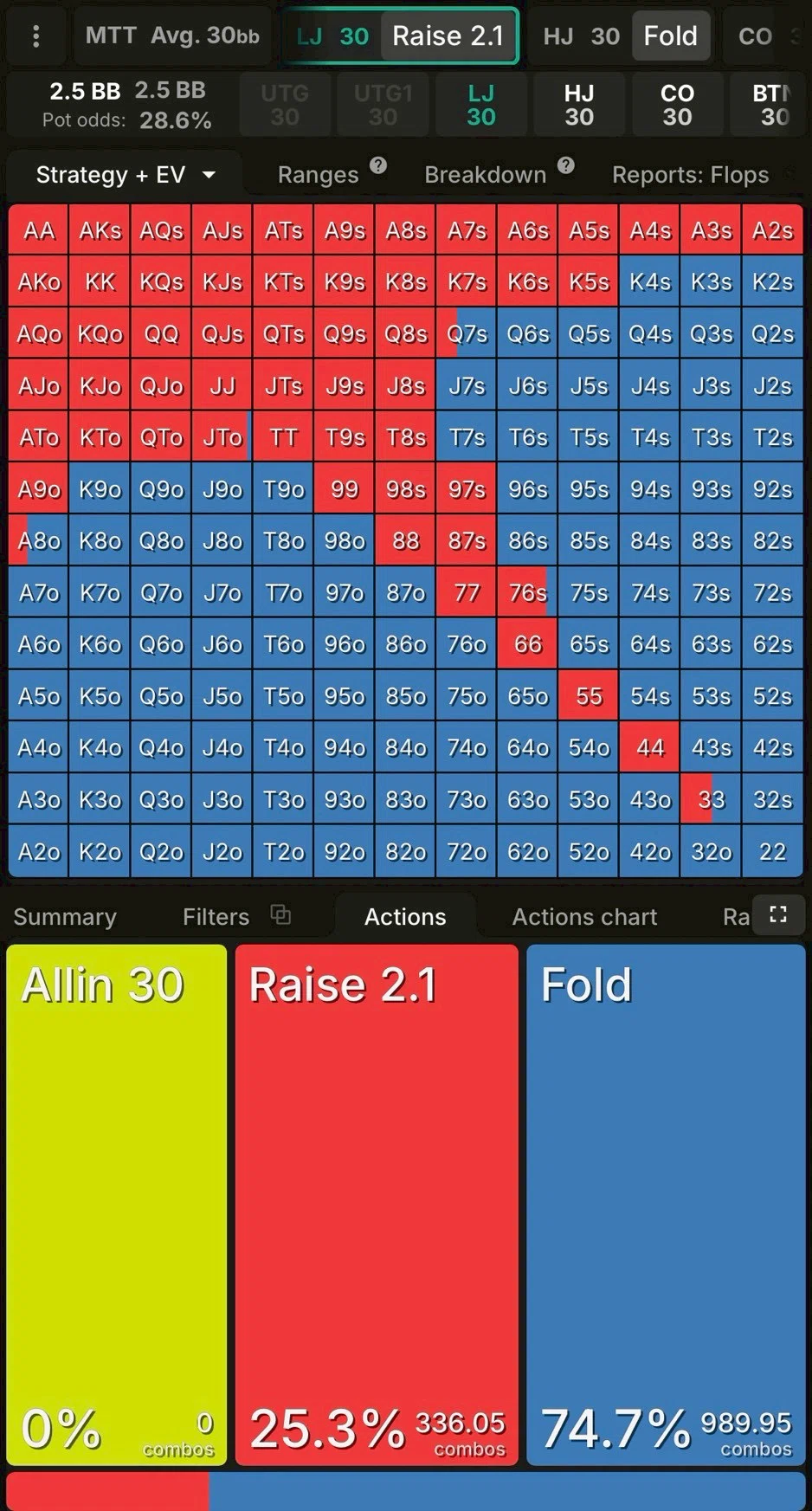
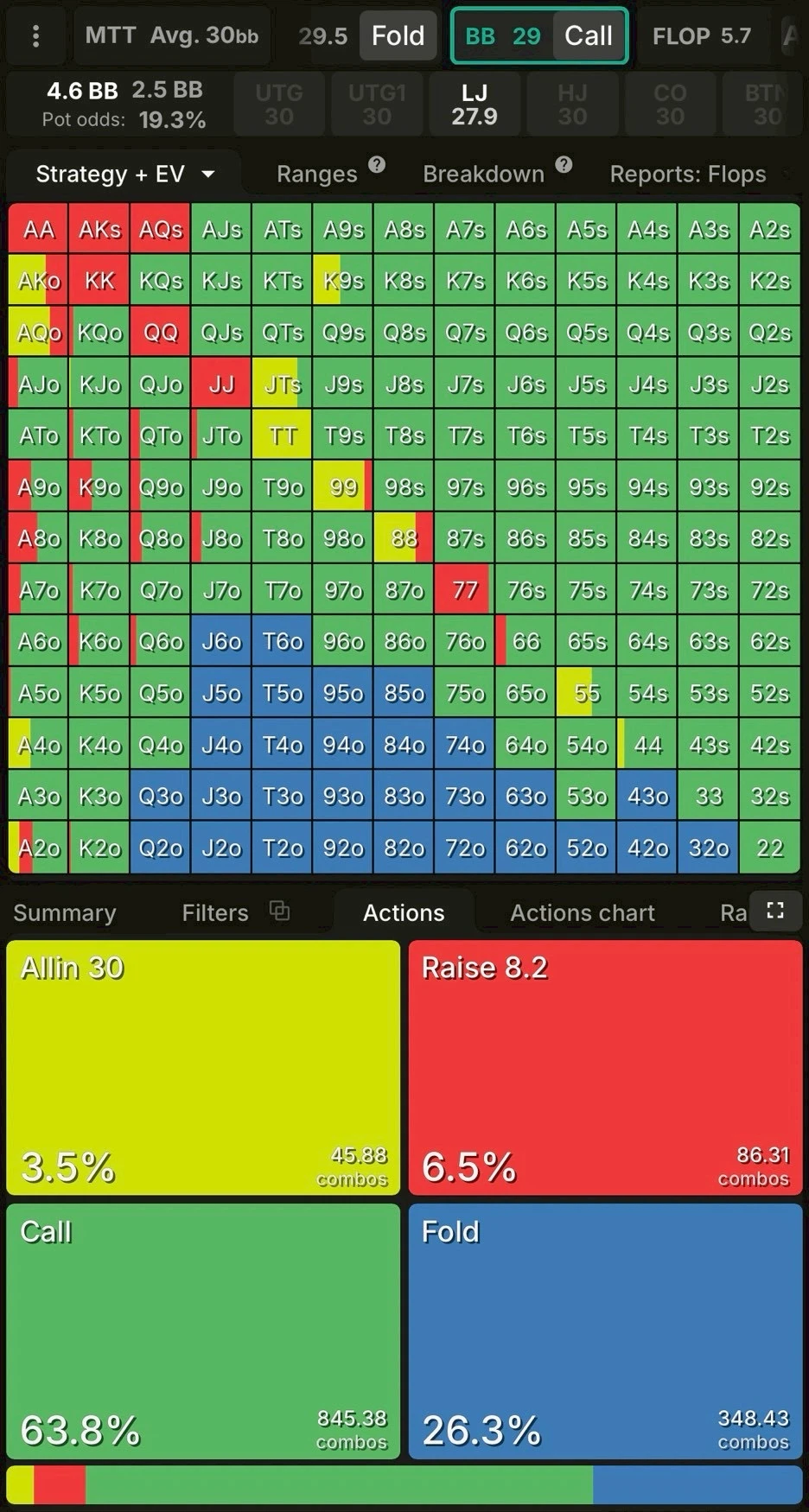
LJ open range
- The bottom of the open is around 33 and A8o (indifferent, mixed)
- Offsuit broadways down to JTo–KTo are open
- At a shallow 30bb, suited connectors and small pocket pairs lose value, while high cards (broadways) gain value
BB defense range
- BB calls broadly — down to Q4o
- 22 and 33 are pure calls (not mixed into 3-bets)
For a deeper dive into BB defense ranges, see Ajo's separate note article (in Japanese).
C-Bet Frequency Tendencies (4 Lenses)
How does the c-bet frequency change with board structure? Four ways to slice it.
1. By high card
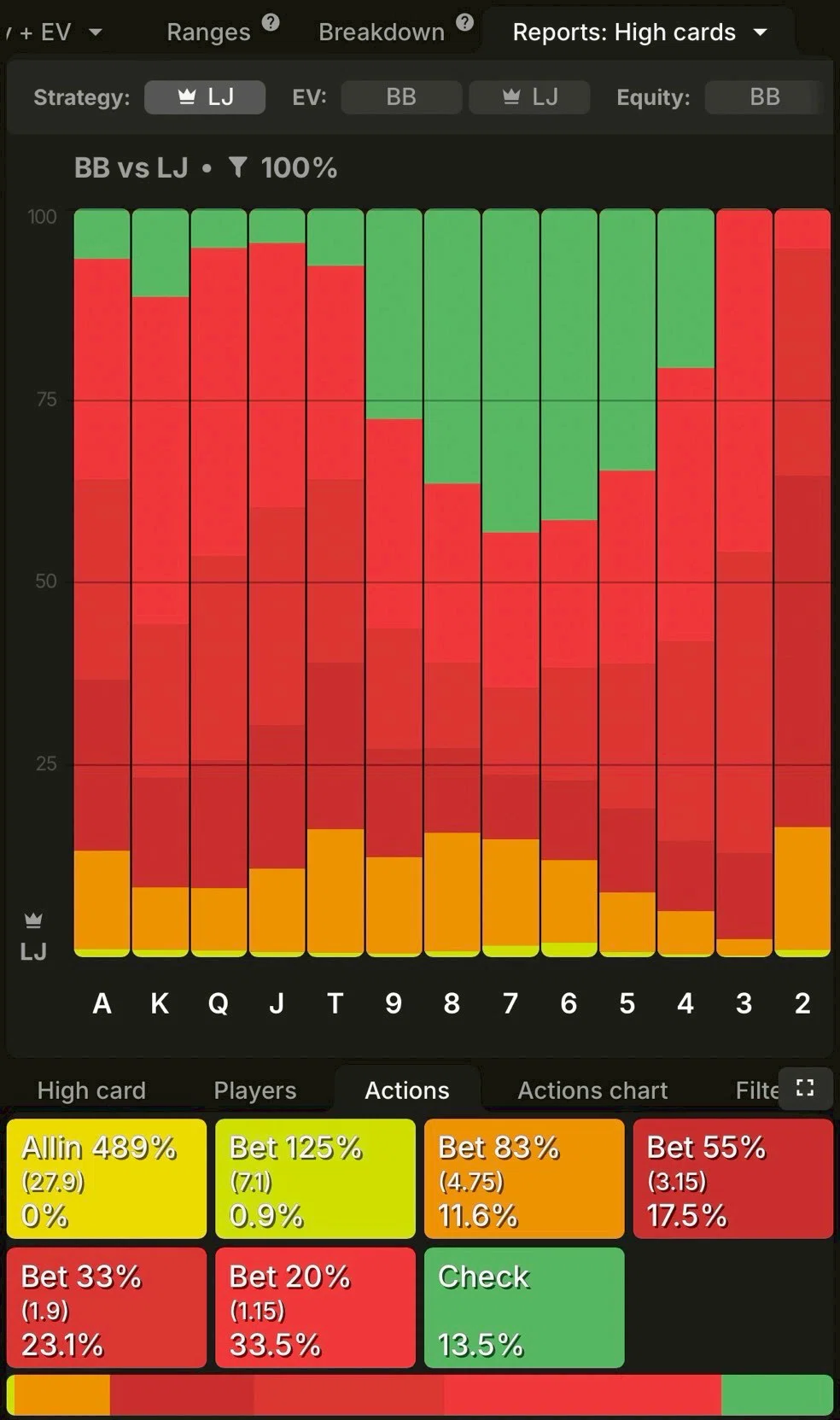
- Boards with a T or higher as the top card see high c-bet frequency
- Frequency drops on 9-or-lower boards
- One subtle exception: KTo is in LJ's range, but the only 9xo is
A9o, which weakens LJ's range on 9x boards
2. By suit structure
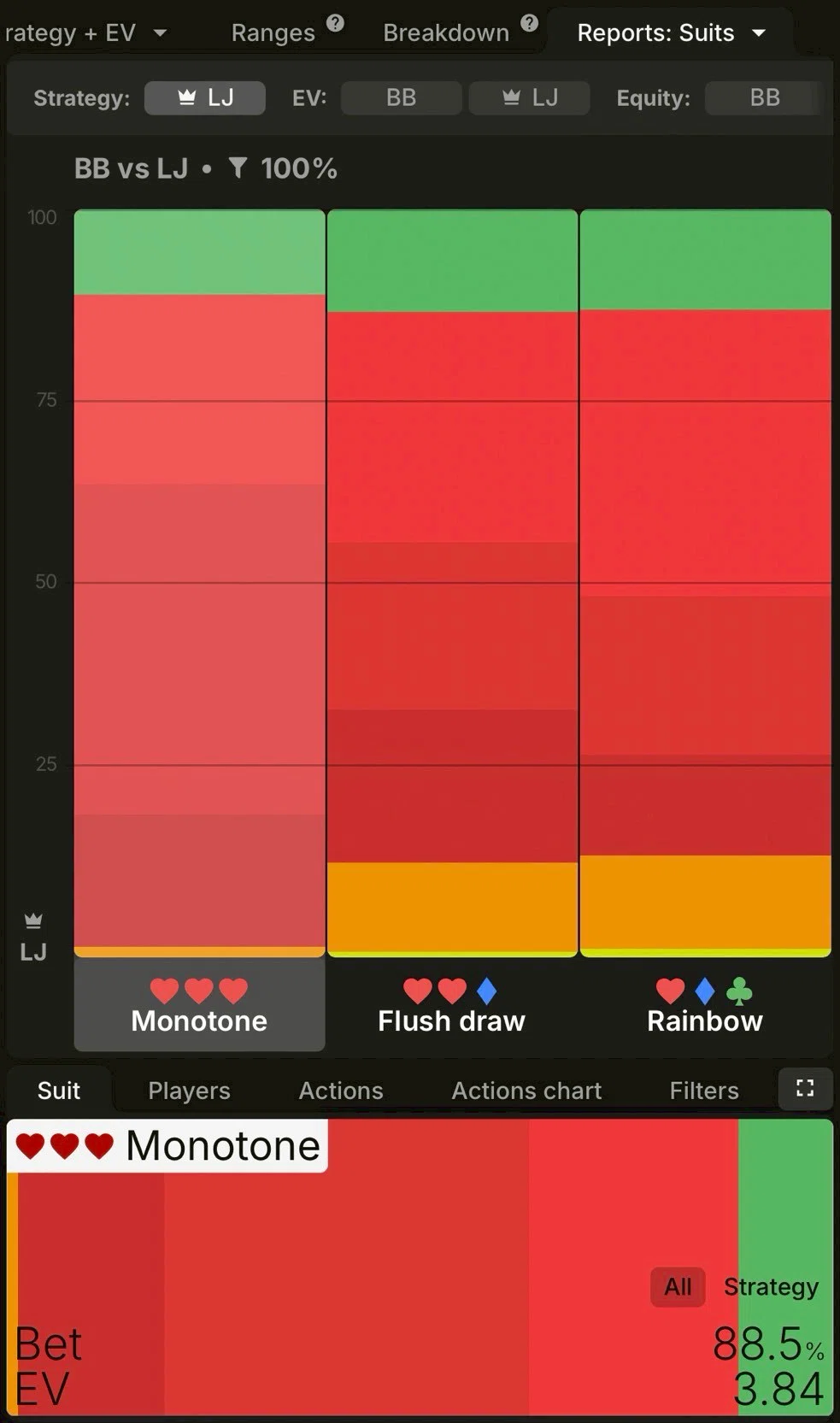
- Monotone boards see the highest c-bet frequency but the lowest EV
- On monotone boards, BB also has nutted hands (flushes), so large bet sizes are rarely usable
3. By pairedness
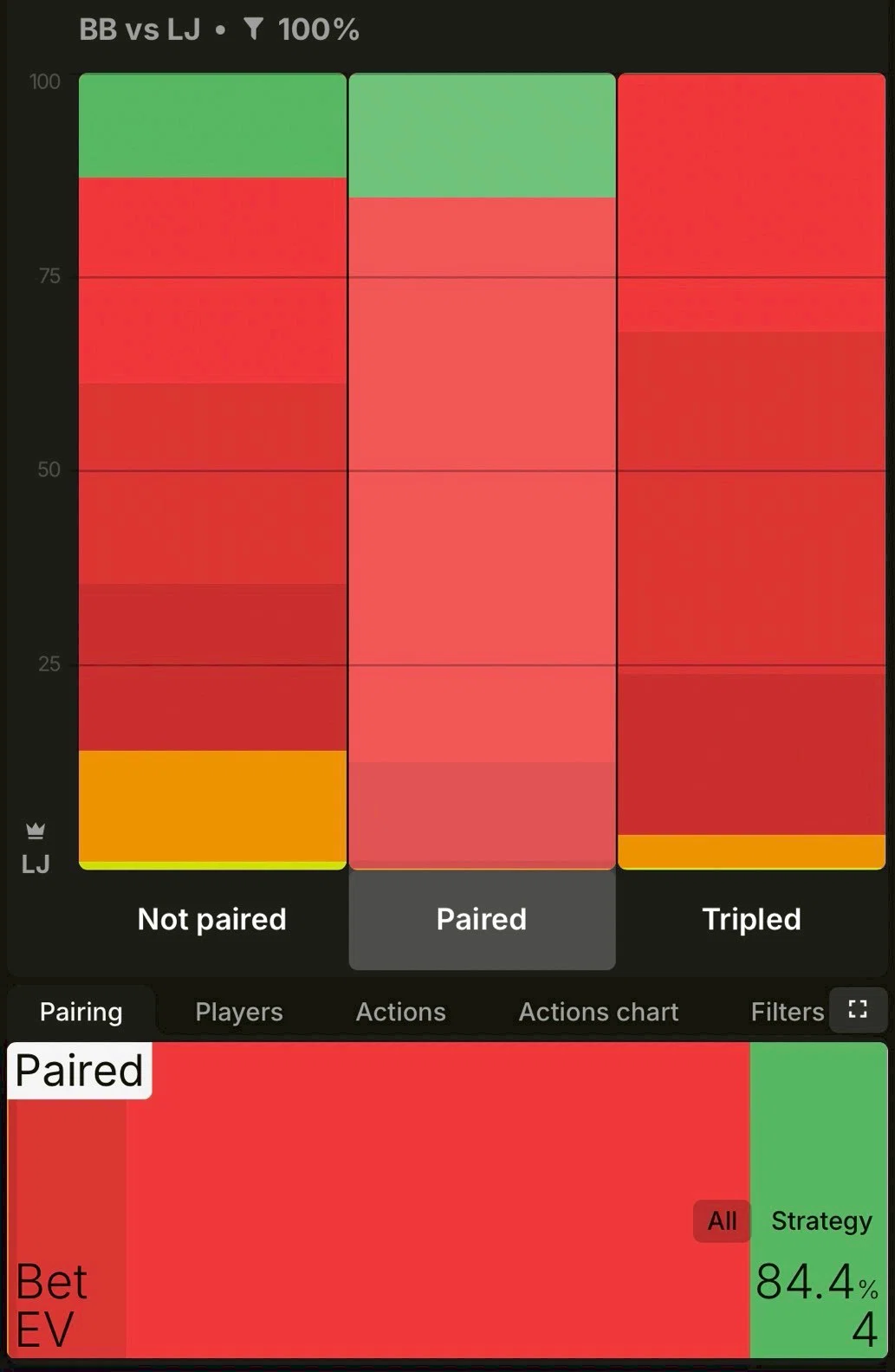
- Paired boards c-bet at 84% — high but not as extreme as you might expect
- As we'll see, low paired boards are the exception because of trips coverage
4. By connectedness
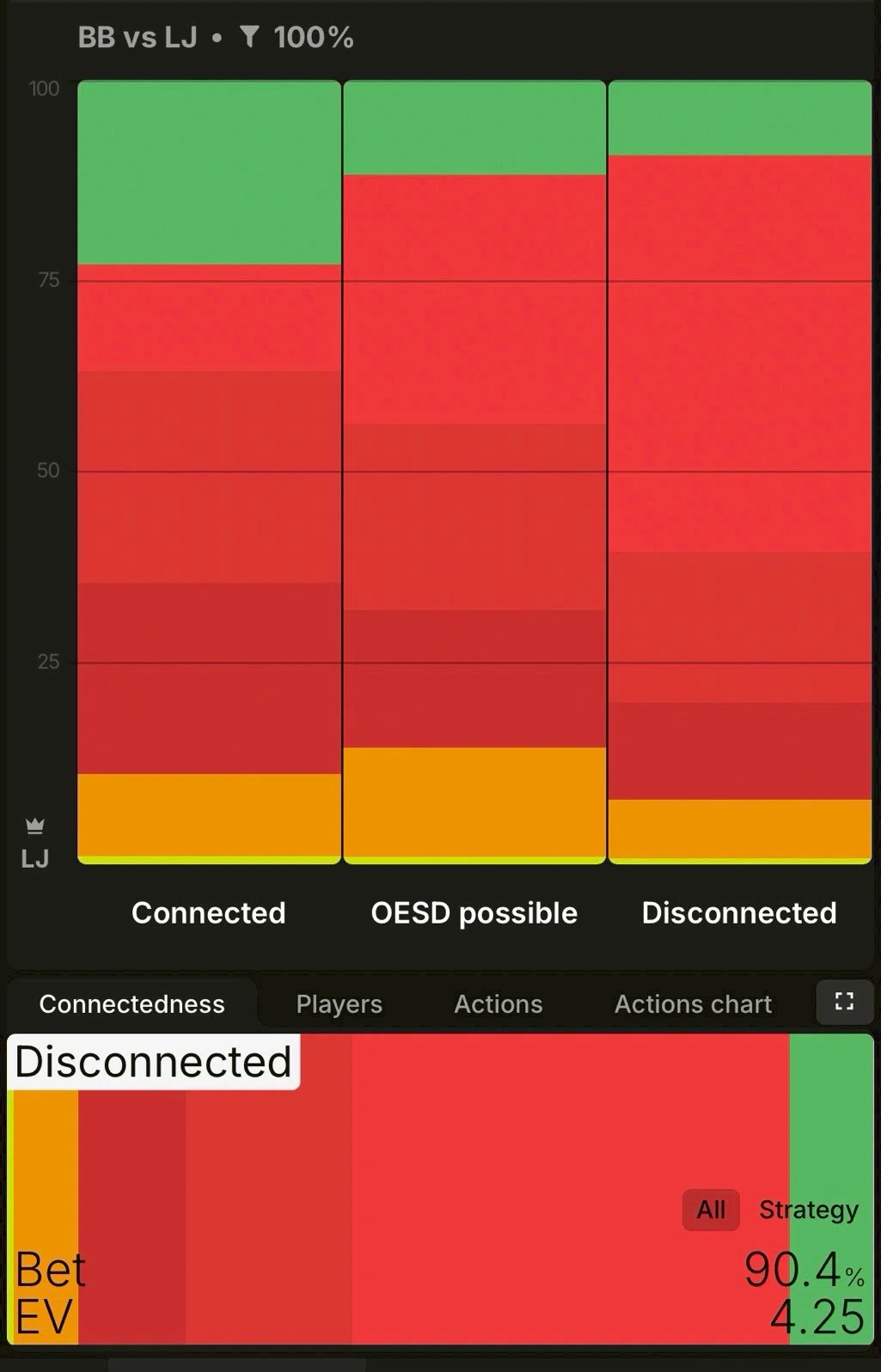
- The drier (less connected) the board, the higher the c-bet frequency
- Less straight potential = clearer range advantage for IP
Individual Board Breakdowns
Eight specific boards.
1. A95 Rainbow
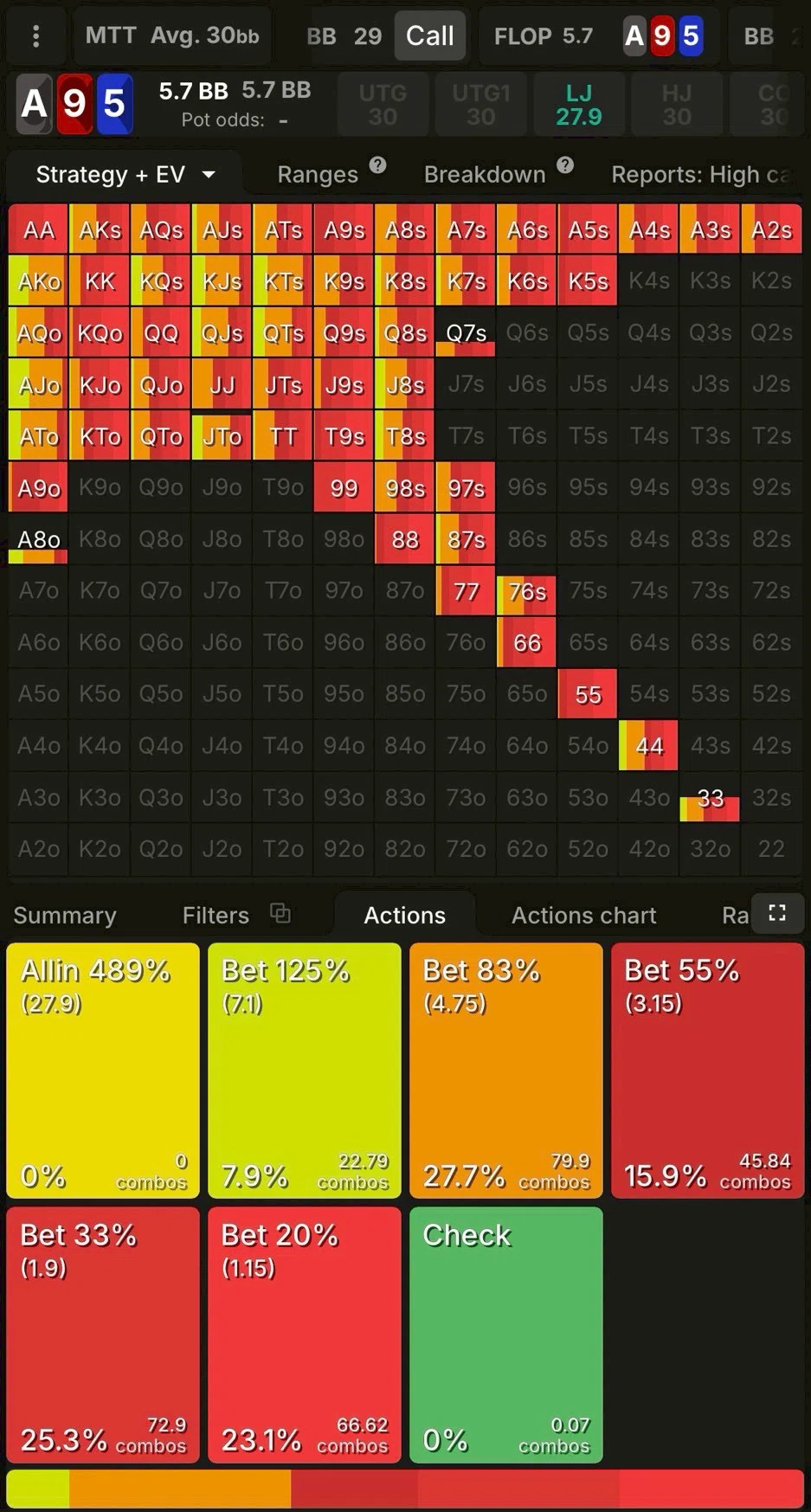
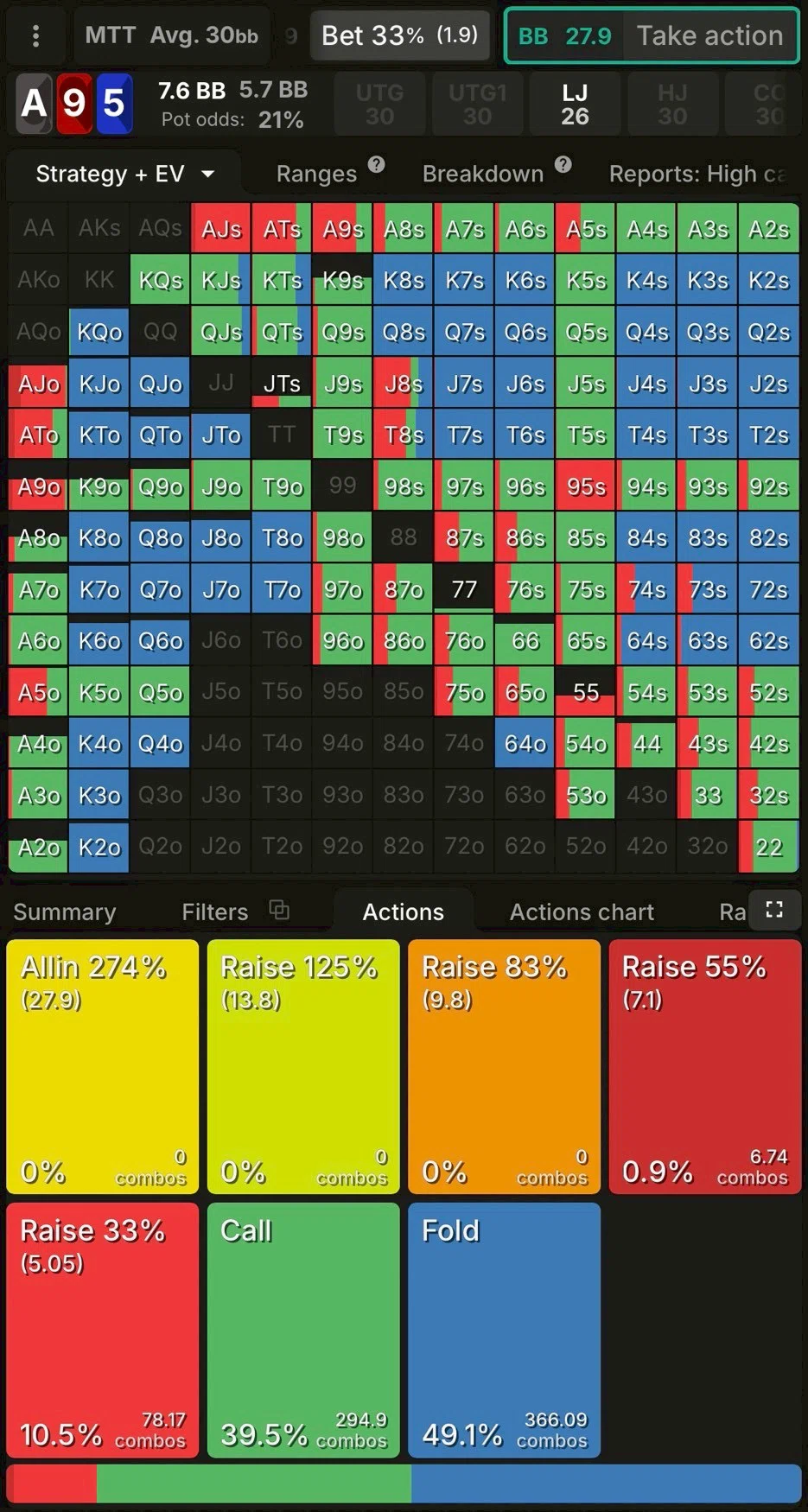
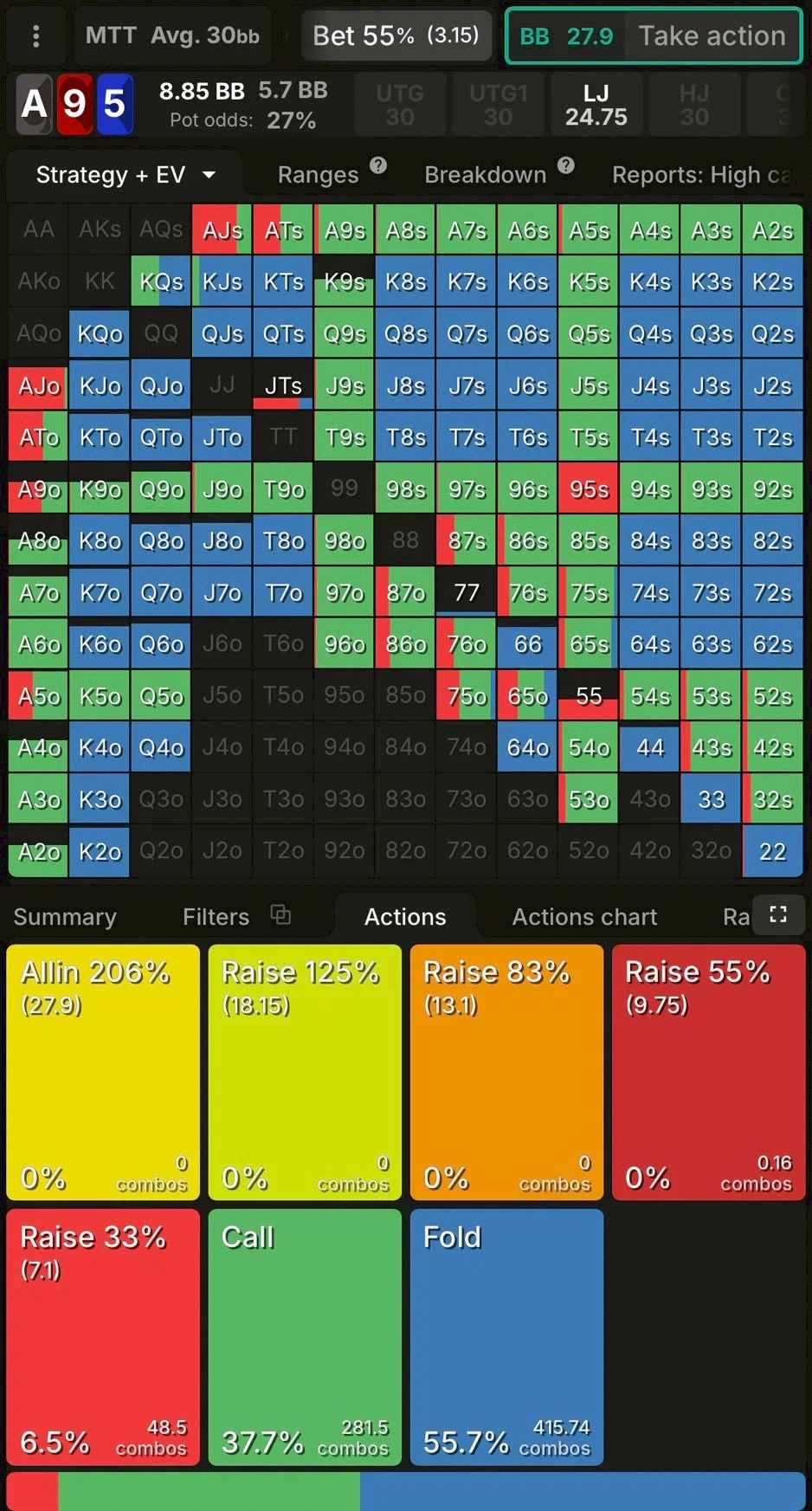
- Range bet (almost every hand bets)
- Sizes used range from 20% to 125% pot
- AT+ is the value lower bound for large bets
- Pocket pairs don't fold to a 33% bet
- Pocket pairs fold to a 55% bet
→ To force pocket pairs to fold, you need 55% or larger.
2. A95 Two-Tone
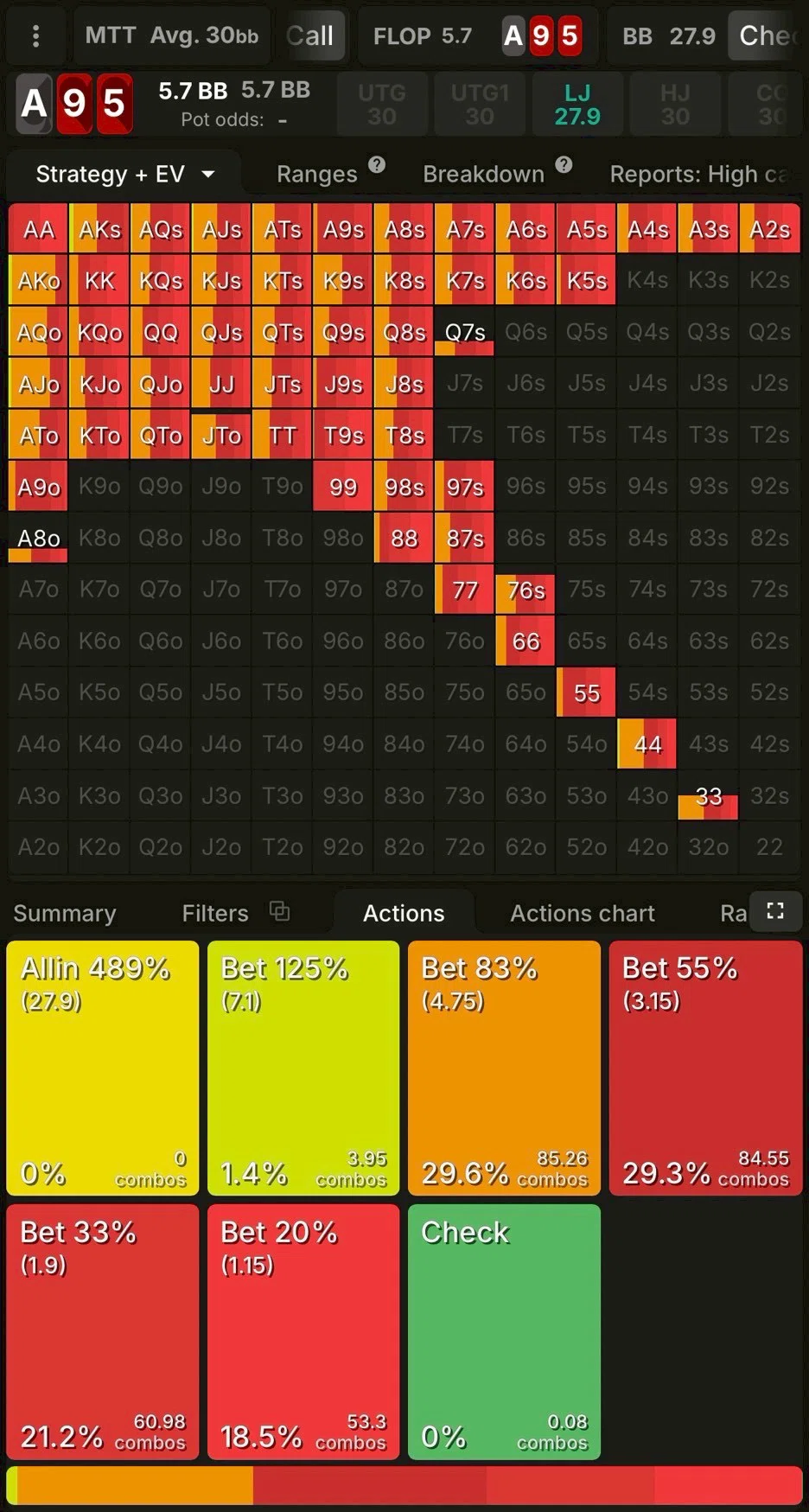
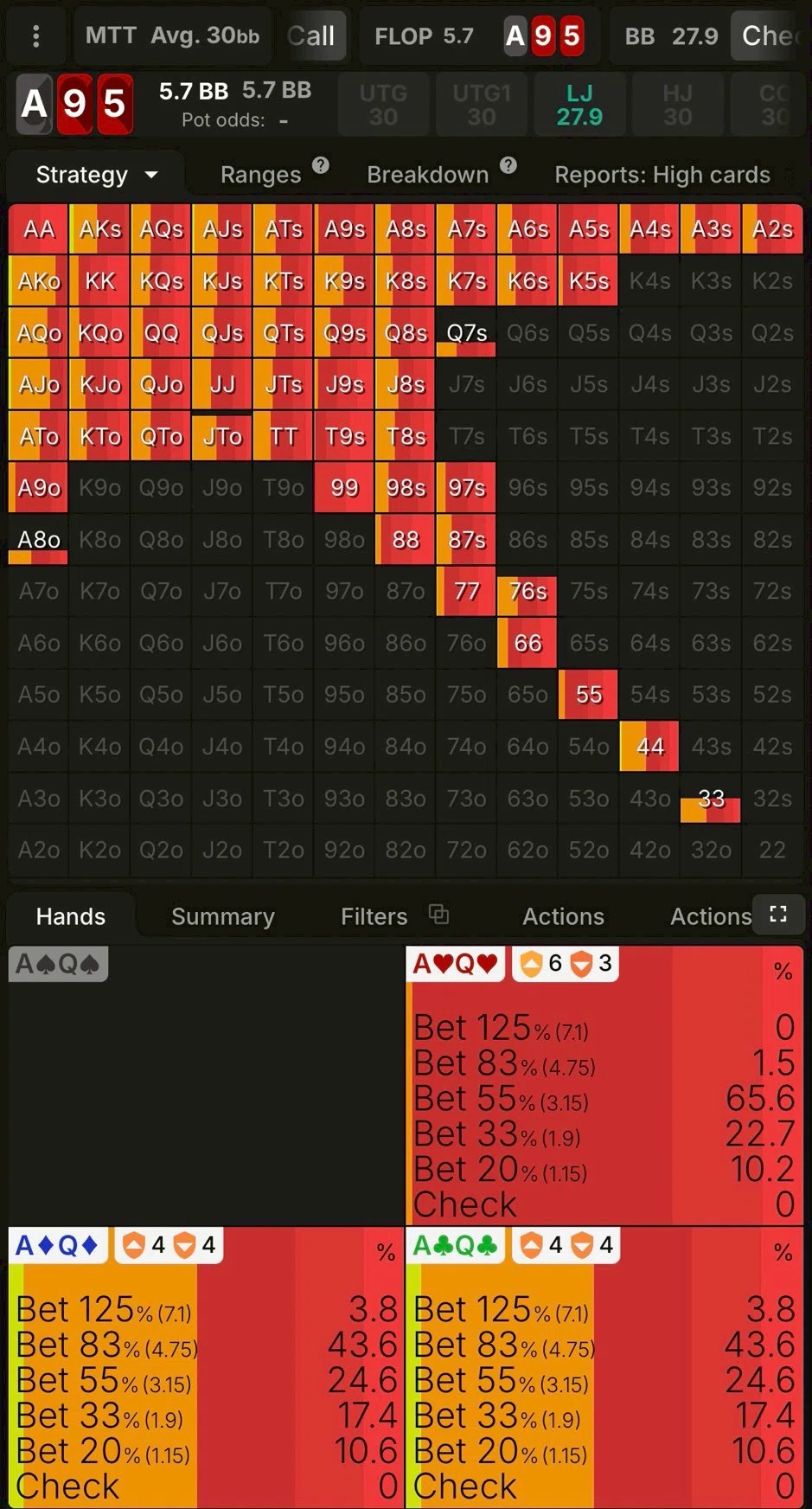
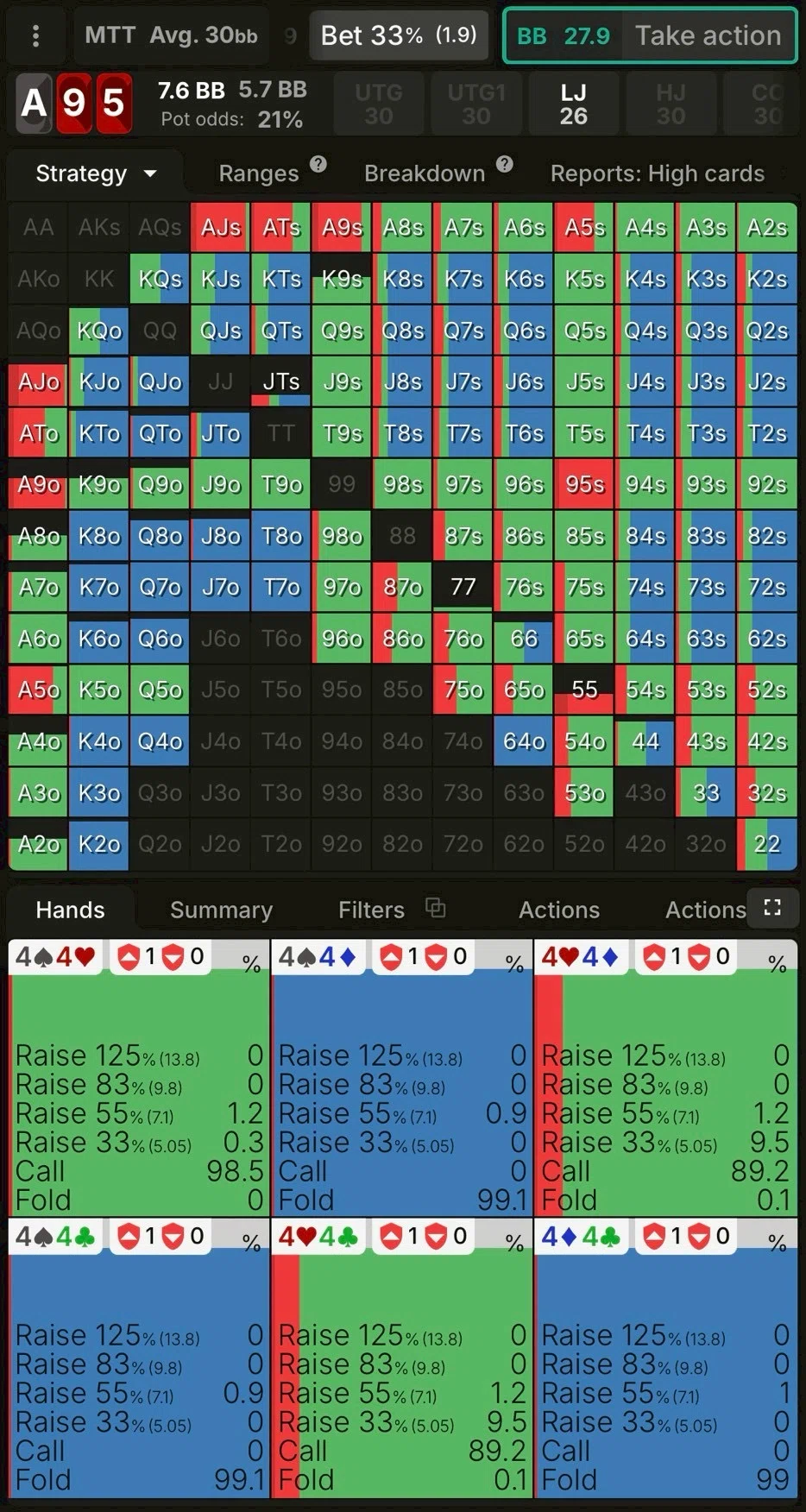
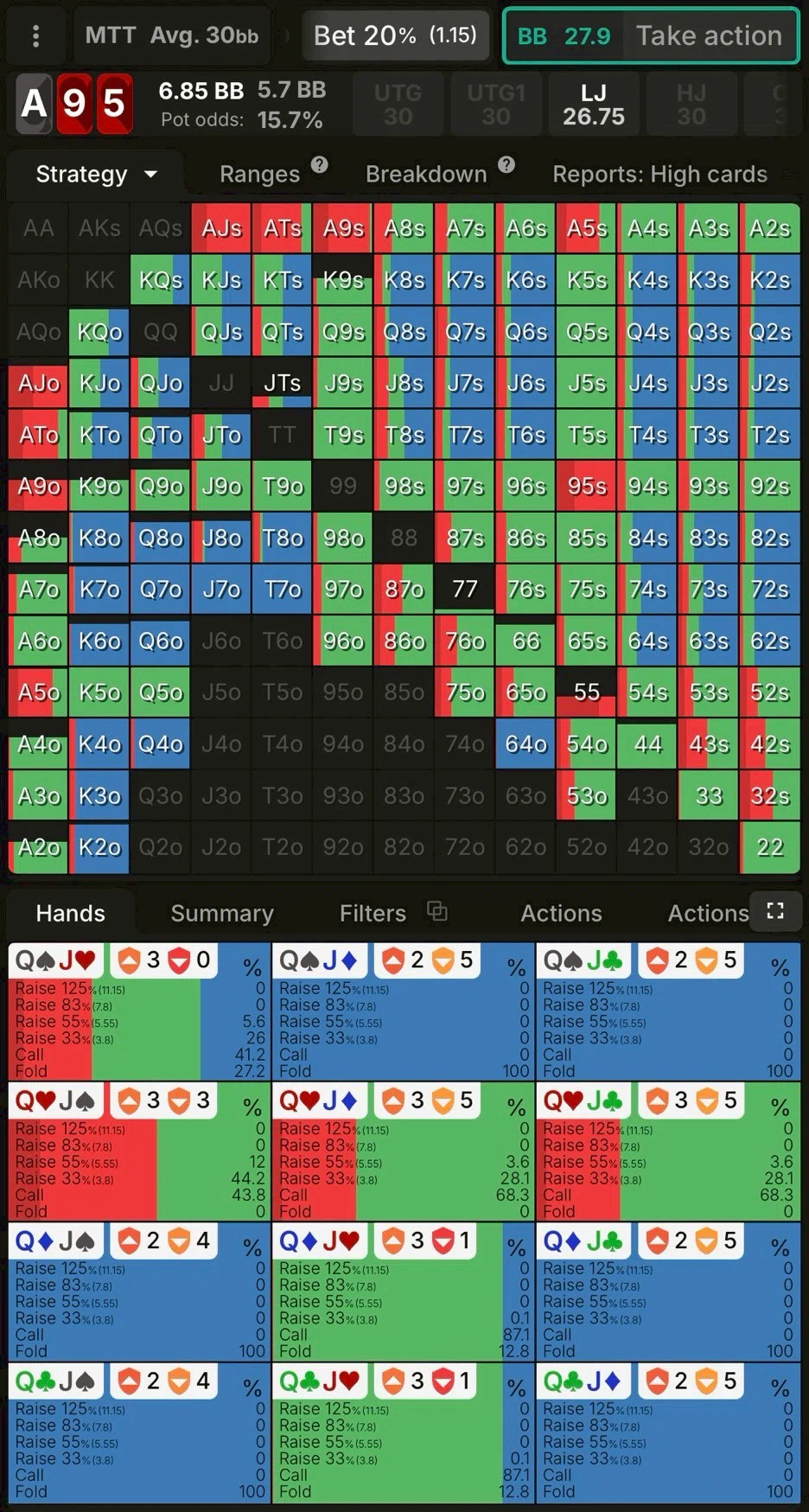
- Range bet
- Sizes used: 20% to 83%
- AQs with a flush draw favors 55%, while AQs without a flush draw favors 83% for protection
- Pocket pairs don't fold to a 20% bet
- Pocket pairs without backdoor flush draws mostly fold to a 33% bet
- QJo with a backdoor flush draw check-raises at a meaningful frequency
3. K95 Rainbow
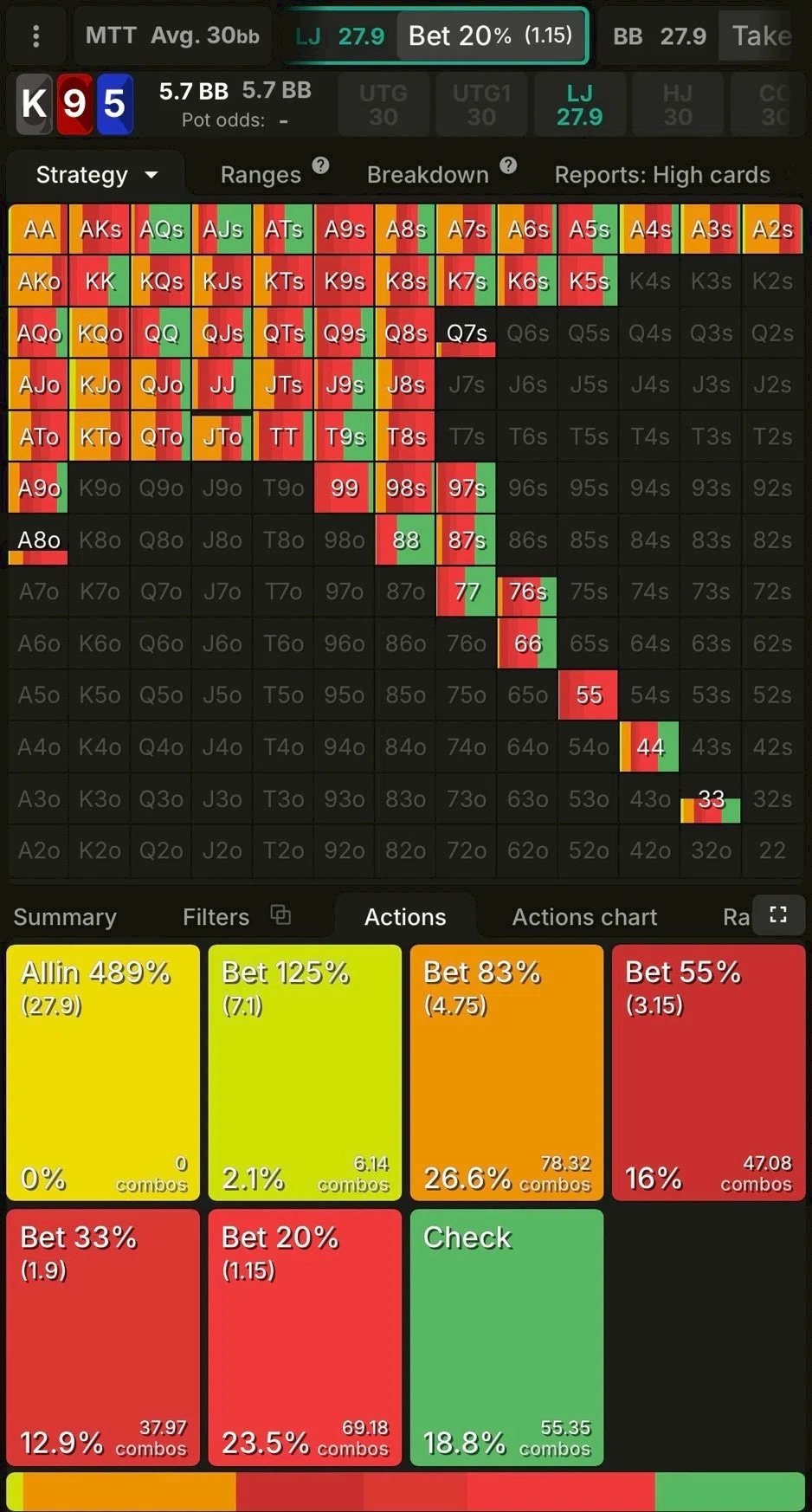
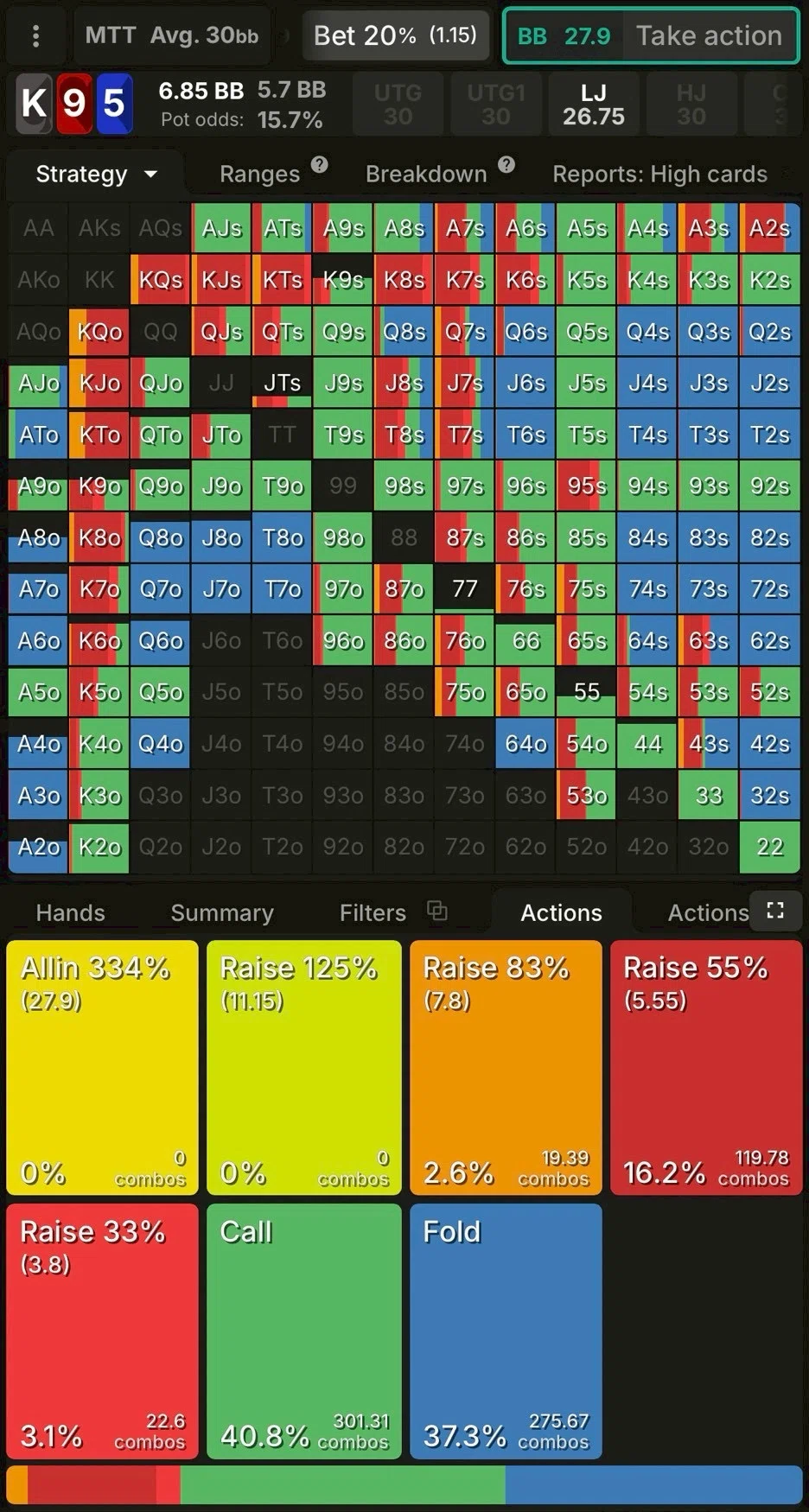
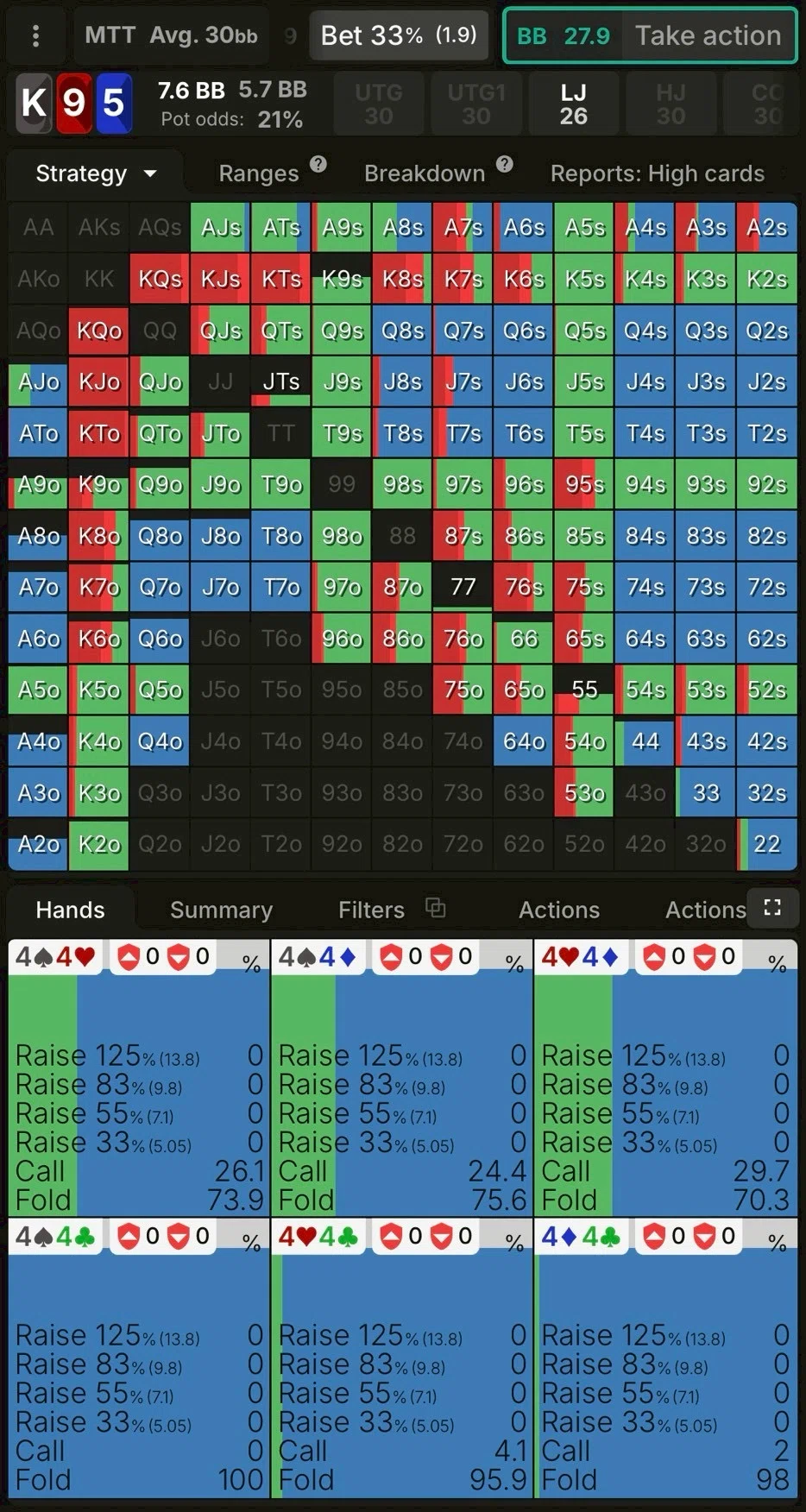
- Bets at 81% of range
- Sizes used: 20% to 83%
- High check-frequency hands: ATs–AQs, pocket pairs, K5s–K7s, etc.
- Pocket pairs call a 20% bet
- Pocket pairs with both backdoor flush colors call a 33% bet at low frequency
4. K95 Two-Tone
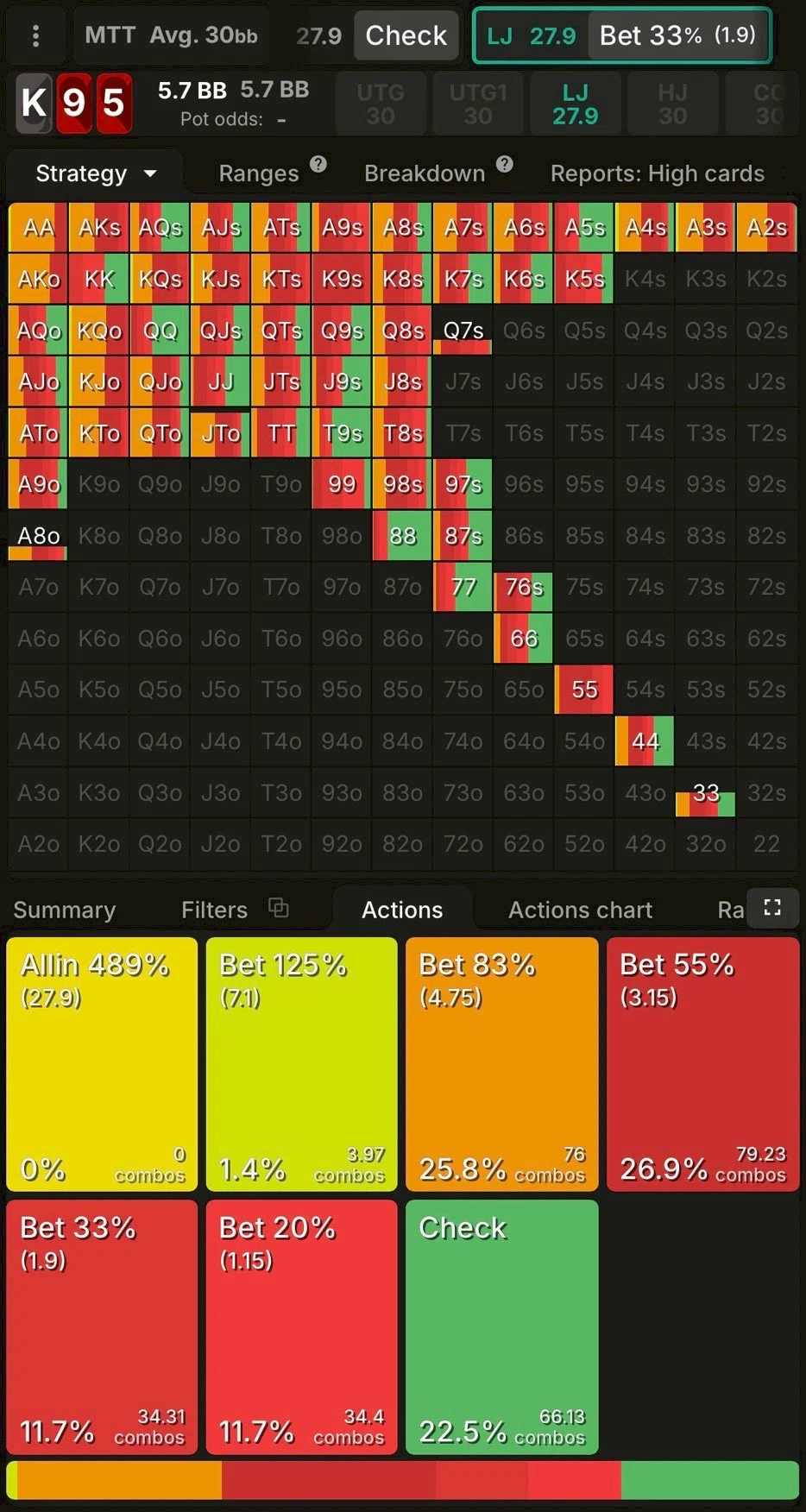
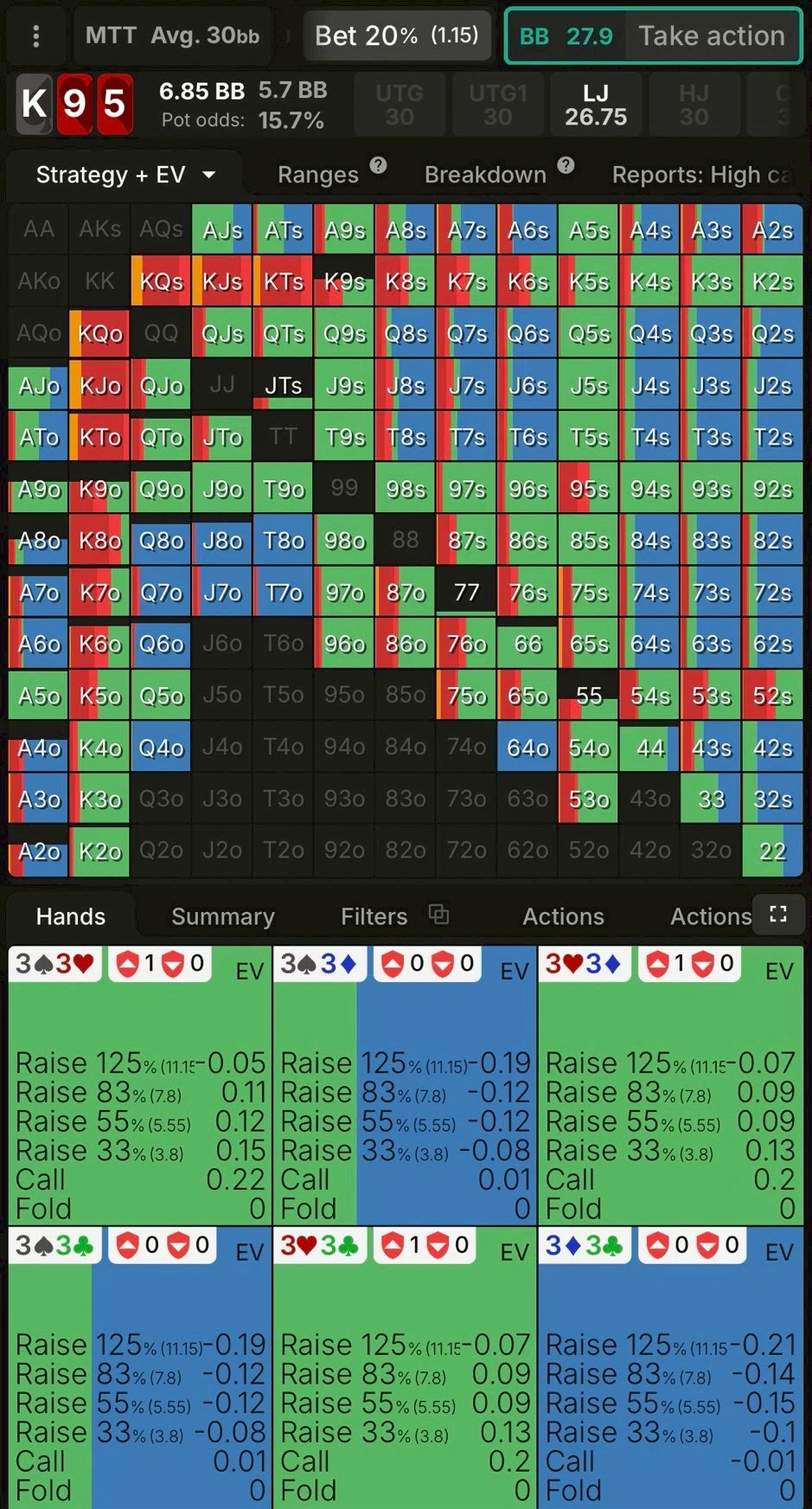
- Bets at 77% of range
- Even at a 20% bet, small pocket pairs without a backdoor flush draw prefer to fold
- Why? Because gutshots and flush draws have higher continuation priority
- This is a board where small pocket pairs become tough calls in practice
5. KK5 Rainbow
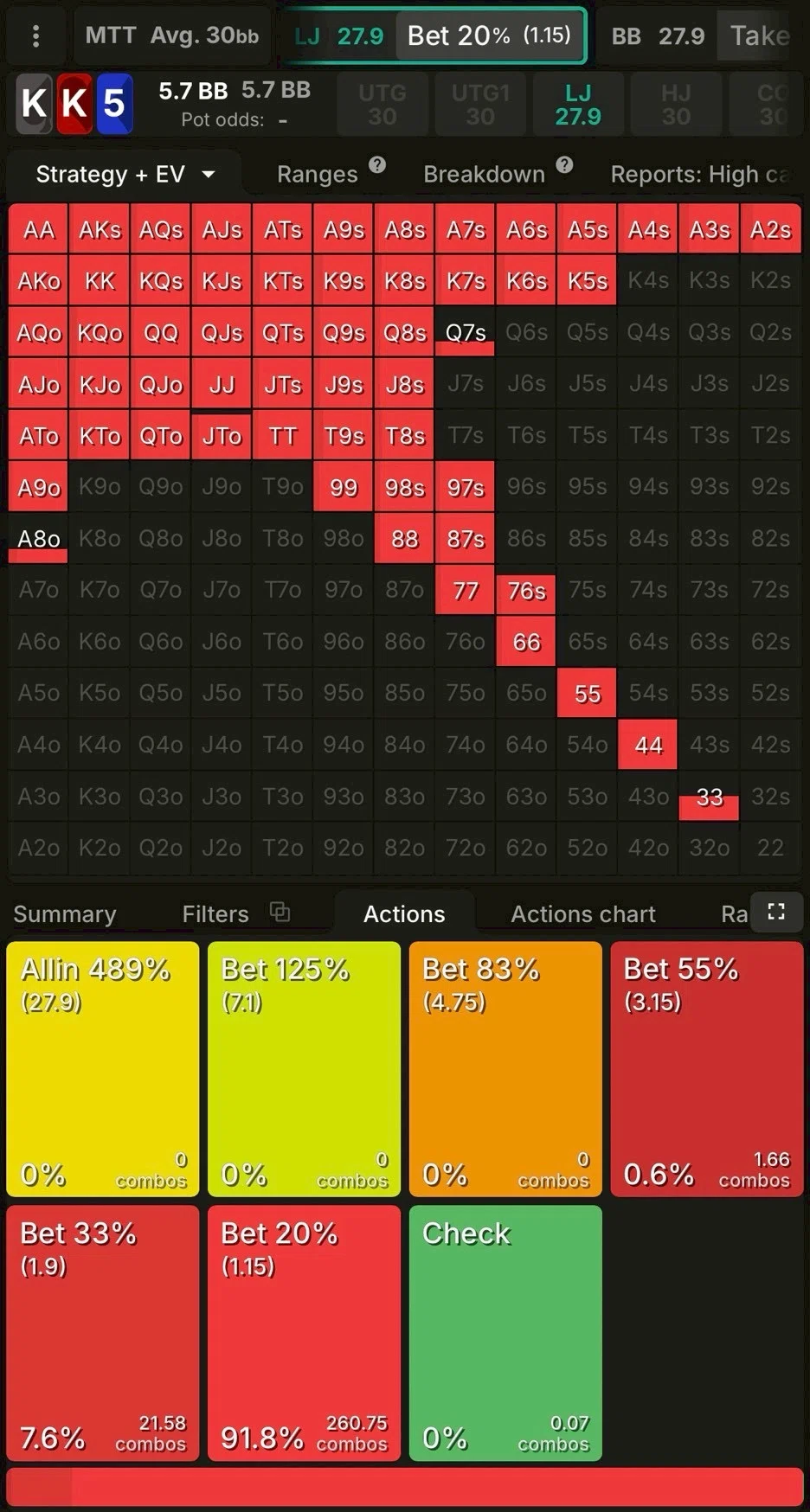
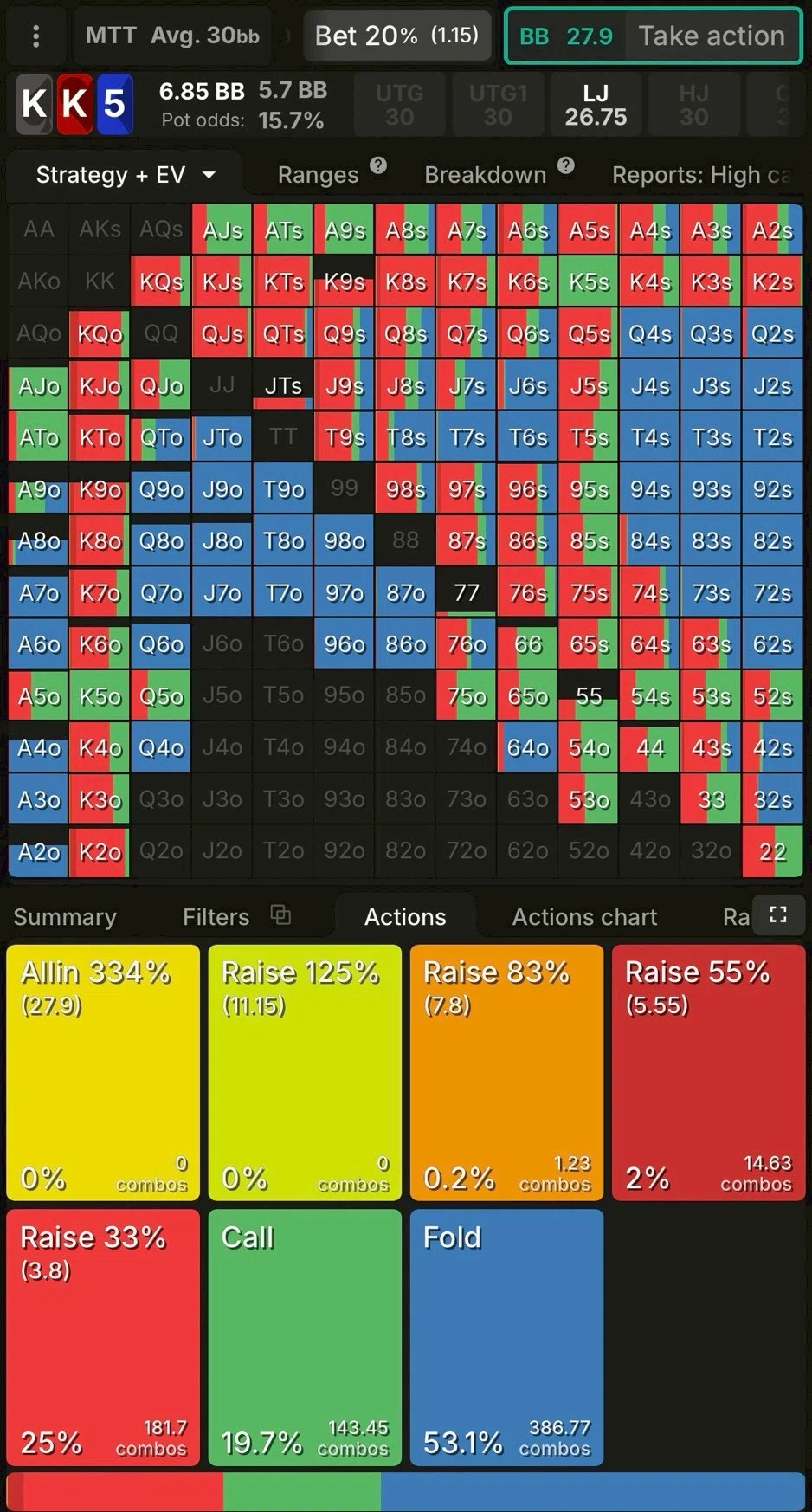
- Range bet
- Most of the time at a 20% size
- Against the 20% bet, even ace-high struggles, and BB folds 53% of its range
- BB raises with most Kx, 5x, and backdoor straight draws
6. K55 Rainbow
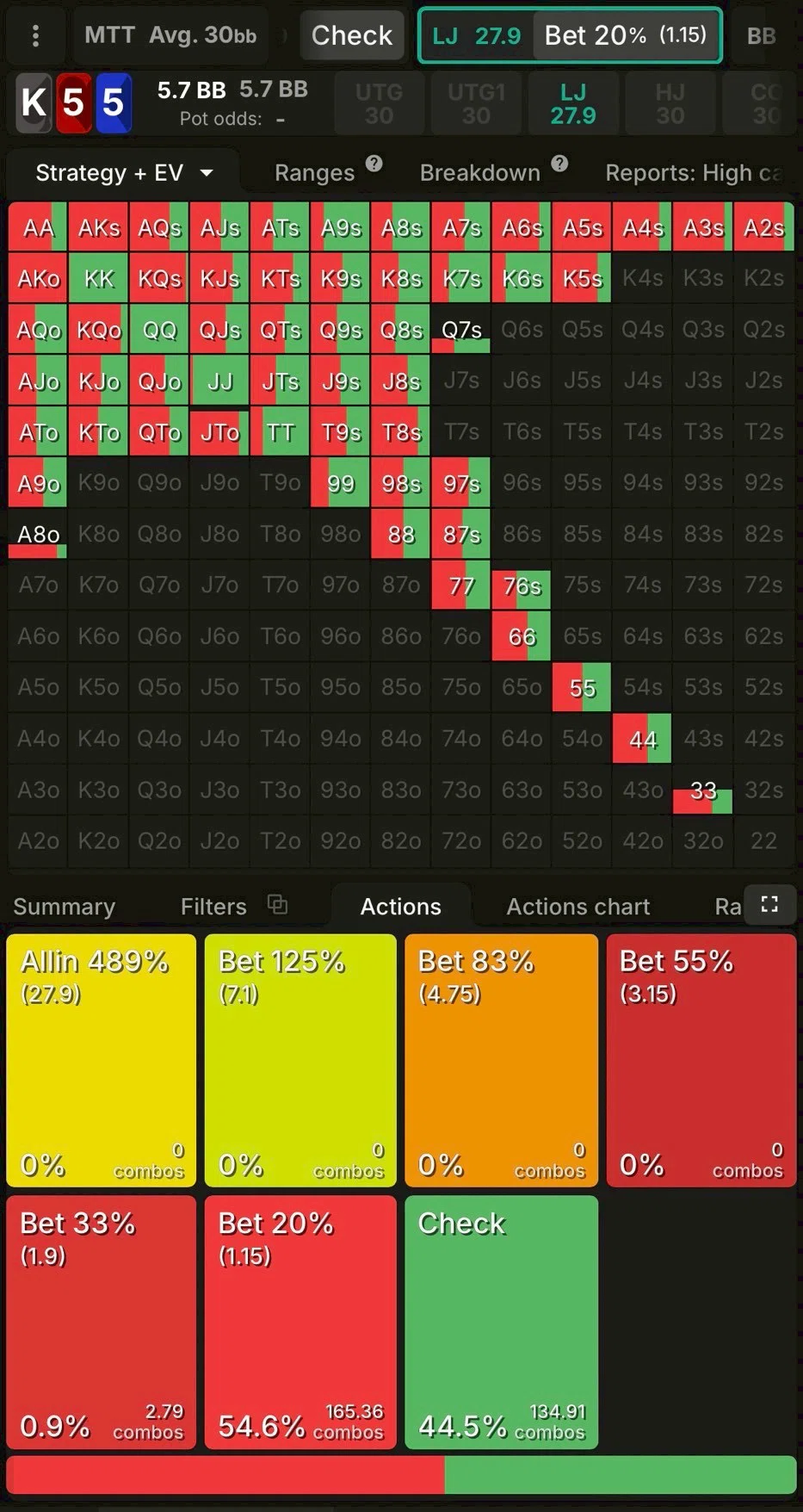
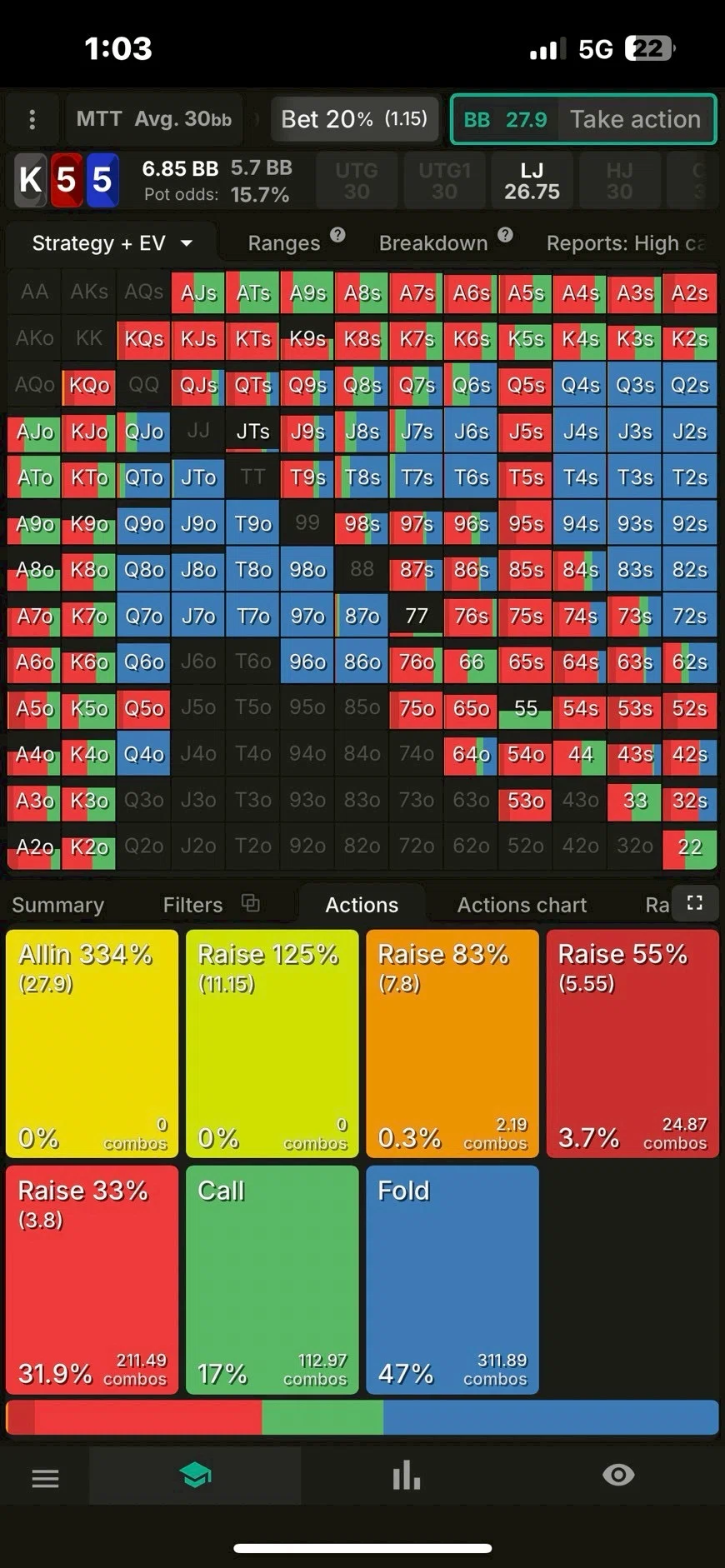
- Bets at 55% of range (not a range bet)
- QQ and JJ — marginal hands with low protection needs — check at high frequency
- Only size used: 20%
- Against the 20% bet, ace-high check-raises at high frequency
📍 Exploit point
The "raise-instead-of-call" line on paired boards is theoretically valid, but most opponents under-raise here.
→ You can c-bet looser than equilibrium without much practical risk.
7. 777 (Trips Board)
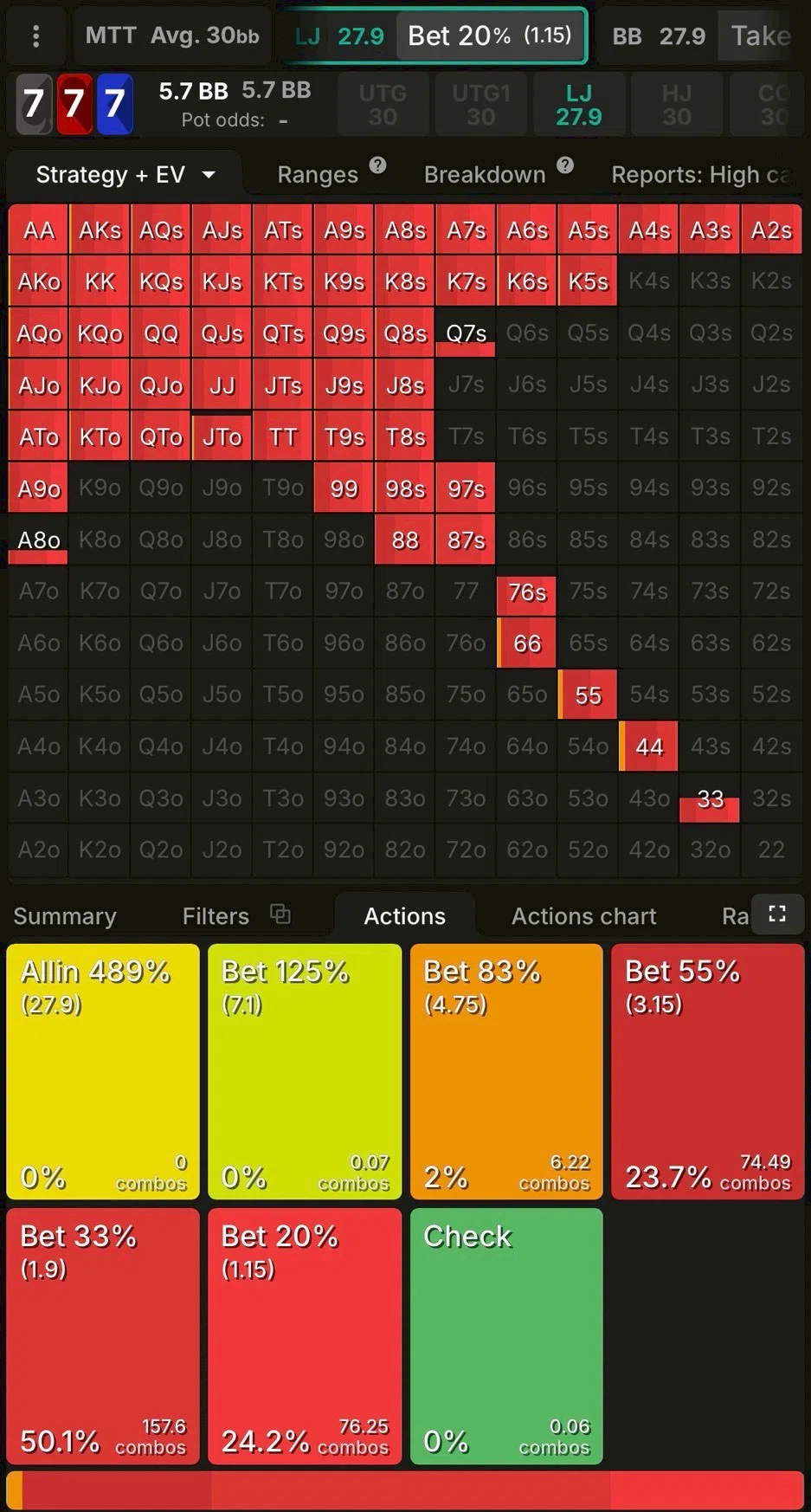
- Range bet
- Trips boards heavily favor IP (overpair / nut-hand coverage skews)
- Bet without hesitation
8. 862 Rainbow
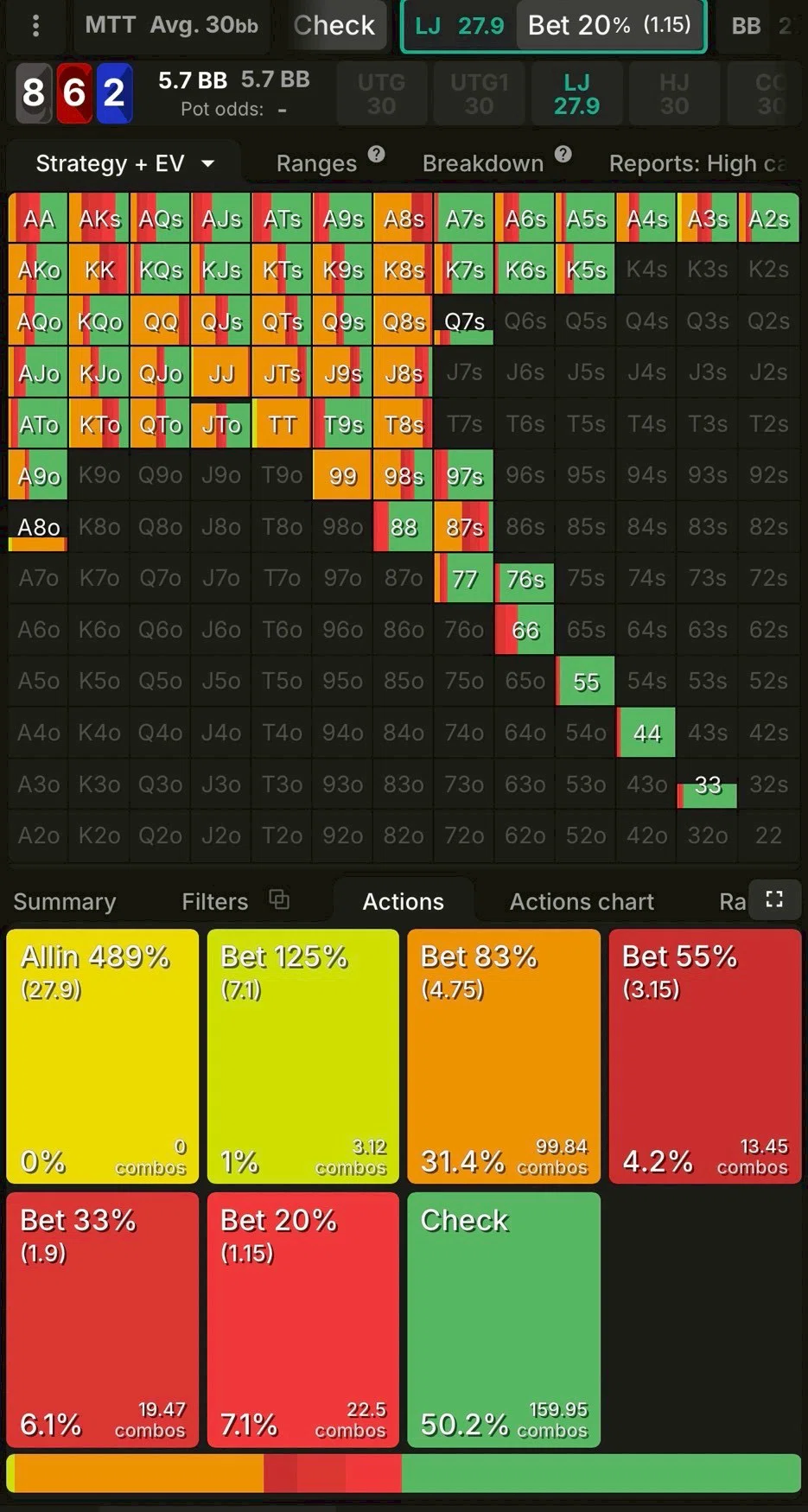
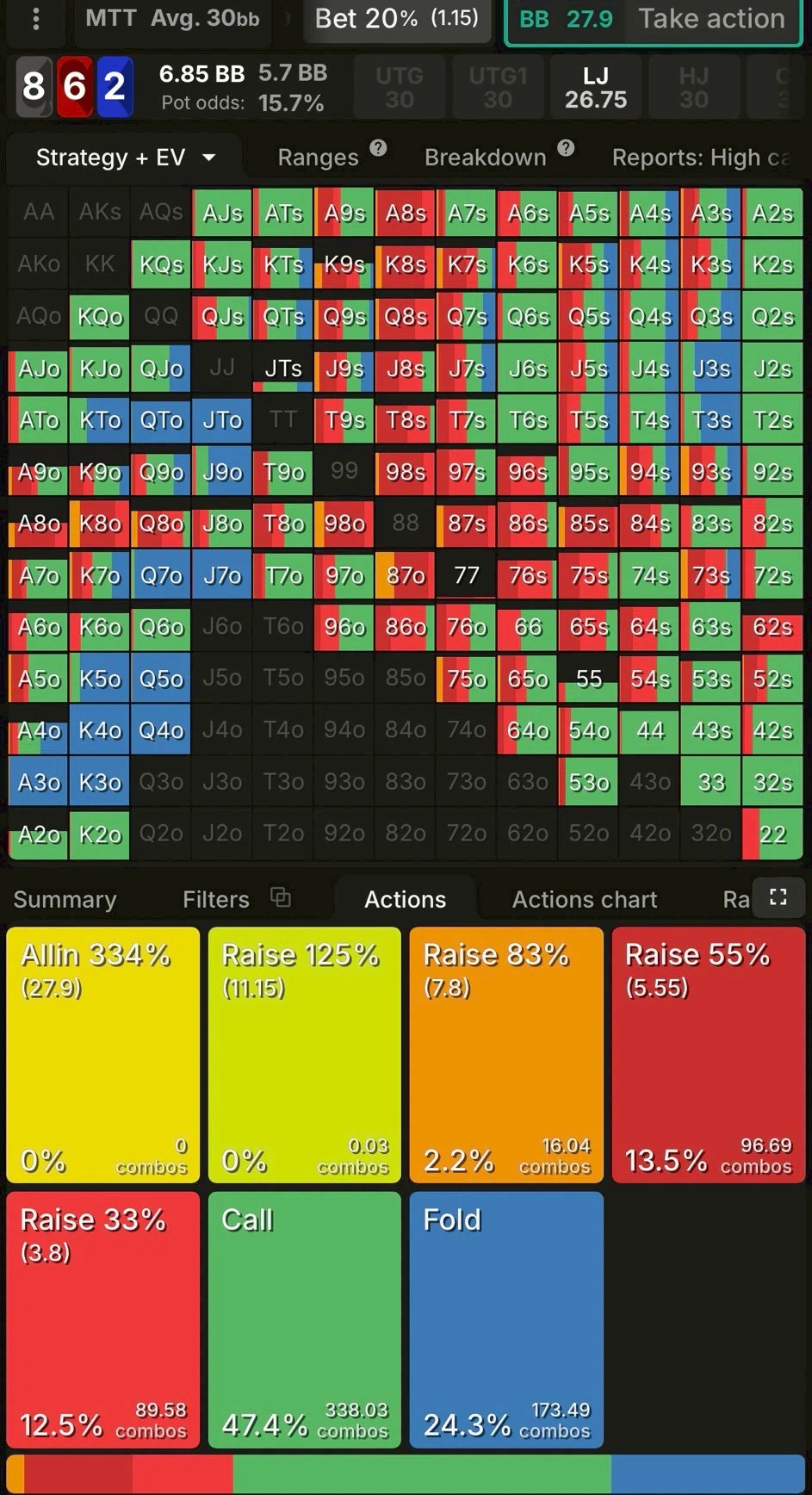
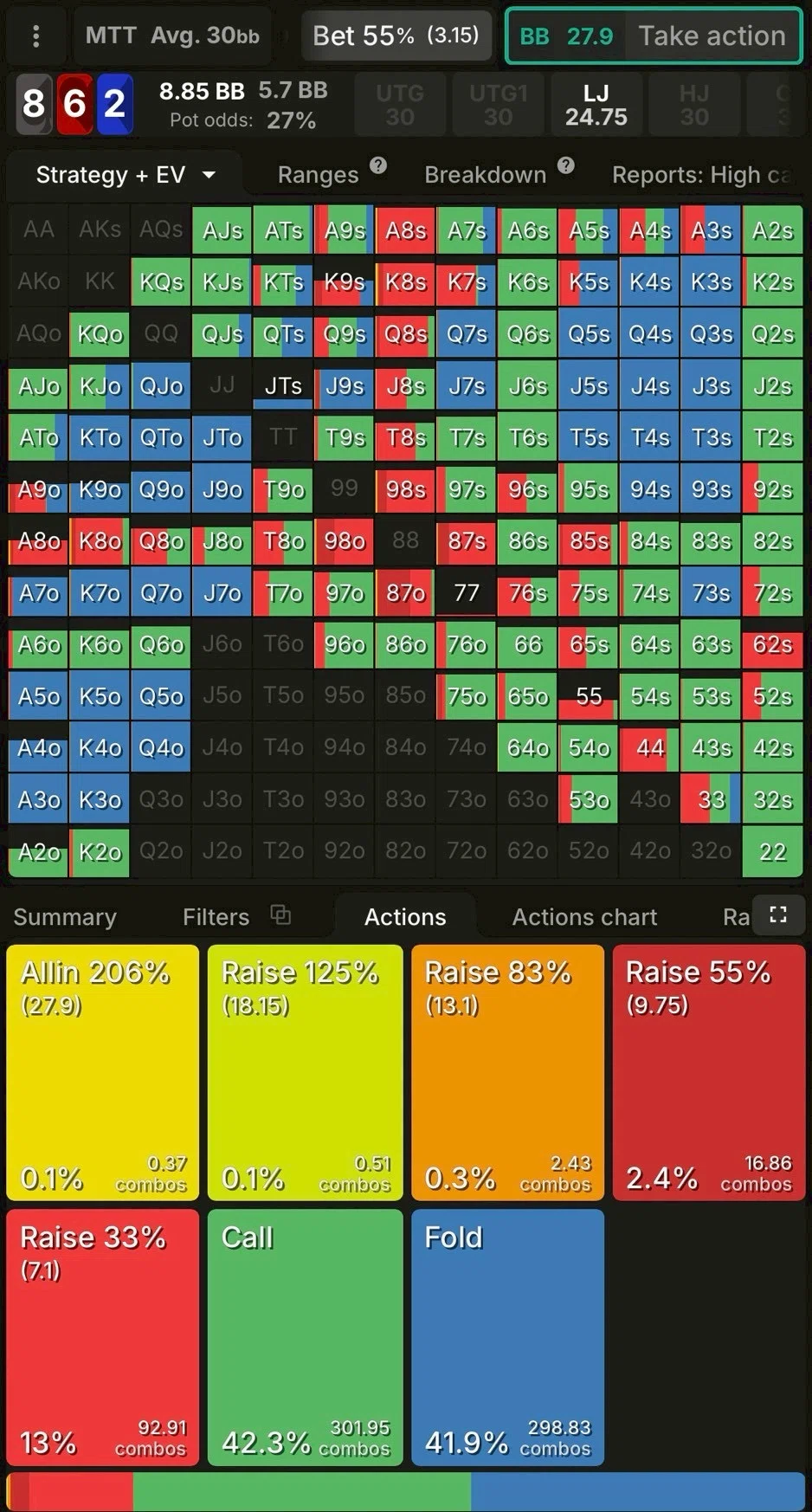
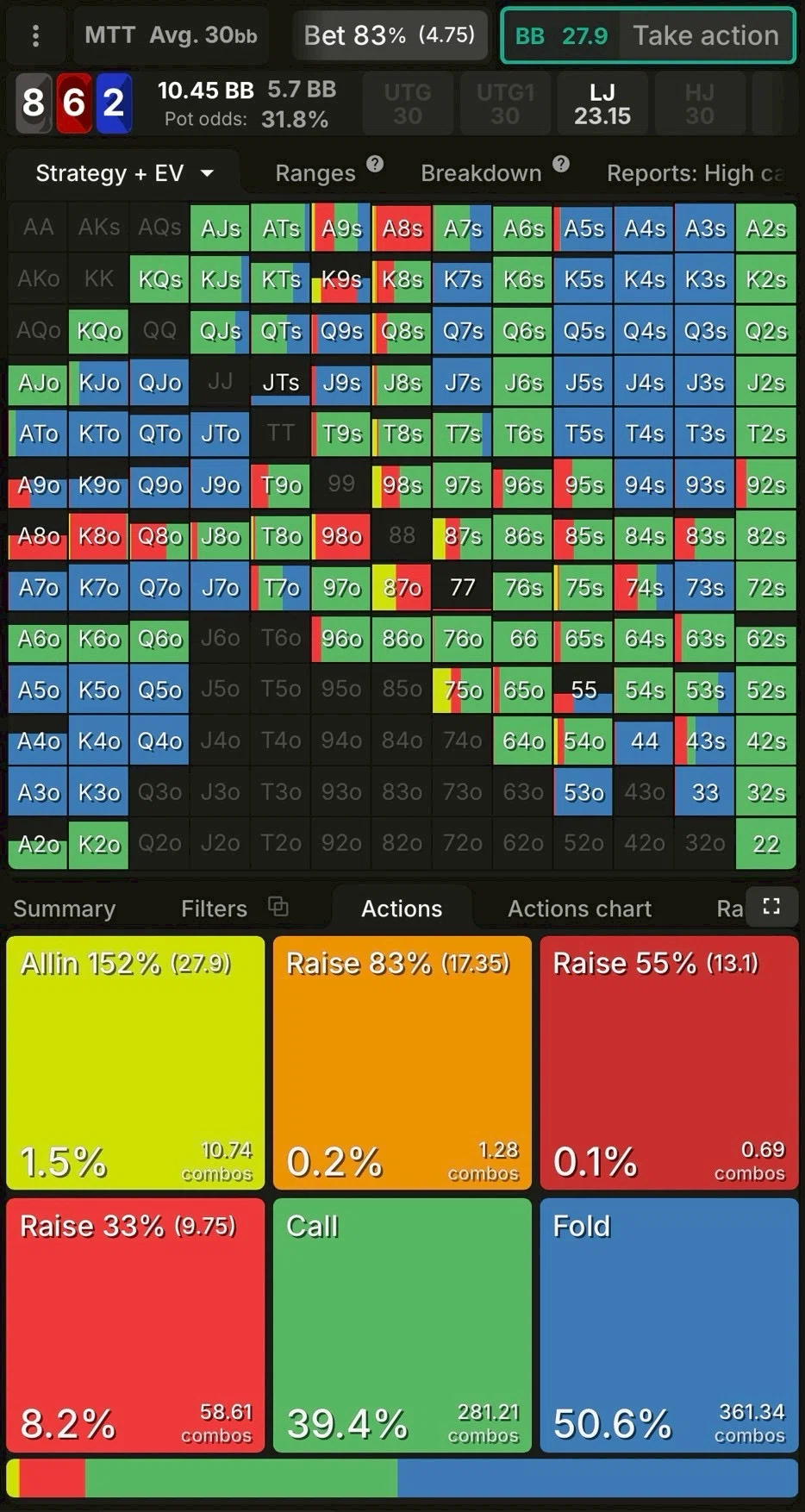
- Bets at 50% of range (low / connected boards have more checking)
- Most-used size: 83%
- 99–QQ and 8x prefer large bets for protection
- Small pocket pairs don't fold to 55%-or-smaller, but fold to 83%
- Out counts for small pocket pairs:
- vs top hit: 2 outs
- vs bottom hit: 5 outs
Summary
A two-lens framework for c-betting decisions.
Equilibrium lens (from the GTO solution)
- How much does this board favor the IP raiser?
- Can a small bet already fold out a lot of hands?
- Do you hold hands that need protection?
Exploit lens (from opponent tendencies)
- Will this be a tough call? (Especially watch how small pocket pairs respond.)
- Are check-raises sufficient? (Most opponents under-raise.)
Combine both lenses to choose your sizes and frequencies.
⚠️ Where this exploit works — and where it doesn't
The "make small pairs tough-call or over-fold" framing only pays off when you can read your opponent's tendencies. Over-using range bets against adaptive opponents leaves your check range capped and exploitable. Calibrate your frequency based on the player you're up against.

Found this helpful?
Bookmark this page to revisit anytime!
Ctrl+D (Mac: ⌘+D)
Found an error or have a question about this article? Let us know.
✉️ Contact Us
![Blind Heads-Up C-Bet Strategy on A-High Boards (Limp-Raise Line) [Ajo MTT Vol.6]](/images/thumbnails/article-mtt-blind-battle-25bb-a-high-cb-en-sm.webp)
![Blind Heads-Up C-Bet Strategy on K-High Boards (Limp-Raise Line) [Ajo MTT Vol.7]](/images/thumbnails/article-mtt-blind-battle-25bb-k-high-cb-en-sm.webp)
![Blind Heads-Up C-Bet Strategy on Paired Boards (Limp-Raise Line) [Ajo MTT Vol.8]](/images/thumbnails/article-mtt-blind-battle-25bb-pair-board-cb-en-sm.webp)
This article includes solution screens from GTO Wizard. Copyright in those figures belongs to GTO Wizard.