
Blind Heads-Up 25bb Preflop Strategy [Ajo MTT Vol.1]
A GTO Wizard walkthrough of the SB vs BB heads-up situation in the mid-to-late MTT stage with 50% of the field remaining and 25bb effective. Covering SB's four options (all-in / 3BB raise / limp / fold), BB's responses, and an ICM-aware exploit plan. Vol.1 of Ajo's MTT Strategy Series.
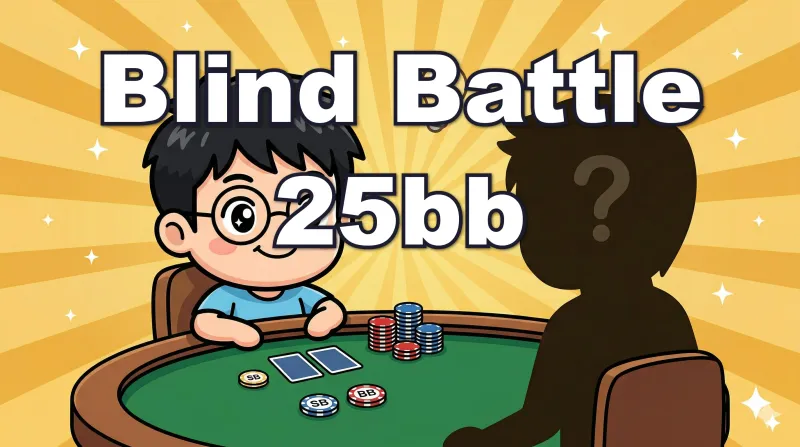
Written by: Ajo (X: @AjoPoker)
Hi, I'm Ajo. I play MTTs (Multi-Table Tournaments) and study the game with GTO Wizard.
The theme of Vol. 1 is the blind heads-up battle. Many players struggle in this spot, but if you lock it in, you'll pick up a meaningful edge over the rest of the field.
The scenario we'll use: 1,000-player tournament, 50% of the field remaining, everyone sitting on 25bb — SB vs BB.
SB's Open Range
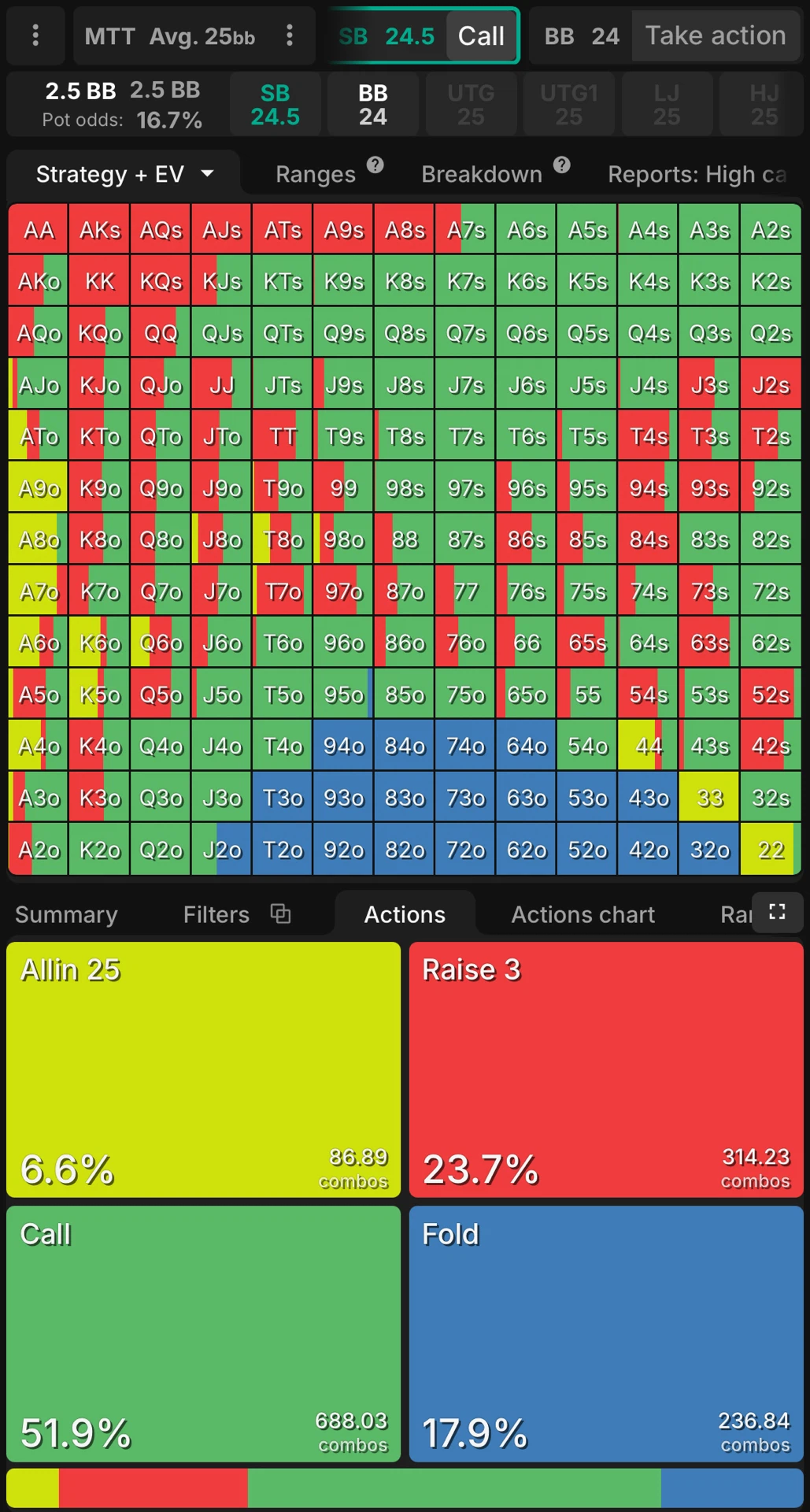
SB has four options: all-in / 3BB raise / call (limp) / fold.
1. Hands that go all-in
Small pocket pairs like 22–44, plus some Axo and Kxo hands.
Preflop all-ins are used with hands that are "somewhat strong but awkward postflop" — taking them straight to showdown. SB is out of position (OOP) postflop and that's a structural disadvantage, but going all-in preflop cancels the position issue entirely.
2. Hands that raise to 3BB
Premium hands like AA/KK and A8s+, plus a variety of other hands mixed in for balance. Suited connectors like 89s and 78s are generally NOT used here — if a 3-bet all-in comes back, they play poorly stacked off preflop.
3. Hands that limp (call)
Marginal hands like Q2o, J3o, 45o that are barely playable, along with low suited aces (A2s–A6s) for board coverage.
4. Hands that fold
Weak junk like T3o and 94o is folded.
BB's Response to SB's All-In
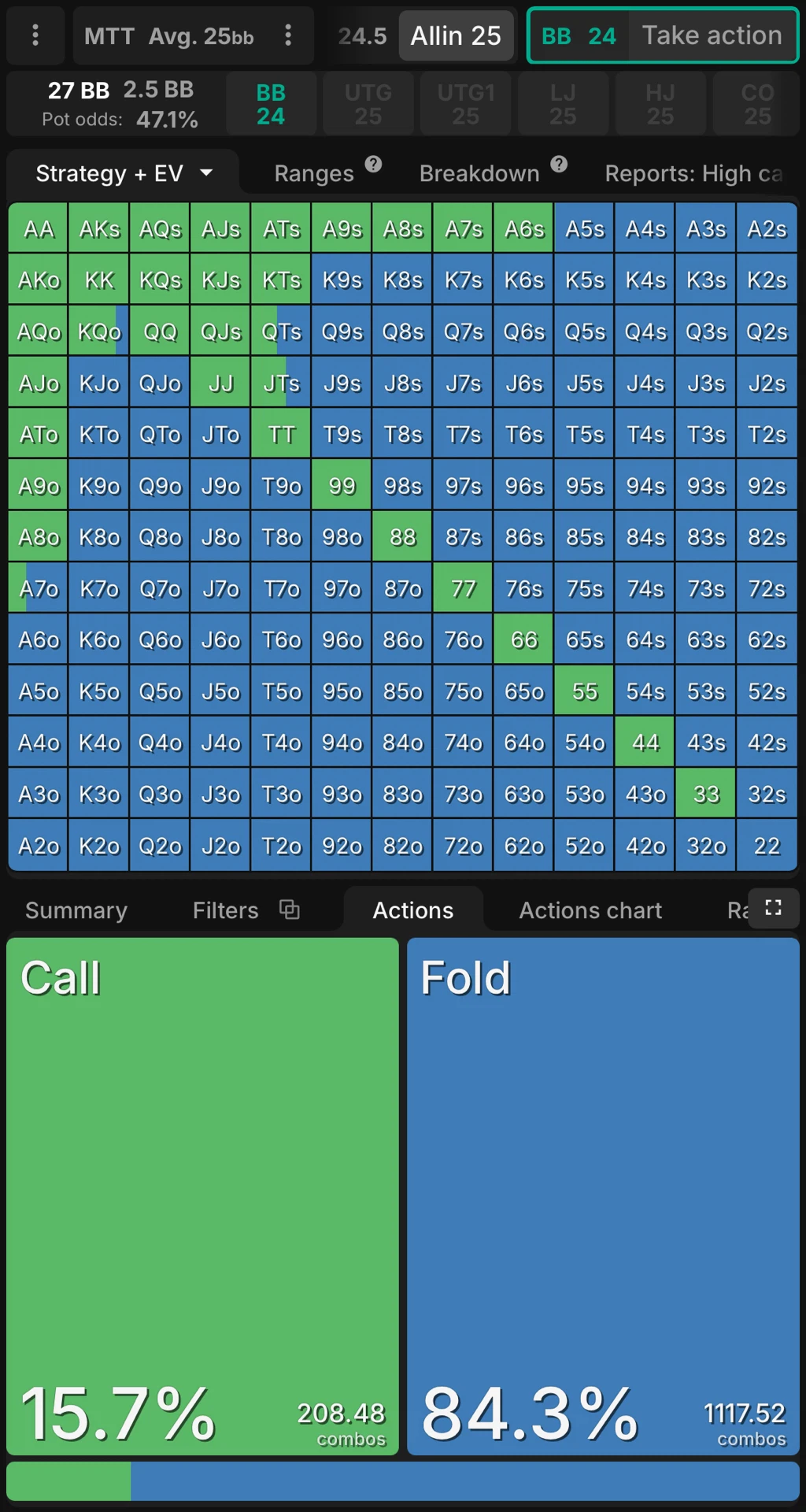
BB calls with 15.7% of its range.
At 50% of the field with everyone on 25bb, ICM is in play, which means you need an extra 3.9% equity compared to the ChipEV baseline to make a correct call. Losing chips is weighted more heavily because of pay jumps ahead.
BB's Response to SB's 3BB Raise
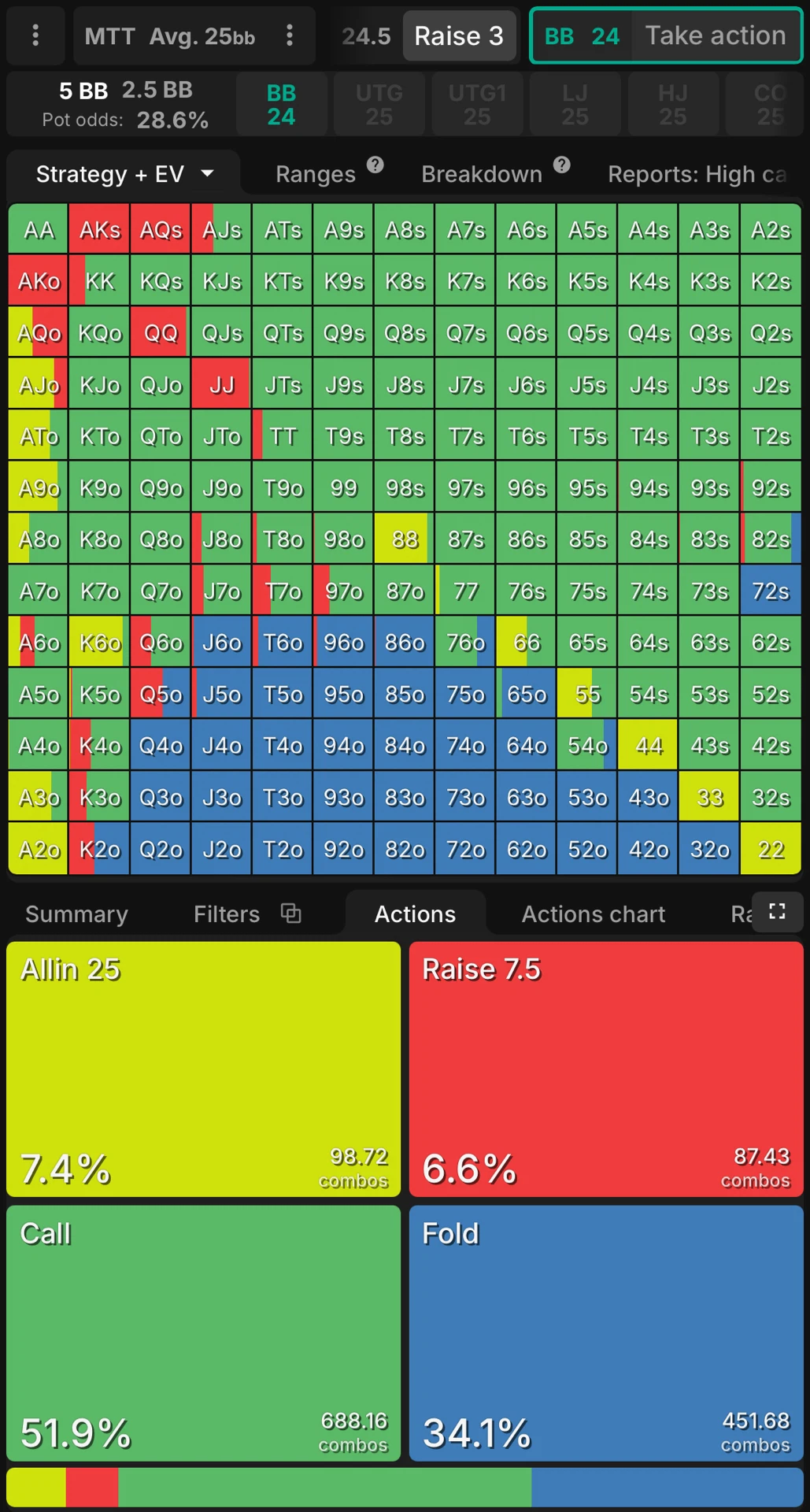
BB has four options: all-in / 7.5BB raise / call / fold.
1. Hands that go all-in
Mostly 22–88 pocket pairs and Axo hands.
One caveat: if SB is not mixing in weak junk like 24s or Q6o into the raising range, BB's all-in runs straight into a tight, strong range. In practice, watch your opponent's open range before shipping it in.
2. Hands that 4-bet to 7.5BB
Premiums like AK, QQ, JJ, alongside some "one big card offsuit" hands like A6o and K4o.
3. Hands that call
Because BB has position postflop, it calls a wide variety of marginal hands. AA and KK are also mixed into the call range to keep the calling range uncapped.
4. Hands that fold
Since SB is raising to 3BB, BB folds at a fairly high rate — 34.1% of its range.
⚠️ In practice, some players use smaller raise sizes like 2BB or 2.5BB. BB's response range shifts significantly with SB's raise size, so always check the size before applying a fixed strategy.
BB's Response to SB's Limp
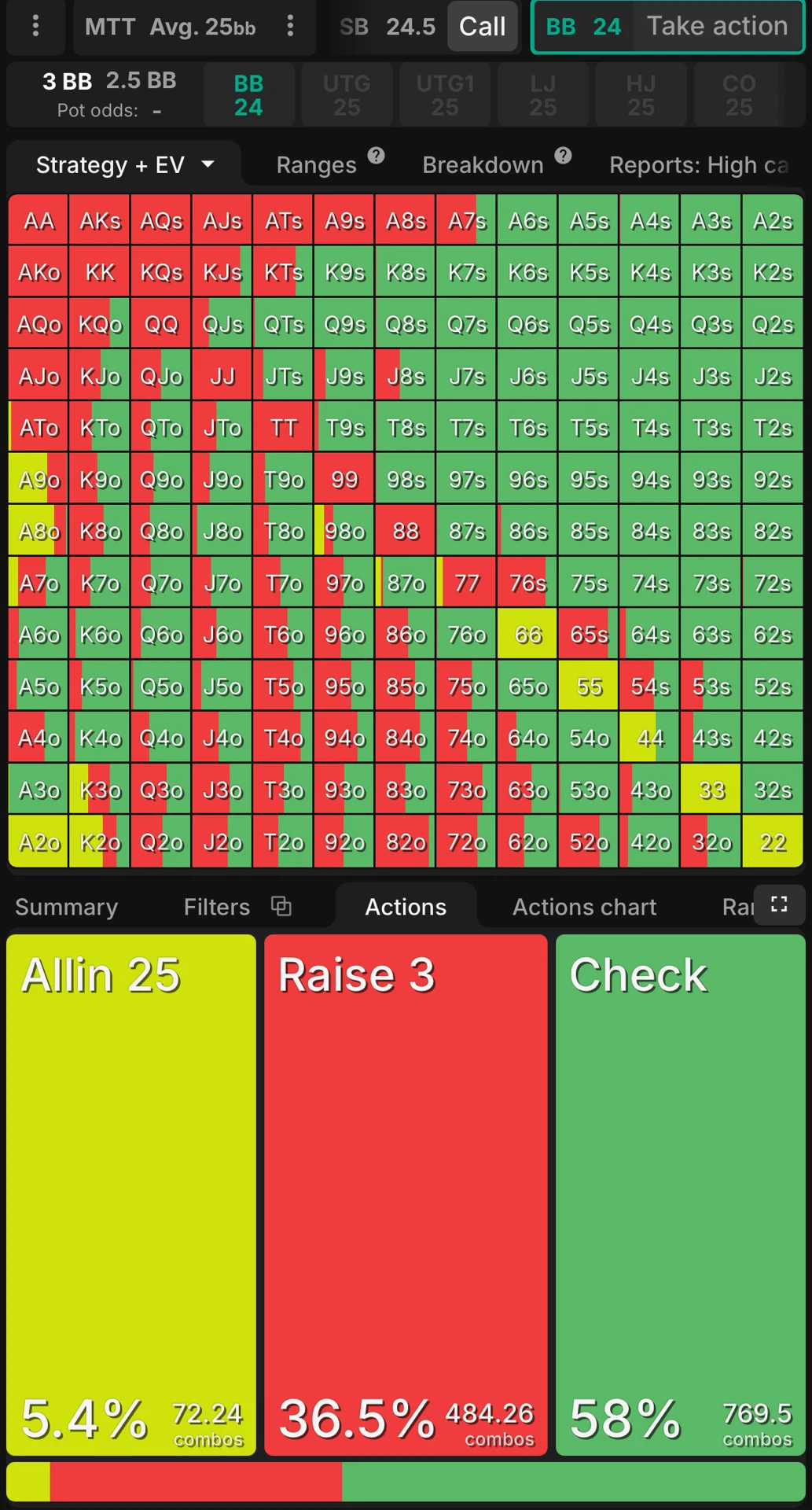
BB has three options: all-in / 3BB raise / check.
1. Hands that go all-in
22–66, Axo, Kxo, etc. — the same "somewhat strong but awkward postflop" pattern as before.
2. Hands that raise to 3BB
BB raises with 36.5% of its range.
The raising range is polarized: premium hands like 77+ and A8s+ alongside offsuit trash like 26o and 96o. Suited hands are mostly absent here because if SB 3-bet shoves, those hands play poorly.
3. Hands that check
Check frequency is 58%. Pure checks are mostly suited hands.
Exploit Strategy in the Blind Battle
Up to this point we've been looking at GTO Wizard solutions, but real opponents almost never play GTO. Here's how to adjust against common leaks.
From the previous section, BB should attack SB's limp with an all-in + 3BB raise for a combined ~42% frequency.
Now think about the players you actually face:
- Are they going all-in with small pocket pairs?
- Are they raising trash like 26o and 92o?
Most players don't come close to that raise frequency — the "under-raise leak" is extremely common.
📍 The exploit conclusion
Against opponents who under-raise, heavily polarize SB's open range:
- Strong hands → 3BB Open (BB doesn't raise often, so you realize value directly)
- Weak hands → call (limp) (BB just checks, so you see a flop cheaply)
The GTO idea of "mixing some strong hands into the limp to stay balanced" isn't necessary as long as the opponent under-raises.
⚠️ Who this exploit works on — and who it backfires against
This adjustment only works against players with a concrete under-raise leak in BB. Against adaptive opponents, "SB limp = weak range" gets read quickly and you'll get aggressively attacked for having a capped range. Watch your opponents and switch between this exploit and a balanced GTO construction depending on who you're up against.
Summary
The blind heads-up battle is tough because both ranges are wide, but that's exactly why aggressively raising to deny equity matters here.
Key takeaways:
- Understand SB's four options (all-in / 3BB raise / limp / fold)
- BB needs 3.9% extra equity to call due to ICM
- BB's response shifts with SB's raise size — always check the size
- Polarize SB's range to exploit players with an under-raise leak
Future installments will continue to use GTO Wizard solutions to dig into specific MTT spots.
Found this helpful?
Bookmark this page to revisit anytime!
Ctrl+D (Mac: ⌘+D)
Found an error or have a question about this article? Let us know.
✉️ Contact Us
![FT 20bb BB Defense Ranges | vs Open by Position [Ajo MTT Vol.5]](/images/thumbnails/article-mtt-ft-20bb-bb-defense-ranges-en-sm.webp)
![FT 20bb Open Ranges | Position-by-Position ICM Guide [Ajo MTT Vol.4]](/images/thumbnails/article-mtt-ft-20bb-open-ranges-en-sm.webp)
![LJ vs BB SRP C-Bet Strategy | 30bb Board-by-Board Hit Chart [Ajo MTT Vol.3]](/images/thumbnails/article-mtt-cb-lj-vs-bb-srp-30bb-en-sm.webp)