
FT 20bb Open Ranges | Position-by-Position ICM Guide [Ajo MTT Vol.4]
A GTO Wizard ICM walkthrough of open ranges at the 9-handed final table of a 1,000-runner MTT, with everyone sitting on 20bb and a 10x prize gradient between 9th and 1st. Covers UTG, LJ, HJ, CO, BTN, and SB strategies and how ICM reshapes hand values. Vol.4 of Ajo's MTT Strategy Series.
Written by: Ajo (X: @AjoPoker)
The theme of Vol. 4 is open ranges at the final table (FT).
The setup we'll work with: a 1,000-player MTT, 9-handed final table, everyone on 20bb, with a 10x prize gradient between 9th and 1st. This is one of the spots where ICM pressure is at its most extreme.
You don't reach the FT often, so when you do, you want to be calm and prepared — that's what this article is for.
📌 Setup
- Spot: 1,000-player MTT FT, 9 players, everyone at 20bb
- Prize gradient: 9th to 1st = 10x
- Solution: GTO Wizard ICM
- Positions covered: UTG / UTG+1 / UTG+2 / LJ / HJ / CO / BTN / SB (8 positions)
Prize Structure
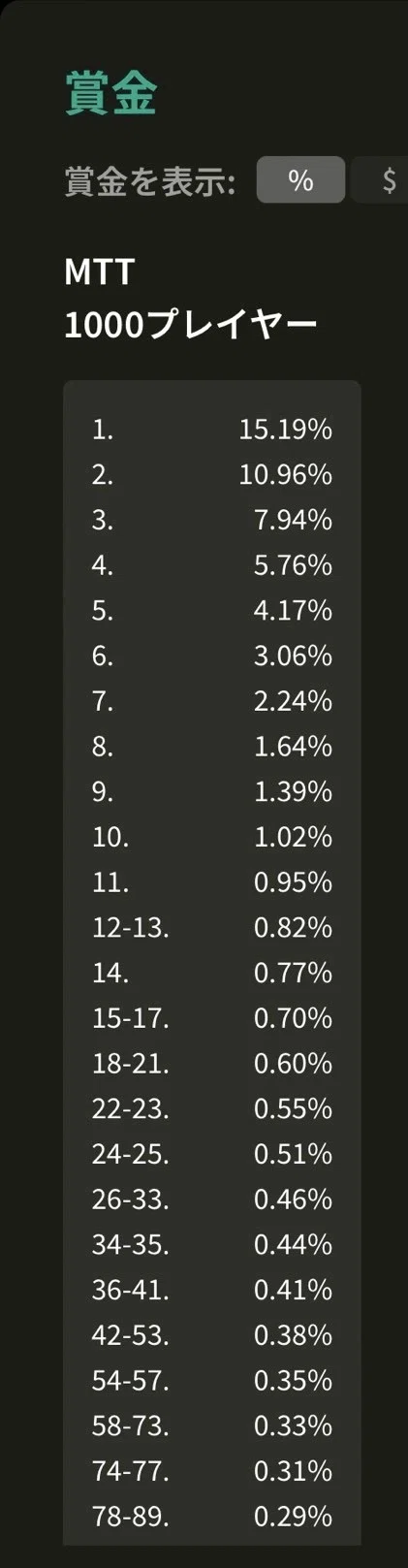
The payout climbs steeply from 9th to 1st, which means losing chips is weighted heavily when chasing top-3 finishes. That weighting is exactly what ICM pressure represents.
1. UTG / UTG+1 / UTG+2 Open Ranges
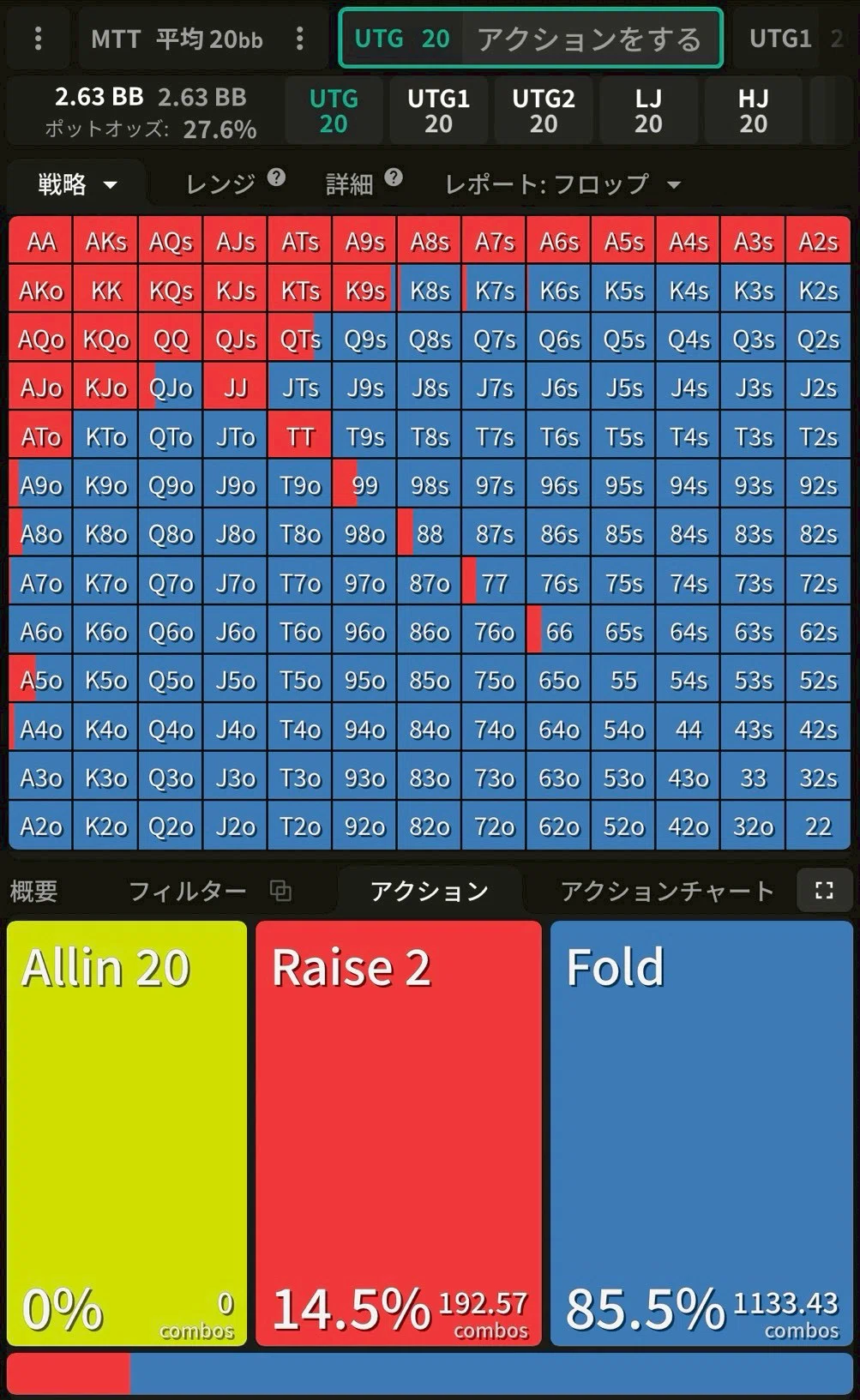
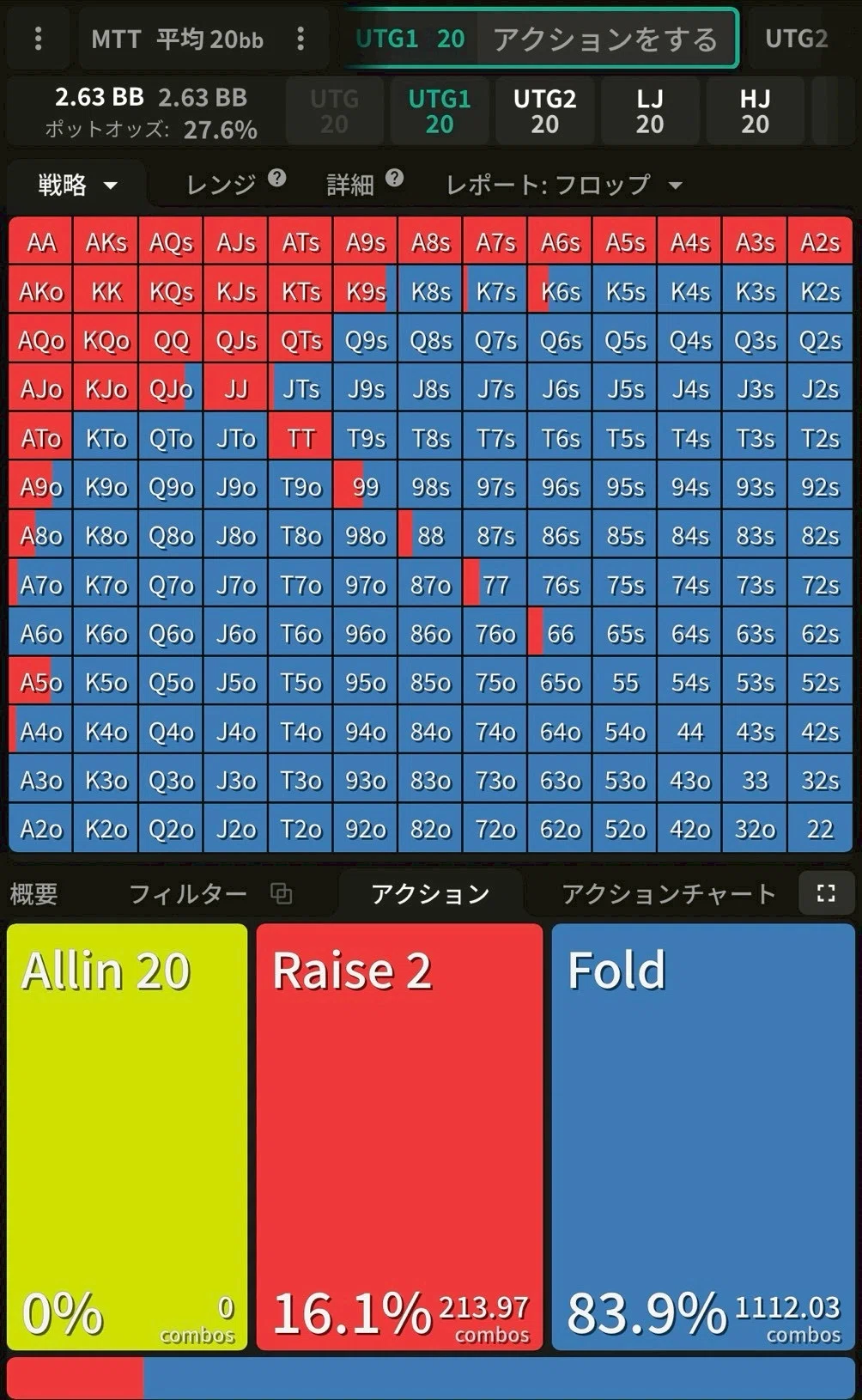
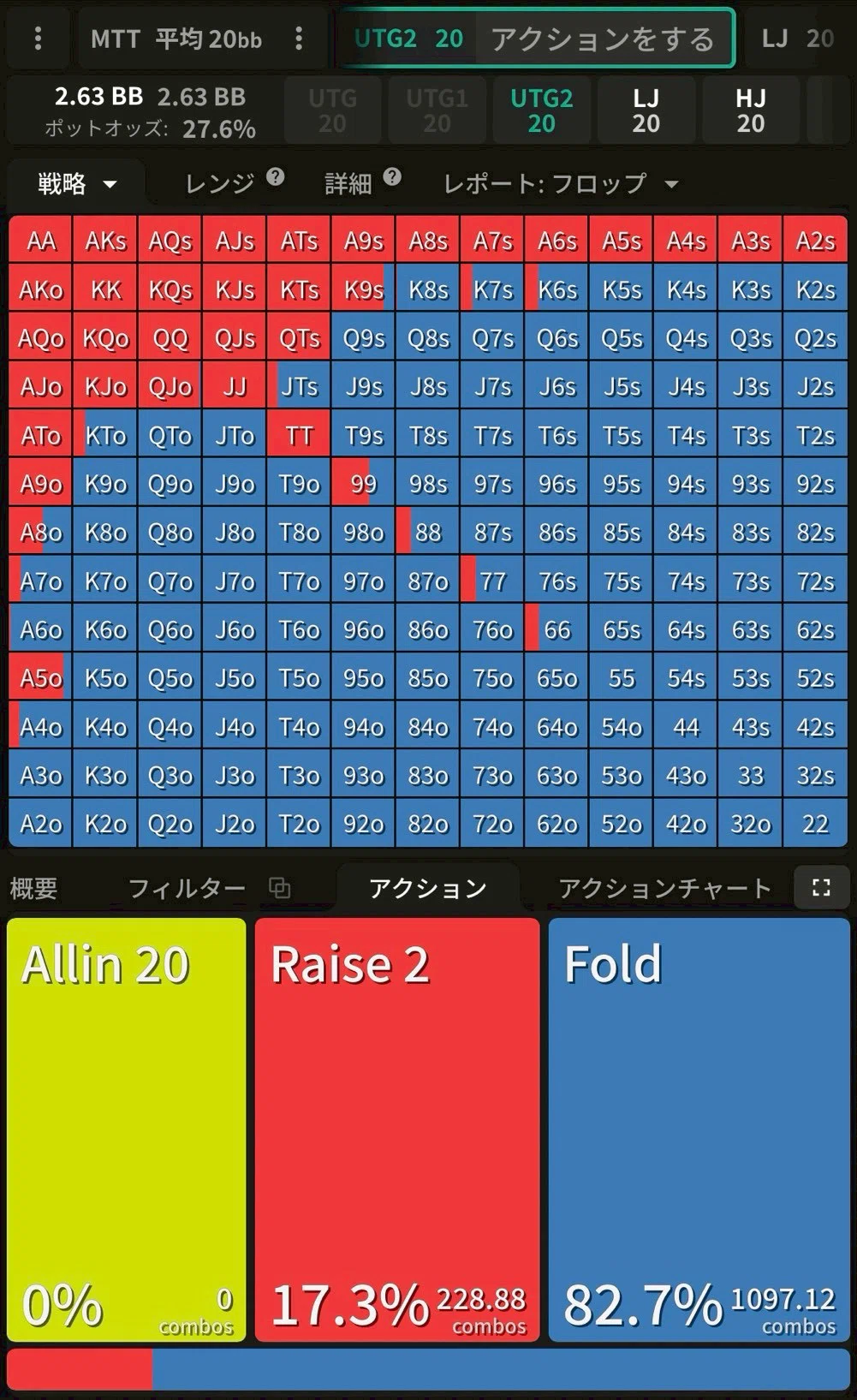
UTG opens about 14.5% of its range.
Hands that get opened
- Axs is opened pure
- A4o, A5o, A7o–A9o show up at low frequency
- 66–99 pocket pairs are also opened at some frequency
Hands that are dropped
- Strong suited connectors like JTs and T9s are pure folds
- Postflop playability and board coverage are not weighted highly
📍 How ICM reshapes hand values
- Ace blockers are highly valued (they physically remove chunks of the opponent's strong range)
- Pocket pairs lose value (ICM's all-in equity calculation is harsh on hands that mostly just want to flop a set)
- Suited connectors also lose value because realizing equity through risky postflop chips is less attractive
2. LJ / HJ Open Ranges
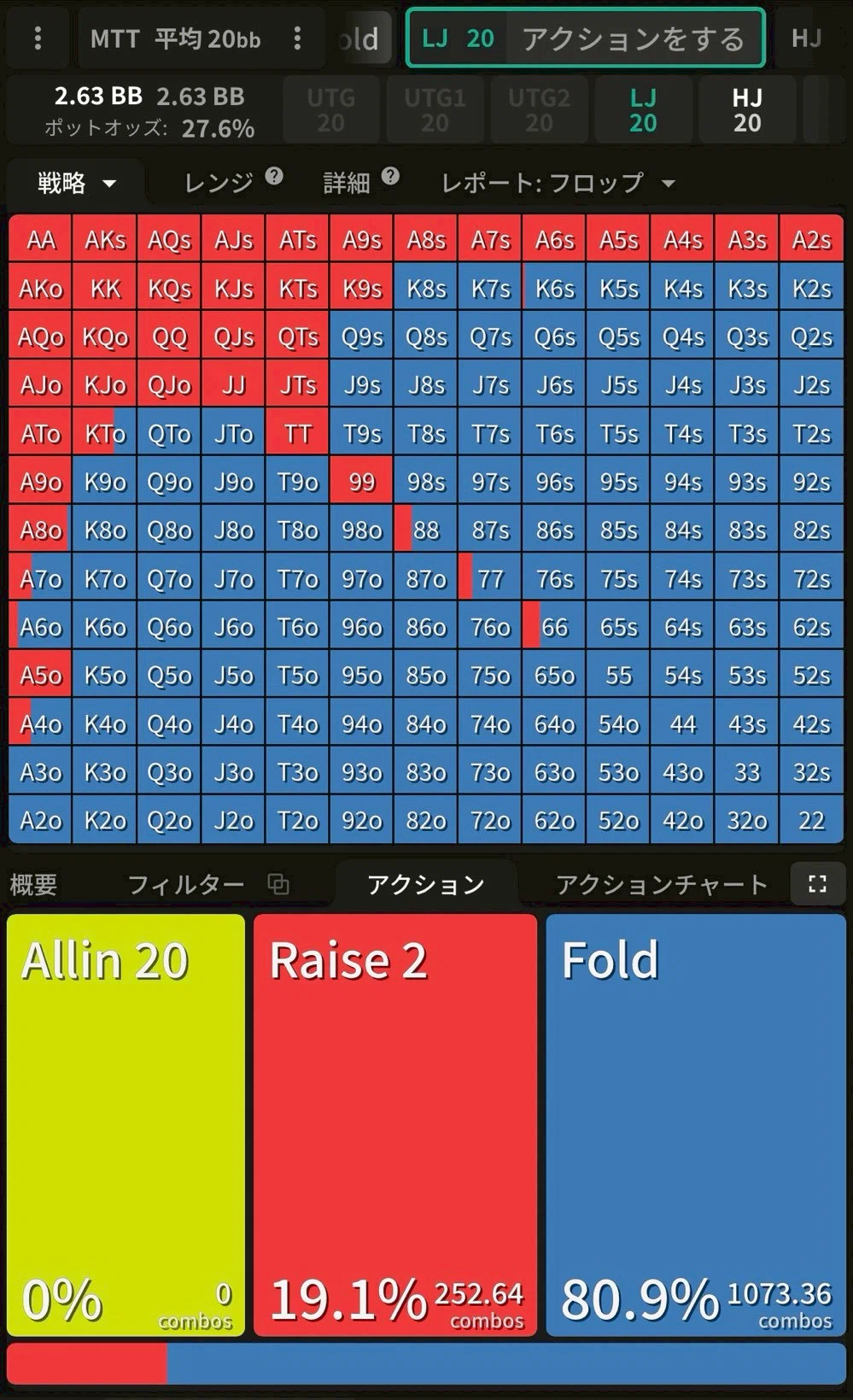
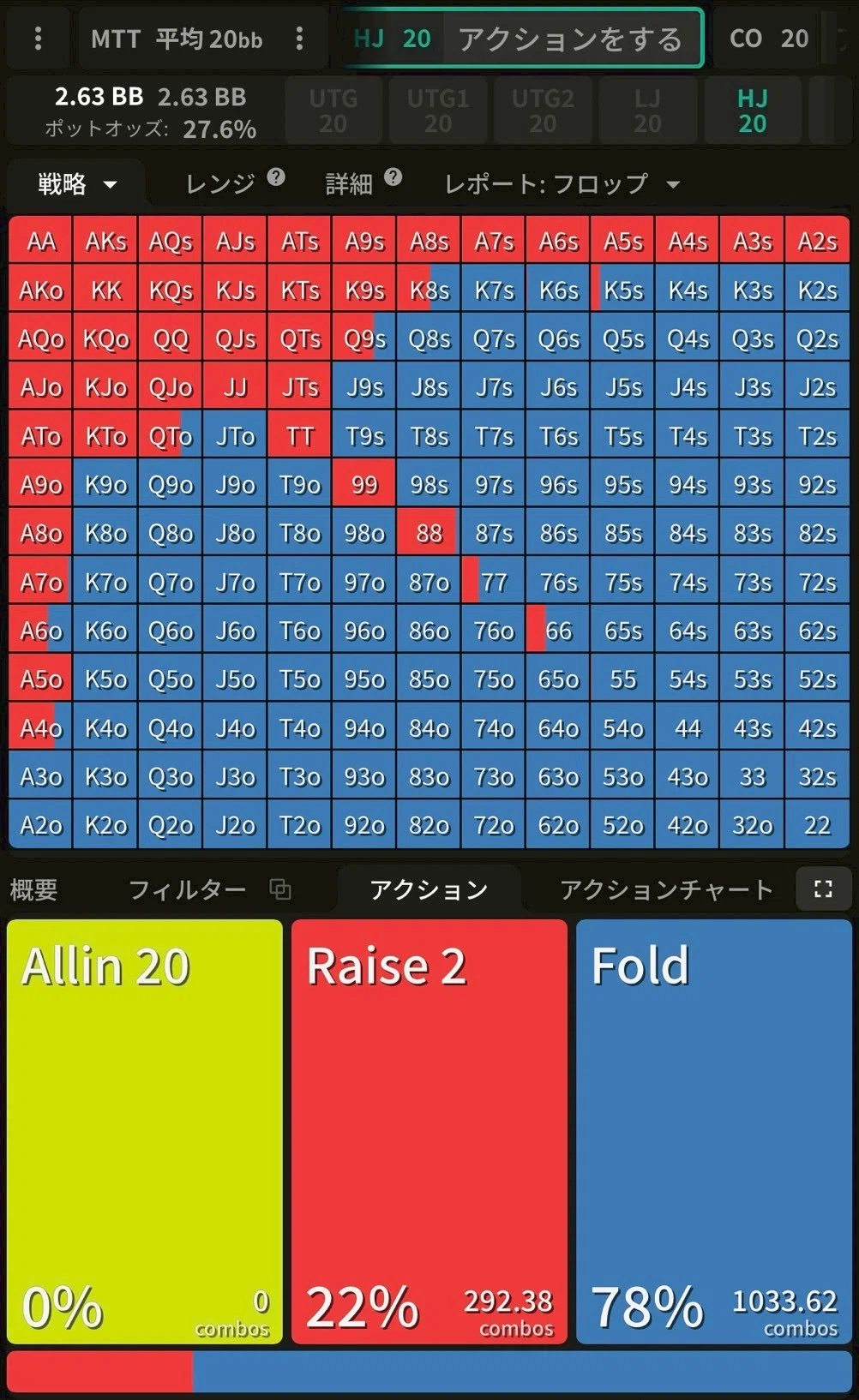
LJ and HJ widen the open frequency gradually.
Key changes
- Axo open frequency increases
- A5o, A8o, A9o become near-pure opens
- 99 is upgraded to a pure open
- 66–88 stays mixed (still opened at frequency, not pure)
The "ace-blocker priority" theme from UTG continues here — suited connectors are still subdued, while Ax expands first.
3. CO Open Range
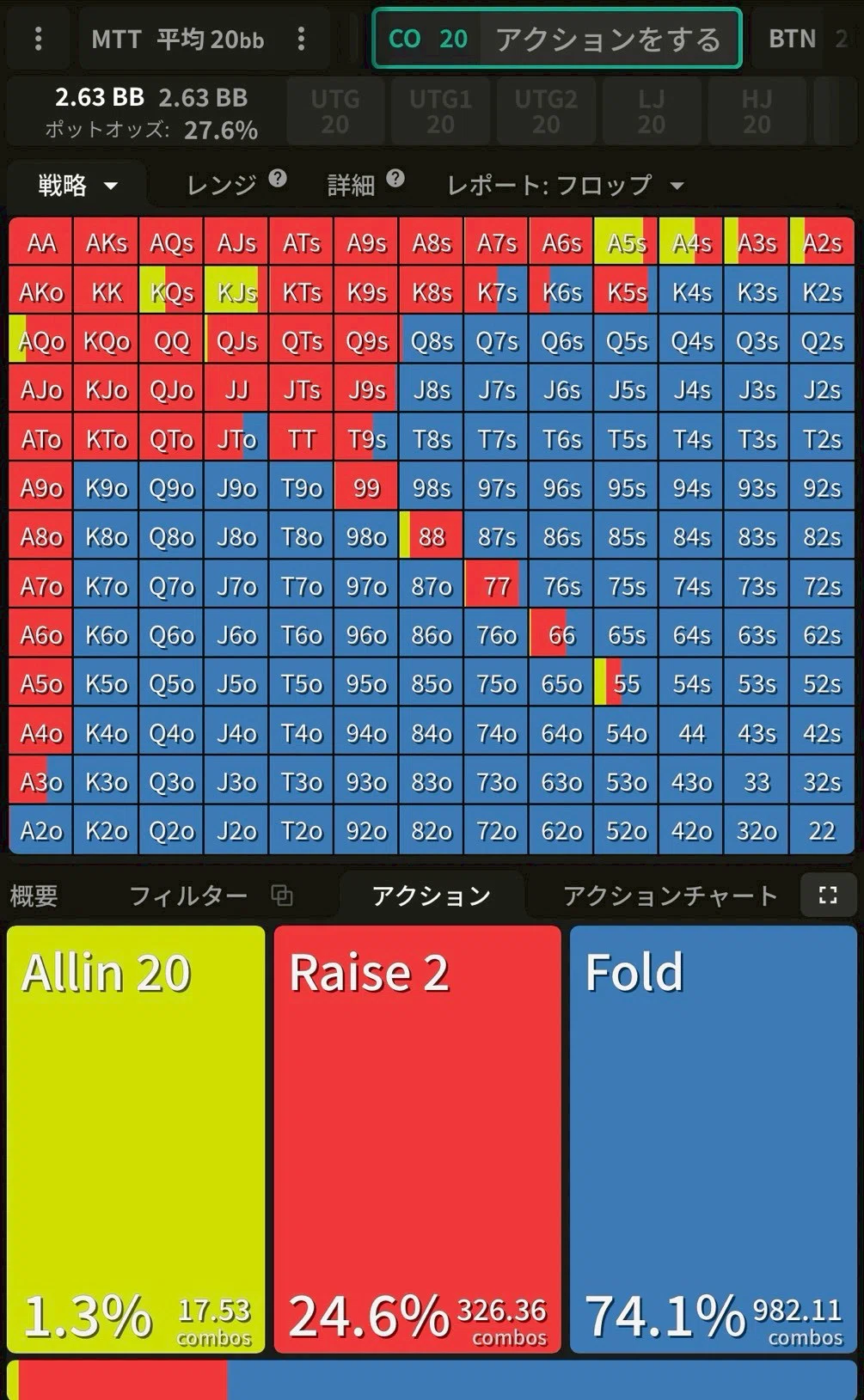
The 20bb open-jam range first appears at CO.
Hands that go all-in
- Mid-frequency: A2s–A5s, KJs, KQs, AQo
- Low-frequency: 55–88
Hands that open with a smaller raise
- A4o+ is pure open
- A3o is mixed (ID — indifferent)
- 22–44 small pocket pairs are pure folds
The 22–44 fold note is significant. Under ICM, "set-mining small pairs" become a bad investment because the implied-odds payoff is reduced when chips are valued non-linearly.
4. BTN Open Range
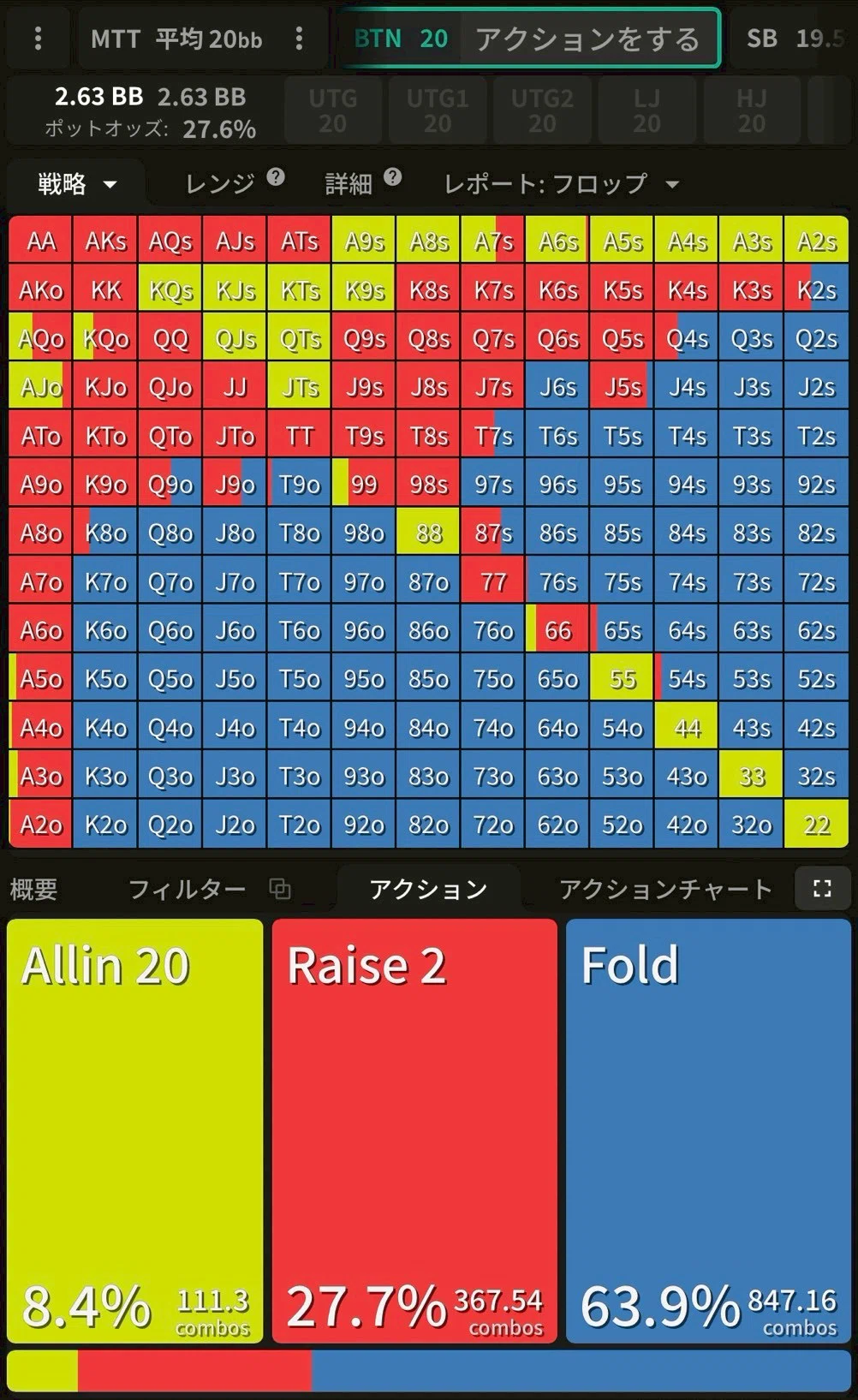
BTN goes all-in with 8.4% of its range.
Hands that all-in (mostly middle-strength)
- 22–55 small pairs → pure all-in
- A2s–A9s, K9s–KQs, JTs, QTs, QJs, 88
- AJo, AQo
- Low frequency: A2o–A5o
A small-raise opening range exists separately, but BTN's signature is shoving its middle-strength hands. Going first forces opponents to need premiums to call, which is exactly the ICM dynamic that favors the aggressor.
5. SB Open Range
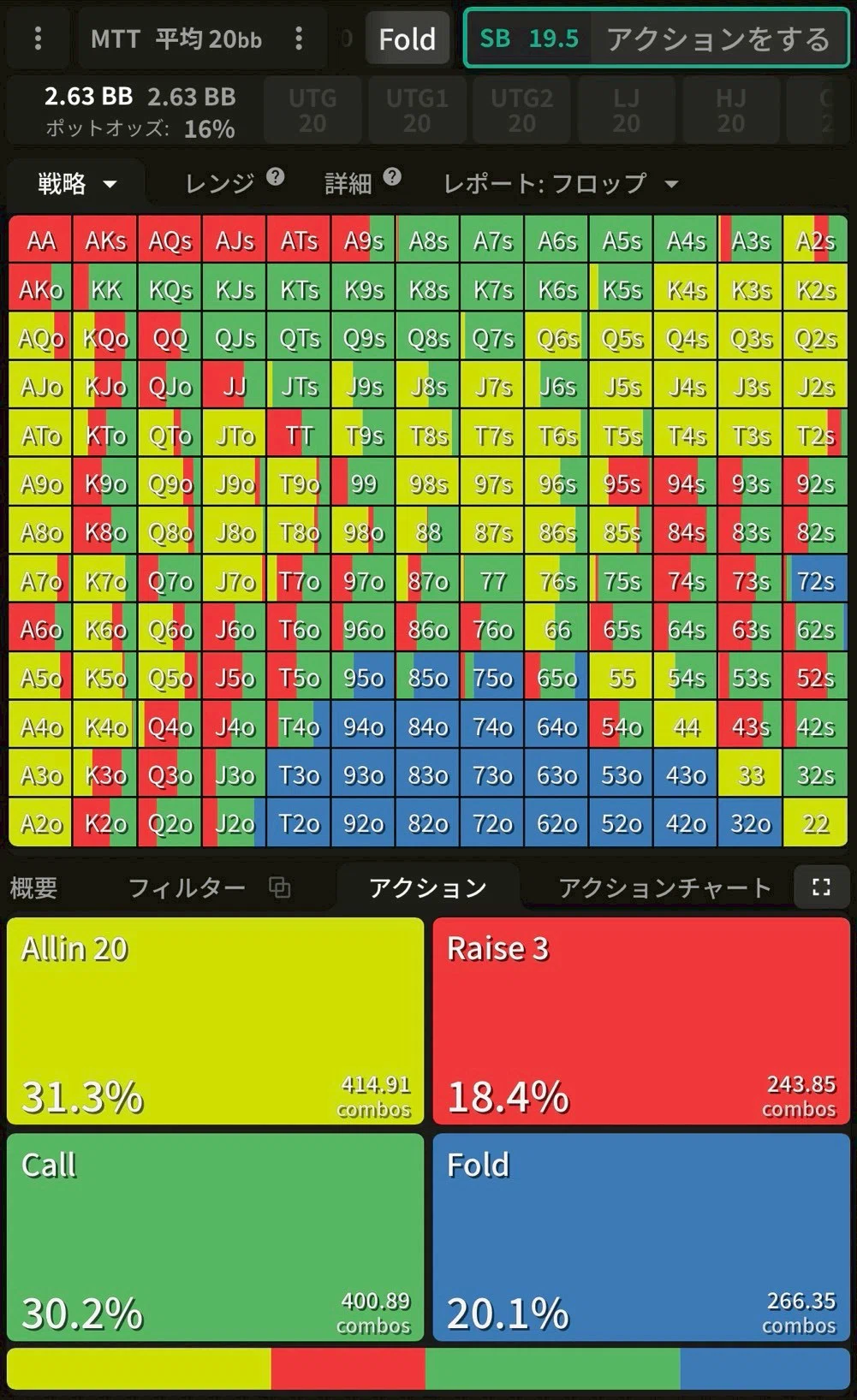
SB shoves 31.3% of its range — strikingly wide.
Hands that all-in (very wide)
- Small pairs and Axo — of course
- Kxo, Qxo, Txs, etc. — all part of the jamming range
Smaller open size
- 3BB when not jamming
The asymmetry of this spot
Even at 31.3% wide, the math depends heavily on how BB calls. Under proper ICM play, BB tightens up sharply because busting carries a heavy survival cost — calling ranges shrink to about 77+ / A7s+ premium hands.
⚠️ Wide jams can leak EV against the wrong opponent
If your BB opponent calls with something close to a ChipEV-wide range (ignoring ICM), SB's ultra-wide jamming starts losing value. Watch your opponent's tendencies — especially whether BB understands ICM — and adjust your jam frequency accordingly.
Summary
Two essential ideas drive ICM-aware open ranges at FT 20bb:
1. Hand values get distorted by ICM
- Ace blockers are king → Ax opens wide
- Pocket pairs and suited connectors open narrow
- Why? ICM penalizes risky postflop chip swings, so set-mining and implied-odds-driven hands lose appeal, while preflop blockers gain importance
2. The "first-in shove" advantage
- Whoever shoves first forces opponents to need premiums
- BTN and SB can therefore jam their middle-strength hands aggressively
- The 31.3% SB shove is the clearest expression of this advantage
📍 Practical takeaways
- In early positions, prioritize whether you hold an ace blocker
- At BTN / SB, calibrate by whether your opponent actually plays ICM-correctly
- If BB is calling with a ChipEV-wide range, dial back the wide SB jam

Found this helpful?
Bookmark this page to revisit anytime!
Ctrl+D (Mac: ⌘+D)
Found an error or have a question about this article? Let us know.
✉️ Contact Us
![Blind Heads-Up 25bb Preflop Strategy [Ajo MTT Vol.1]](/images/thumbnails/article-mtt-blind-battle-25bb-preflop-en-sm.webp)
![The Complete Guide to 3-Betting | Polar, Depolar, Linear, Super Polar [Ajo MTT Vol.2]](/images/thumbnails/article-mtt-3bet-response-patterns-en-sm.webp)
![LJ vs BB SRP C-Bet Strategy | 30bb Board-by-Board Hit Chart [Ajo MTT Vol.3]](/images/thumbnails/article-mtt-cb-lj-vs-bb-srp-30bb-en-sm.webp)
This article includes solution screens from GTO Wizard. Copyright in those figures belongs to GTO Wizard.