Poker Etiquette | Know the Difference Between Rule Violations and Bad Manners
A beginner's guide to poker etiquette. Learn about string bets, slow rolls, and other rule violations and bad manners — with clear reasons why each one matters. Feel confident at your first live poker table.
Know Poker Etiquette and Feel Confident at Any Table
When you sit down at a poker table for the first time, it's natural to worry about making a mistake and bothering the other players.
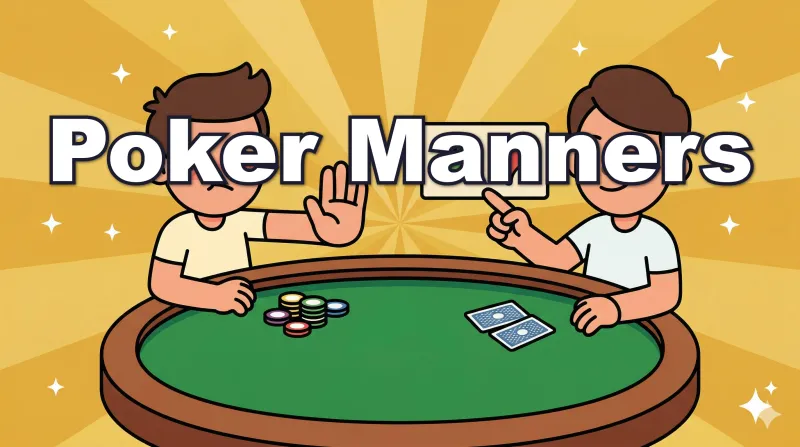
Don't worry. Poker etiquette boils down to one simple principle: don't make other people uncomfortable. Once you know what's OK and what's not, you can play confidently even at your very first table.
This article breaks poker etiquette into rule violations (actions that can result in penalties) and bad manners (not against the rules, but frowned upon). We'll also explain why each one matters.
Poker Etiquette Part 1: Rule Violations
Let's start with actions that can lead to penalties. If you do these unknowingly, you may receive a warning — or in the worst case, your hand could be declared dead.
String Bet
A string bet is when you put chips into the pot in multiple motions.
For example, if you want to bet 1,000, you push 500 forward first, then add another 500 afterward — that's a string bet.
The reason it's not allowed is that you could gauge your opponent's reaction before deciding how much to bet. You could push a small amount first, read their expression, and add more if they look weak.
Revealing Information During a Live Hand
Saying something like "Oh man, I had a 9!" after you fold is a rule violation.
Imagine the board shows 9♠9♣9♦. If you reveal you had a 9, the remaining players now know the last 9 is gone. This creates an unfair information advantage.
Verbal is Binding
Poker has a universal rule called verbal is binding. Whatever you say out loud takes priority over your chip movements and cannot be taken back.
For example, if you say "call" but don't push chips forward, the call still stands. Conversely, if you meant to say "raise" but accidentally said "call," it's processed as a call.
This rule exists to prevent cheating, but it can actually be a beginner's best friend. If you're unsure, declare your action verbally first, then move your chips — this way you'll never accidentally string bet.
Collusion
Collusion is when multiple players secretly work together to gain an unfair advantage over others.
This includes things like sharing card information with each other, or deliberately playing weak to funnel chips to a partner. If caught, you can face severe consequences such as being permanently banned from the venue.
Poker Etiquette Part 2: Bad Manners
Now let's look at actions that aren't rule violations but are frowned upon. These are important for keeping the table atmosphere positive.
Hiding Chips
Hiding your chips behind your body or stacking high-denomination chips behind low-denomination ones is considered bad manners.
In poker, players need to see how many chips their opponents have in order to make decisions. If your chips aren't visible, others can't make informed choices.
Follow these guidelines:
- Place high-denomination chips in front (where opponents can see them)
- Keep your chips neatly stacked
- Don't move chips to the edge of the table or behind your body
Show One, Show All
Show One, Show All is an etiquette rule meaning if you show your cards to one player, you must show them to everyone at the table.
Secretly showing your cards to a friend might seem harmless, but it creates an unfair situation where some players have information that others don't. This rule exists to protect the fairness of information.
Slow Rolling
A slow roll is when you know you have the winning hand but deliberately take your time revealing your cards at showdown.
For example, you hold a full house and you're 100% sure you've won, but you say "Hmm, I'm not sure..." and slowly flip your cards over. Your opponent briefly thinks they might have won, which makes the reveal extremely frustrating.
Slow rolling is considered one of the most hated etiquette violations in poker. At casinos abroad, there have been reports of slow rolls leading to violent confrontations outside the venue. This is not a joke — take it seriously. If you know you've won, show your cards immediately.
Commenting on Others' Play
Criticizing your opponent's play is obviously a no-go, but even explaining your own play is best avoided.
After winning a big pot, you might feel like saying "I raised because I thought they were weak on that flop." That's understandable, but from the loser's perspective, it's rubbing salt in the wound.
On the flip side, if the loser starts explaining their thought process — "I was actually thinking..." — the winner might interpret it as passive-aggressive criticism.
One thing to be especially careful about: asking the player you just beat "Are you a beginner?" Even without bad intentions, this can feel absolutely awful for the other person.
Showing Your Hand After a Successful Bluff
Some players love to show their cards after pulling off a bluff. Among close friends, this might be playful banter, but doing it to a stranger can come across as taunting.
Note that showing a strong winning hand is perfectly fine. Showing cards isn't the problem — it's showing them in a way that makes someone uncomfortable.
Using Your Phone During a Hand
Using your phone while you're in a hand is a no-go. It disrupts your focus and slows down the game.
However, when you're not in a hand (after folding or between hands), it's generally acceptable. Watching strategy videos or taking notes on your play is fine after you've folded.
Excessive Tanking
Taking time to think (tanking) is perfectly fine. When facing a tough decision, it's only natural to think carefully. Beginners taking their time is completely acceptable too.
However, deliberately stalling when you've already decided to fold, or using time as an intimidation tactic, is bad manners.
Poker is a game where everyone pays to play. At card rooms, everyone has paid a buy-in; at casinos, rake is charged over time. One person's time is everyone's time. Act as promptly as you can.
Taking Cards Off the Table
Taking your cards behind your body or checking them under the table is a no-go. Other players can't tell whether you're still in the hand.
Keep your cards on the table at all times, and when you check them, just lift the corners slightly while they remain on the table.
Acting Out of Turn
Even if you've decided to fold, don't toss your cards or announce "fold" before it's your turn.
If the player before you knows you're going to fold, it could change their decision. Wait until it's your turn to act.
Taking It Out on the Dealer
After a tough loss, some players complain "I always run bad with this dealer" and take their frustration out on the dealer.
But the dealer is simply shuffling and dealing cards. The cards you receive have nothing to do with the dealer's intentions. There's no such thing as an "unlucky dealer."
Without dealers, poker wouldn't exist. Treat them with gratitude and respect.
Angle Shooting
Angle shooting is exploiting gray areas and technicalities to gain an unfair advantage, without technically breaking any rules.
Examples include:
- Saying "I'm so weak" while holding a strong hand
- Pretending to fold while pushing chips forward
- Making deliberately ambiguous gestures to confuse opponents
Poker is a game of deception, but bluffing and angle shooting are completely different things. Bluffing uses legitimate actions like betting and raising as part of the game. Angle shooting exploits loopholes — it's just unsportsmanlike.
Helpful Tips for First-Timers
Here are some things that aren't rule violations or bad manners, but often confuse beginners.
You Can Leave the Table Anytime
You're free to leave the table whenever you want during a poker session. Whether you need the restroom, get a phone call, or just want a break — you can step away for any reason.
Just know that your blinds will still be posted even when you're away. Extended absences only cost you chips, so the only person who loses out is you. When you come back, you simply resume playing.
Don't Forget Card Protection
Get into the habit of placing a chip or card guard on top of your cards. Without it, the dealer might mistake your hand for a fold and collect your cards.
Card protection is a basic move to safeguard your hand. Bringing your own card guard is also one of the fun parts of poker.
Proper Chip Placement
Stack your chips by color and place the highest denominations in front. A standard stack is 20 chips.
Well-organized chip stacks make it easy for other players to gauge your stack size, and also make it easier for you to bet.
It's OK to Make Mistakes
We've covered a lot of etiquette here, but nobody expects a beginner to get everything perfect right away.
If you accidentally string bet or act out of turn, the dealer will kindly let you know. What matters is saying "sorry" gracefully when corrected and keeping it in mind for next time.
Everyone starts as a beginner. Knowing about etiquette is already a great first step.
Summary
At its core, poker etiquette comes down to "don't make others uncomfortable."
| Category | Key Actions |
|---|---|
| Rule Violations | String bets, revealing hand info during play, verbal is binding violations, collusion |
| Bad Manners | Hiding chips, Show One Show All violations, slow rolling, commenting on play, showing bluffs, phone use, excessive tanking, taking it out on the dealer |
Poker is a game where everyone gathers around a table to have a good time. Being considerate of others and creating an environment where everyone can enjoy themselves — that's part of being a good player.
If you're curious about the actual flow of playing at a casino or card room, check out this guide:
Found this helpful?
Bookmark this page to revisit anytime!
Ctrl+D (Mac: ⌘+D)
Found an error or have a question about this article? Let us know.
✉️ Contact Us