Poker Hand Probabilities | Complete Odds Chart by Street
Complete Texas Hold'em hand probability chart showing all 10 hand rankings by flop, turn, and river. Includes draw completion rates, backdoor odds, and how likely your hand is to improve.
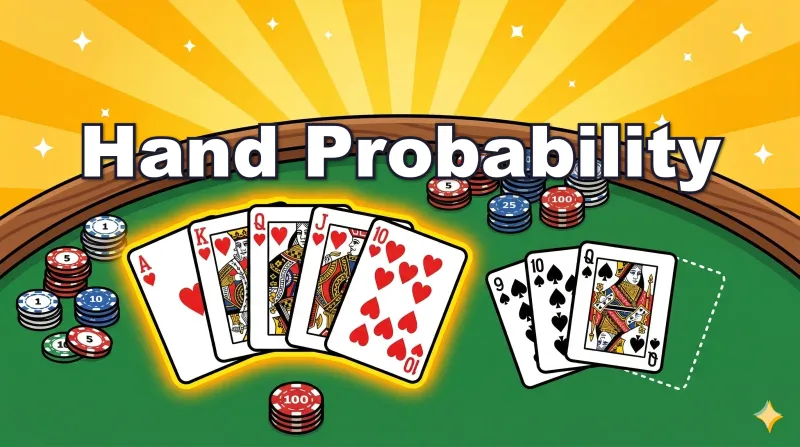
This article is part of the "Poker Probability" series, focusing on hand probabilities.
Texas Hold'em Hand Rankings & Probability Chart
In Texas Hold'em, you make the best 5-card hand from your 2 hole cards and 5 board cards. Here are the probabilities of making each hand by street.
| Hand | By Flop | By Turn | By River |
|---|---|---|---|
| Royal Flush | 0.0008% | 0.0017% | 0.0032% |
| Straight Flush | 0.005% | 0.014% | 0.028% |
| Four of a Kind | 0.02% | 0.07% | 0.17% |
| Full House | 0.09% | 0.82% | 2.60% |
| Flush | 0.20% | 1.07% | 3.03% |
| Straight | 0.39% | 1.73% | 4.62% |
| Three of a Kind | 2.11% | 3.40% | 4.83% |
| Two Pair | 4.75% | 12.5% | 23.5% |
| One Pair | 42.3% | 43.8% | 43.8% |
| High Card | 50.1% | 36.6% | 17.4% |
These probabilities are for any random hand. If you hold a specific hand type (pocket pair, suited, etc.), the odds change. See "How Likely Is Your Hand to Improve?" later in this article.
The further into the hand you go, the more likely stronger hands become. On the flop, high card accounts for 50%, but by the river it drops to just 17%.
Draw Completion Rates
The probability of completing a draw (an incomplete hand needing 1-2 more cards) helps you decide whether to call or fold. Here are the completion rates by number of outs (cards remaining that complete your draw).
| Draw | Outs | ×4% | Actual | ×2% | Actual |
|---|---|---|---|---|---|
| Quads Draw | 1 | 4% | 4.3% | 2% | 2.1% |
| Set Draw | 2 | 8% | 8.4% | 4% | 4.3% |
| One Overcard | 3 | 12% | 12.5% | 6% | 6.4% |
| Gutshot | 4 | 16% | 16.5% | 8% | 8.5% |
| Two Overcards | 6 | 24% | 24.1% | 12% | 12.8% |
| OESD | 8 | 32% | 31.5% | 16% | 17.0% |
| Flush Draw | 9 | 36% | 35.0% | 18% | 19.1% |
| OESD + Flush Draw | 15 | 60% | 54.1% | 30% | 31.9% |
"×4%" is the estimate for turn + river (2 cards to come), and "×2%" is for the river only (1 card). This shortcut is called the Rule of 2 and 4, and it lets you quickly estimate draw completion odds in your head.
For more on counting outs and draw types, see Counting Outs.
Key Hand Probabilities for Real Play
Here are some practical probability insights from the chart above that are especially useful during actual play.
Three of a Kind (Sets vs. Trips)
Three of a kind comes in two forms, and they play very differently.
| Type | Description | Flop | By River |
|---|---|---|---|
| Set | Pocket pair + 1 board card | 11.5% | 19.2% |
| Trips | 1 hole card + 2 board cards | 1.4% | 4.7% |
A set is made from a pocket pair matching one board card—it's hard for opponents to detect, so you can often win big pots. Trips come from a paired board, which is visible to everyone and requires more caution.
Two Pair: Two Different Patterns
Two pair can be made in two ways, each with different odds and strength.
| Pattern | Example (holding AK) | Flop | By River |
|---|---|---|---|
| Both hole cards hit | Board: A-K-7 | 2.0% | 5.6% |
| One hole card + board pair | Board: A-7-7 | 2.0% | 14.0% |
| Total | 4.0% | 23.0% |
Two pair from both hole cards hitting tends to be strong, but it's rare. Board-pair two pair happens much more often by the river (14%), but your opponents can also use that board pair.
Backdoor Probabilities
A backdoor draw means you need both the turn and river cards to complete your hand.
| Backdoor Draw | Probability |
|---|---|
| Backdoor Flush (need 2 more) | ~4.2% |
| Backdoor Straight (need 2 more) | ~1.5% |
| Full House (from one pair) | ~1.0% |
Backdoor draws have very low completion rates, so calling based solely on a backdoor draw is generally not recommended. However, they can add value when combined with other draws or when pot odds are very favorable.
How Likely Is Your Hand to Improve?
How often does your preflop hand connect with the board? Here's a breakdown by hand type.
Pocket Pairs
| Situation | Probability |
|---|---|
| Flopping a set | 11.8% |
| Making a set by the river | 19.2% |
With a pocket pair, you'll flop a set about 1 in 8.5 times. By the river, it's roughly 1 in 5.
Unpaired Hands
| Situation | Probability |
|---|---|
| Hitting a pair on the flop | 32.4% |
| Hitting a pair by the river | 48.7% |
With an unpaired hand, about 1 in 3 flops will pair one of your cards. By the river, it's roughly a coin flip.
Ace-High (AX)
| Situation | Probability |
|---|---|
| Hitting an ace on the flop | 17.2% |
| Hitting an ace by the river | 27.6% |
Even holding an ace, you'll only see another ace on the flop about 1 in 6 times.
Suited Hands
| Situation | Probability |
|---|---|
| Flopping a flush or flush draw | 11.8% |
Suited hands connect with flush-related opportunities about 1 in 8.5 flops.
Suited Connectors
| Situation | Probability |
|---|---|
| Flopping a flush, flush draw, straight, or straight draw | 36.4% |
Suited connectors (same suit + consecutive ranks) connect with some kind of draw or made hand on about 1 in 3 flops. This is why suited connectors are often called "dream hands."
Learning to intuitively grasp these frequencies early on will help you accurately judge your hand strength in real time.
Summary
Understanding probabilities is the first step toward eliminating guesswork in poker.
- Informs your call-or-fold decisions: Knowing a flush draw completes 35% of the time lets you compare against pot odds for a mathematical decision
- Prevents unrealistic expectations: Hitting the flop is roughly a 1-in-3 event—missing is completely normal
- Reveals each hand type's strengths: Knowing suited connectors connect 1 in 3 flops changes how you decide whether to play them
- Helps you read opponents: Knowing most two pairs involve a board pair helps you interpret opponent actions on paired boards
Probabilities aren't meant to be memorized—they're tools for better decisions. To learn how to apply these numbers, check out the guide below.
Found this helpful?
Bookmark this page to revisit anytime!
Ctrl+D (Mac: ⌘+D)
Found an error or have a question about this article? Let us know.
✉️ Contact Us