Poker Board Probabilities | Flop Texture Frequency Chart
A comprehensive guide to Texas Hold'em board probabilities. Covers flop texture frequencies for monotone, rainbow, and paired boards, connect board odds, and the probability of aces and overcards appearing.
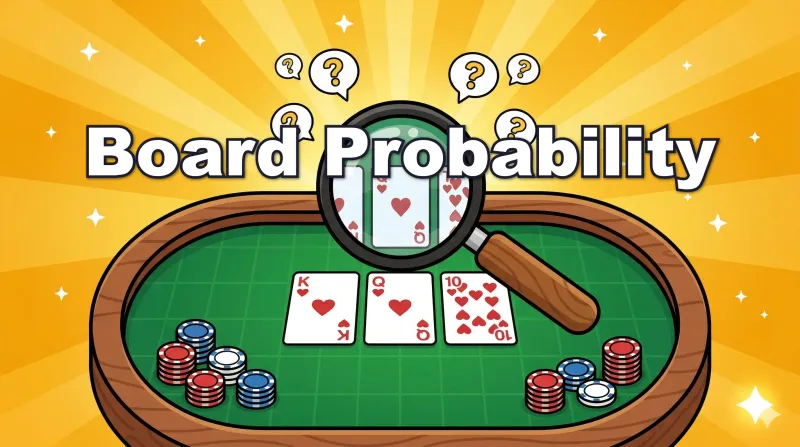
This article is a detailed page in the "Poker Probabilities" series, focusing specifically on board probabilities.
Suit-Based Probabilities (Rainbow, Two-Tone, Monotone)
The three cards on the flop can be classified by their suit combination, rank connectivity, and whether they contain a pair. This classification is called board texture. Since optimal strategy varies by texture, knowing these frequencies is the foundation for better decision-making.
| Texture | Description | Probability |
|---|---|---|
| Rainbow | All 3 cards different suits | 39.8% |
| Two-tone | 2 cards share a suit | 55.0% |
| Monotone | All 3 cards same suit | 5.18% |
Over half of all flops are two-tone. That means flush draws are possible on most flops. Rainbow flops (no flush concern) occur about 40% of the time, and monotone flops (where a flush is already possible) come just 5% of the time.
On a monotone flop, any player holding a flush draw is already just one card away from completing it. The standard approach on these boards is to dial back your aggression.
Paired Board Probability (16.9%)
| Texture | Description | Probability |
|---|---|---|
| Unpaired board | All 3 cards different ranks | 82.8% |
| Paired board | 2 cards share a rank | 16.9% |
| Trips board | All 3 cards same rank | 0.24% |
Paired boards show up roughly once every 6 flops. On a paired board, trips and full houses become possible, which means a simple one-pair hand loses relative value.
A trips board (three of the same rank) is extremely rare. When it does appear, most players have no connection to the board, so high cards and pocket pairs tend to decide the winner.
Connect Board Probability (18.5%)
A connect board is one where a straight can be made using two hole cards and the three board cards. The three cards don't need to be consecutive — as long as the cards fall within a range that can form a straight, it qualifies (e.g., 4-5-6, 4-6-7, 4-6-8).
| Texture | Description | Probability |
|---|---|---|
| Connect board | A straight can be made | 18.5% |
| OESD possible | An open-ended straight draw exists | 54.6% |
| No OESD possible | No straight draw exists | 26.9% |
About 20% of flops are connect boards. When you include the possibility of OESDs, straight-related draws can exist on roughly 70% of flops, meaning you can only completely ignore straights on about 1 in 4 flops.
Probability of an Ace on the Flop (22.6%)
| Scenario | Probability |
|---|---|
| At least one A on the flop | 22.6% |
| At least one A by the turn | 29.1% |
| At least one A by the river | 35.3% |
An ace appears on the flop about 22.6% of the time — roughly once every 4-5 flops.
When you hold KK or QQ: The probability of no ace on the flop is about 77%. In other words, an ace will appear on roughly 1 in 4 flops, so you need to be prepared for overcards.
Overcard Probability by Pocket Pair
When you hold a pocket pair, this is the probability that at least one card higher than your pair (an overcard) appears on the flop.
| Pocket Pair | No Overcard | Overcard Appears |
|---|---|---|
| AA | 100% | 0% |
| KK | 77.5% | 22.5% |
| 58.6% | 41.4% | |
| JJ | 43.0% | 57.0% |
| TT | 30.5% | 69.5% |
| 99 | 20.7% | 79.3% |
| 88 | 13.3% | 86.7% |
With pocket jacks or lower, overcards appear on the flop more often than not. With JJ, there's about a 57% chance that a Q, K, or A lands. That familiar feeling of raising with JJ only to see a king on the flop? Statistically, it's completely normal.
Summary
The biggest benefit of knowing board probabilities is that you can prioritize studying the spots that come up most often.
Poker strategy varies by board texture. It's not realistic to learn every pattern at once, so starting with the most common boards is the most efficient approach.
Now that you understand board probabilities, the next step is learning how to apply these numbers in practice.

Found this helpful?
Bookmark this page to revisit anytime!
Ctrl+D (Mac: ⌘+D)
Found an error or have a question about this article? Let us know.
✉️ Contact Us