What Is Tilt in Poker? 7 Types and How to Overcome It
Learn about the 7 types of poker tilt from 'The Mental Game of Poker,' their causes, how to identify your patterns, and practical strategies to prevent and manage tilt.
What Is Tilt in Poker?
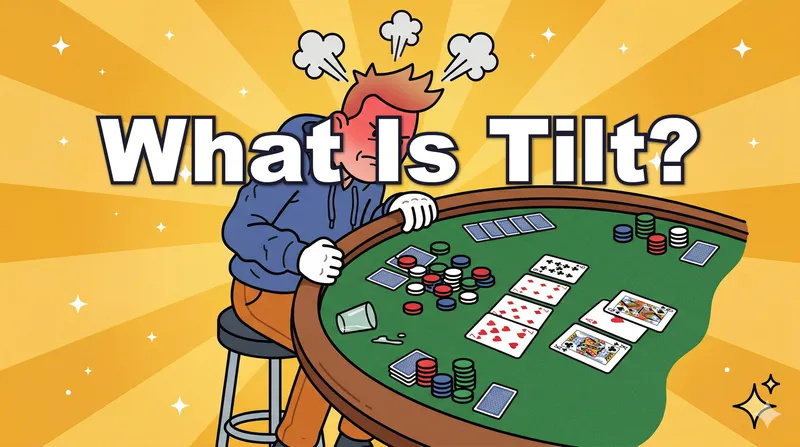
Tilt is a state where emotions take over and you can no longer make rational decisions.
You go all-in with A♠A♣, only to lose to 7♦2♣. The frustration won't stop. After a string of losses, you shove all-in with a weak hand trying to win it back. If any of this sounds familiar, you've experienced tilt.
According to research by GTO Wizard, simply reducing mistakes made while emotional can nearly double your win rate (2.5BB/100 → 4.7BB/100). That means earning 4.7 big blinds per 1,000 hands instead of 2.5 — in a 2 game, that's nearly twice the profit from the same number of hands. In many cases, controlling tilt has a bigger impact on your win rate than learning new strategies.
This article breaks down tilt using the 7-type framework from Jared Tendler's book "The Mental Game of Poker," covering causes, prevention, and practical solutions.
Origin of the Term "Tilt"
The word "tilt" comes from pinball. When players shake a pinball machine too hard, the screen displays "TILT" and the game freezes. In poker, the idea is the same — when you lose control of your emotions, your game falls apart (Wikipedia: Tilt (poker)).
The 7 Types of Poker Tilt
Mental game coach Jared Tendler classifies tilt into 7 types in his book "The Mental Game of Poker." Identifying which types you're most prone to is the first step toward overcoming tilt.
1. Running Bad Tilt
When bad beats (losing a hand you were heavily favored to win) and losing streaks pile up, you start feeling like "today just isn't my day" and lose your composure. For example, you go all-in with K♠K♣ only for an Ace to hit the river, then you lose the next hand to a flush draw that gets there — anyone would feel shaken.
Poker always involves variance, and short-term losses are unavoidable. But when the bad stretch continues, you start thinking "I'm going to lose anyway," and your play deteriorates.
2. Injustice Tilt
This is when you fall into a victim mentality of "why does this only happen to me?" You miss your flush draw, then immediately watch your opponent complete their flush on the river to win — and you think "this is unbelievable" or "I'm the unluckiest player here."
In reality, every player experiences bad beats at the same rate. But humans tend to remember their own misfortune vividly while overlooking others'.
3. Hate-Losing Tilt
This type can't accept losing, period. While poker involves a significant element of luck, players with this tendency equate losing with failure.
You can make the correct decision and still lose. What matters is not the result but the quality of your decisions. Stack up good decisions, and results will follow in the long run.
4. Mistake Tilt
You get angry at your own mistakes, and that frustration leads to even more mistakes. You called what was obviously a bluff, and now you keep beating yourself up — "why did I make that play?" — which destroys your focus.
Everyone makes mistakes. The key is to let go and refocus on the next hand.
5. Entitlement Tilt
This tilt comes from the arrogance of thinking "I've studied so much, I deserve to win." But effort and knowledge don't guarantee short-term success.
This type hits hardest when you lose to a weaker player. Your opponent calls preflop with 9♥4♣, flops two pair, and wins — and you think "how can someone play that hand?" Looking down on opponents makes you lose your rational edge.
6. Revenge Tilt
You become consumed by the desire to "get back at" a specific opponent. After losing a big pot to someone, you start calling or raising every time that player bets, regardless of your hand.
When revenge drives your play, you're reacting to the person rather than their hand, and rational decision-making goes out the window.
7. Desperation Tilt
When you're stuck deep in losses and think "I have to win it back," you become reckless. You move up to higher stakes or force your way into hands you'd normally fold.
This is the most dangerous type of tilt — it can destroy your bankroll (your poker funds). One way to combat it is to think in terms of your hourly rate. Instead of trying to recover today's losses today, remind yourself: "My hourly rate is positive in the long run. Even if I quit now, I'll make it back in future sessions." Pro poker player Phil Galfond has given similar advice.
Off-the-Table Factors
Tilt isn't triggered only by what happens at the table. These off-the-table factors can significantly lower your resistance to tilt:
- Sleep deprivation: Both judgment and emotional control deteriorate
- Alcohol: Lowers inhibitions, making you more susceptible to tilt
- Life stress: Playing while dealing with work or relationship problems
- Poor physical condition: Hunger, fatigue, and illness weaken your mental resilience
Choosing not to play when you're in poor condition is itself a legitimate tilt prevention strategy.
How Tilt Manifests: Aggressive vs. Passive
The 7 types above and off-the-table factors are tilt triggers, but the way tilt actually shows up in your play falls into two broad categories:
| Type | Characteristics | Example |
|---|---|---|
| Aggressive | Play becomes extremely aggressive | Raising with weak hands like J♣4♥, firing baseless bluffs |
| Passive | Play becomes extremely passive | Folding top pair to a bet, convinced "I'll just lose again" |
Even if you're not angry, if you're loosely calling every hand out of resignation or folding everything because you've given up — that's tilt too.
For a deeper dive into each of the 7 tilt types and specific strategies to combat them, check out Jared Tendler's "The Mental Game of Poker" series. It systematically covers not just tilt, but also fear, motivation, and confidence.
Note: the links below are Amazon Associates affiliate links.
Overcoming Tilt: Know Your Patterns
The most important step in overcoming tilt is identifying your tilt patterns before they happen. It's nearly impossible to objectively assess yourself in the middle of a tilt episode, so you need to analyze your tendencies while you're calm.
Try creating a "tilt profile" like this:
| Category | Example |
|---|---|
| Types you're prone to | Running Bad Tilt, Revenge Tilt |
| Triggers | Losing multiple pots to the same opponent |
| Symptoms (mistakes you make) | Range widens; start bluffing excessively against that specific player |
| Early warning signs | Heart rate increases; you start fixating on opponent's chip stack |
Once you know your patterns, you can catch yourself early — "I'm doing that thing again." And once you notice it, you can take action.
Preventing and Managing Poker Tilt
Session Management: Set Quit Criteria in Advance
Deciding to quit while you're already tilted means trusting a decision made by a tilted brain — not reliable. Set your quit criteria before you start playing.
- Loss limit: e.g., "If I'm down 3 buy-ins, I'm done for the day"
- Time limit: e.g., "Take a mandatory break after 4 hours"
- Emotional limit: "If I feel irritated, step away for 10 minutes"
Injecting Logic
A technique from "The Mental Game of Poker": prepare phrases to tell yourself when you notice tilt creeping in.
Example phrases:
- "Short-term results are driven by luck. The only thing I can control is the quality of my decisions."
- "The outcome of this hand has nothing to do with my skill level."
- "I can't trust decisions made while I'm emotional."
The phrases that resonate are different for everyone. Read, reflect on your experiences, and find the ones that genuinely convince you.
Daniel Negreanu's 4-Step Method
Poker legend Daniel Negreanu reportedly uses these 4 steps when he feels tilt coming on:
- Vent: Acknowledge the frustration internally. Don't suppress it
- Check your mental state: Observe your emotions objectively and bring your awareness back to the present moment
- Check your body: Notice if your breathing is shallow or your shoulders are tense
- Choose your emotion: Decide how you want to feel going forward
Lifestyle Management
Your resistance to tilt is heavily influenced by your daily condition:
- Get enough sleep before playing
- Avoid playing while drinking (or limit your intake)
- Eat before sitting down at the table
- Skip sessions when life stress is high
Studying Poker Is Also Tilt Prevention
Learning poker theory and probability is actually a form of tilt prevention. If you understand the probability of bad beats, you can accept them as "something that happens at a known frequency." If you can evaluate whether an opponent's play was correct or incorrect, you're less likely to fall into Injustice Tilt or Entitlement Tilt.
How to Spot and Exploit a Tilted Opponent
Tilt isn't just about you. Recognizing when an opponent is tilting is an important poker skill.
Spotting Tilt
- Bet sizing changes: Unusually large bets or meaningless minimum bets
- Speed changes: Decisions become extremely fast (acting without thinking)
- Participation rate changes: Suddenly playing almost every hand
- Behavioral changes: Sighing, muttering, rough handling of cards or chips
Exploiting a Tilted Opponent
Against a tilted opponent, consider these adjustments:
- Widen your value betting: Tilted players tend to call too wide, so you can value bet thinner than usual
- Reduce your bluffs: If they're calling everything, bluffs become less effective. Let your hand strength do the work
- Don't provoke them: Taunting a tilted opponent is not only bad etiquette — it might also snap them back to their senses
Summary
Every poker player experiences tilt. But whether you can control it makes a huge difference in your results.
Research by GTO Wizard shows that simply reducing mistakes during your worst mental state can nearly double your win rate. Improving your strategy matters, but improving your mental game can have an equal or even greater impact on your bottom line.
You may never eliminate tilt completely, but by knowing your patterns and preparing countermeasures in advance, you can minimize the damage. And the act of continuing to study poker itself builds your ability to accept facts calmly, strengthening your resistance to tilt.
If you want to dive deeper into the idea that "decision quality matters more than results," check out the Expected Value (EV) article.
Found this helpful?
Bookmark this page to revisit anytime!
Ctrl+D (Mac: ⌘+D)
Found an error or have a question about this article? Let us know.
✉️ Contact Us