What Is a Straddle in Poker? Types, Pros & Cons, and Strategy
Learn what a straddle is in poker cash games. Covers UTG straddle, Mississippi straddle, re-straddle, plus how to adjust your strategy when facing a straddle.
What Is a Straddle in Poker?
If you've played cash games, you've probably seen a player announce "Straddle!" and toss out some extra chips before the cards are dealt. Straddles are rarely used in tournaments, but they come up frequently in cash games.
Definition of a Straddle
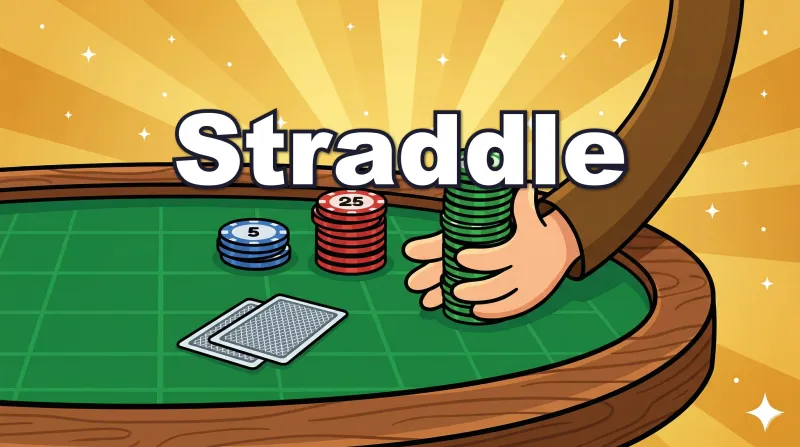
A straddle is a voluntary blind bet placed before the cards are dealt. It's typically twice the size of the big blind (BB), though some poker rooms allow players to straddle for any amount above that minimum.
For example, in a 2 game with a straddle, the blind structure effectively becomes 2/$4. The player who straddles (the straddler) earns the right to act last preflop.
Here are the key characteristics of a straddle:
- It's voluntary: A straddle is never forced — it's entirely your choice
- It must be announced before the cards are dealt
- Cash games only: Straddles are generally not allowed in tournaments
- House rules vary: Whether straddles are permitted and which types are allowed depends on the casino or poker room
📝 Think of a straddle as a "third blind." On top of the SB and BB, one more blind bet is added to the pot.
Types of Straddles
There are several variations of the straddle. Here are the three most common types.
UTG Straddle (Most Common)
The UTG straddle is placed by the UTG (under-the-gun) player for twice the big blind. This is the most common form of straddle and is allowed at most casinos.
Key points about the UTG straddle:
- Preflop action order: Action begins to the left of UTG, continues through SB → BB → straddler (UTG). The straddler acts last preflop
- Postflop action order: Returns to normal (clockwise from SB). The preflop advantage does not carry over
- Minimum raise: The straddle amount (e.g., 8
Mississippi Straddle (Button Straddle)
The Mississippi straddle is placed by the BTN (button) player. It's also known as the button straddle.
- Postflop, the BTN still acts last (the natural positional advantage is preserved)
- Because this is positionally more advantageous than the UTG straddle, fewer casinos allow it
📝 The preflop action order for the Mississippi straddle varies by poker room. In some rooms, action starts from the SB; in others, it starts from UTG. Always check the house rules.
💡 The UTG straddle is "an extra blind from the worst position at the table," while the Mississippi straddle is "an extra blind from the best position." The strategic implications are very different.
Re-straddle
A re-straddle is an additional straddle placed on top of an existing straddle.
For example, in a 2 game, UTG posts a 8 re-straddle.
- The re-straddle is typically double the previous straddle
- In theory, re-straddles can be stacked indefinitely, but most casinos set a cap
- Pots can escalate quickly, making re-straddles especially risky for short-stacked players
Pros and Cons of Straddling
Pros
1. Lower Effective Rake
Most poker rooms have a rake cap (a maximum amount of rake taken per pot). When a straddle inflates the pot, the cap is reached sooner, meaning the rake becomes a smaller percentage of the total pot. This can effectively save players money.
2. Livens Up the Table
Straddles generate more action and create a more exciting atmosphere. At casual or recreational tables, you'll sometimes see "let's all straddle" become the norm.
Cons
1. It's Negative EV
A straddle is a blind bet of twice the BB placed before you've seen your cards. Committing chips without knowing your hand strength is inherently -EV. The UTG straddle is particularly costly because of the poor position. The Mississippi straddle benefits from positional advantage, but according to GTO Wizard's analysis, it's still -EV.
2. Nobody Truly Benefits
A straddle has a similar effect to raising the stakes for the entire table. In an environment where everyone straddles, the game just plays like a higher stake — and no one gains an edge from it.
📝 You'll sometimes hear that "good players don't straddle." This is because there's little reason to voluntarily take a -EV action. That said, some skilled players will straddle anyway to maintain the social dynamic at the table.
Can You Decline a Straddle?
A straddle is entirely optional. Even if the rest of the table is straddling and the social pressure is on, you are under no obligation to join in.
That said, you may feel some social pressure at the table. Declining is perfectly within the rules, but going along with the flow is also a valid choice. If it doesn't fit your bankroll or skill level, there's no need to force it.
Adjusting Your Strategy When Facing a Straddle
Encountering a straddle for the first time can feel intimidating, but don't worry — the game itself hasn't changed. You still get two hole cards, the board still has five cards, and hand rankings are the same. The only thing that changes is the blind amounts.
The fundamental approach when a straddle is in play is to treat the straddle as the new big blind.
Size Your Bets Based on the Straddle
Just as a standard open raise is typically 2.5–3x the BB, when a straddle is in play, size your raise to 2.5–3x the straddle amount. In a 2/10–$12.
The absolute dollar amounts are larger, but if you think of the straddle as the new BB, the relative sizing stays the same.
Tighten Your Hand Range Slightly
When a straddle is in play, there's effectively one more player left to act behind you preflop. The more players behind you, the tighter your range should be — that's a fundamental principle of poker.
According to GTO Wizard's analysis, in straddled pots, the open frequency from the BTN drops by about 15–20% compared to non-straddled pots.
💡 When a straddle is in play, think of it as "the blinds have effectively doubled." A 2/2/$4 game, and framing it that way makes it easier to get a feel for the right sizing. (Reference: GTO Wizard - Preflop Strategy in Straddled Pots)
Summary
🎯 Key Takeaways
- A straddle is a voluntary blind bet placed before the deal (typically 2x the BB)
- The UTG straddle is the most common type. The straddler acts last preflop
- The Mississippi straddle is posted from the BTN, preserving positional advantage postflop
- A re-straddle stacks an additional straddle on top of an existing one
- Pros include a lower effective rake and a livelier table. The main con is that straddling is -EV
- When facing a straddle, treat the straddle as the new BB and tighten your range slightly
- You can always decline to straddle. If it doesn't suit your bankroll, don't force it
Found this helpful?
Bookmark this page to revisit anytime!
Ctrl+D (Mac: ⌘+D)
Found an error or have a question about this article? Let us know.
✉️ Contact Us