What Are the Bubble and ITM in Poker? | Key Tournament Terms Explained
A beginner-friendly guide to the poker tournament Bubble and In The Money (ITM). Covers related terms like Bubble Line, Bubble Boy, ITM Rate, and In The Prizes (ITP).
What You'll Learn
- What In The Money (ITM) and In The Prizes (ITP) mean, plus ITM Rate
- The differences between Bubble, Bubble Line, and Bubble Boy
- How "XX Bubble" is used — Money Bubble, Final Table Bubble, and more
- What happens psychologically at the Bubble
For tournament entry methods and types, check out this guide.

What Does In The Money (ITM) Mean?
In The Money (ITM) means finishing in a high enough position in a poker tournament to receive a payout. The abbreviated term "ITM" is widely used.
In poker tournaments, not everyone gets paid. Only the top portion of the field receives prizes. When you survive long enough to reach that payout threshold, you've made it "in the money."
In some tournaments — particularly in Japan — prizes may be trophies, points, or merchandise rather than cash. In these cases, the term In The Prizes (ITP) is used instead. The meaning is the same: you've reached the prize-paying positions.
Example
Imagine a tournament with 100 players where the top 15 receive payouts.
- Finish 15th or higher → ITM (you receive a payout)
- Finish 16th or lower → Not ITM (no payout)
In this example, 15% of the field made it in the money.
ITM Rate
Your ITM Rate is the percentage of tournaments in which you've cashed.
ITM Rate = Number of cashes ÷ Number of tournaments entered × 100
For example, if you've played 10 tournaments and cashed in 3 of them, your ITM rate is 30%.
The payout percentage varies by tournament, but in large events, typically about 10–20% of the field makes the money. This means it's completely normal to go several tournaments without cashing.
ITM Rate Benchmarks — What's Considered Good?
How high does your ITM rate need to be to be considered a strong player? Here are some rough benchmarks.
| ITM Rate | Assessment |
|---|---|
| 10–15% | Average (this is the normal range given typical payout structures) |
| 15–20% | Good (consistently making the money) |
| 20%+ | Excellent (top player level) |
As a reference, top Japanese pro Kyosuke Nagami recorded an ITM rate of 23.6% in 2024 (48 cashes out of 203 entries).
However, ITM rate alone doesn't tell the whole story. Tournament payouts are top-heavy, so if you're only min-cashing, you may not be profitable overall. It's important to look at your ROI (Return on Investment) alongside your ITM rate.
What Is the Bubble?
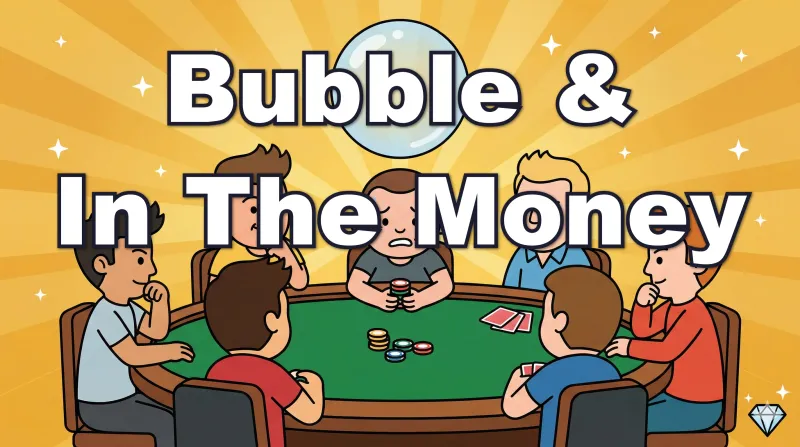
The Bubble is the stage of a tournament when one more elimination will put all remaining players in the money.
Using the earlier example, in a tournament where the top 15 players get paid, the moment 16 players remain is the bubble. Once one more player is eliminated, all 15 remaining players are guaranteed a payout.
The term "bubble" comes from the idea of a soap bubble — fragile and about to burst. You were so close to the money, but you walked away with nothing.
Bubble Line
The Bubble Line refers to the boundary itself. When someone says "we've reached the bubble line," it means the tournament has entered the stage just before payouts begin.
"Bubble" and "Bubble Line" are used almost interchangeably, though "bubble" refers to the situation while "bubble line" emphasizes the boundary.
Bubble Boy
The Bubble Boy is the player who gets eliminated on the bubble — the last person to leave without a payout.
In our example, the player who finishes 16th is the bubble boy. After playing for hours and coming so close to cashing, they leave empty-handed. It's often called the most frustrating finish in tournament poker.
"XX Bubble" — Variations of the Term
"Bubble" is used broadly to mean "one elimination away from XX" and can be applied to many situations.
Money Bubble
The Money Bubble refers specifically to the boundary between getting paid and not getting paid. When people simply say "the bubble," they usually mean the money bubble.
For example, in a tournament that awards both cash prizes and non-cash prizes (like trophies or points), you might already be in the prizes (ITP) but still one spot away from the cash payout — that's the money bubble.
Final Table Bubble
The Final Table Bubble (FT Bubble) is the point when one more elimination will form the final table.
For example, in a tournament with a 9-player final table, the FT bubble occurs when 10 players remain. Since there's often a significant pay jump at the final table, player behavior changes dramatically — just like at the money bubble.
Other "XX Bubbles"
The "XX bubble" pattern is used freely as a general expression meaning "one spot away from XX." For example, if one more elimination would advance everyone to Day 2, that's the "Day 2 bubble."
What Happens at the Bubble
As the bubble approaches, the atmosphere at the tables shifts dramatically. After playing for hours, being eliminated here means walking away with nothing. This psychological pressure has a major impact on how players behave.
The "I Just Want to Cash" Mindset
The most common phenomenon near the bubble is folding too much because you desperately want to make the money. Short-stacked players in particular tend to fold hands they would normally play, driven by the fear that a single loss means instant elimination.
This is a perfectly natural response. Humans tend to fear losses more strongly than they value equivalent gains (loss aversion), and the bubble is exactly the situation where this instinct is at its strongest.
How Stack Size Affects Psychology
- Short stacks: The fear of elimination is overwhelming. The thought "just survive a little longer and I'll cash" dominates their decisions, leading to extreme caution
- Big stacks: With little risk of busting out, these players can afford to be relatively relaxed. They have the mental space to observe the tension around them
- Medium stacks: Not as desperate as short stacks, but one big lost pot could send them tumbling. This creates decision-making paralysis
An Unwritten Rule at the Bubble
In live tournaments, the following unwritten convention is commonly observed during the bubble:
- When a short stack goes all-in → other players check it down to showdown without betting
The idea is to maximize the chance of eliminating the short stack so that everyone else can make the money. While it's not an official rule, it's a widely recognized convention covered by major poker media such as PokerNews.
However, verbally agreeing to check it down could be considered collusion. This remains an unspoken understanding — each player decides independently.
Glossary
Here's a summary of all the terms covered in this article.
| Term | Meaning |
|---|---|
| In The Money (ITM) | Finishing in a payout position in a tournament |
| In The Prizes (ITP) | Finishing in a prize position (used in non-cash tournaments) |
| ITM Rate | The percentage of tournaments in which you cashed |
| Bubble | The stage when one more elimination puts everyone in the money |
| Bubble Line | The boundary of the bubble |
| Bubble Boy | The player eliminated on the bubble |
| Money Bubble | The bubble for cash payouts specifically |
| Final Table Bubble | One elimination away from forming the final table |
🎯 Summary
- In The Money (ITM) = finishing in a payout position in a tournament
- In The Prizes (ITP) = finishing in a prize position (common in non-cash tournaments)
- ITM Rate = your cash rate across tournaments (benchmark: top 10–20% of the field typically cashes)
- Bubble = one elimination away from the money
- Bubble Boy = the last player eliminated before payouts begin
- "XX Bubble" = a flexible expression meaning "one spot away from XX"
- At the bubble, short stacks tend to play too tight while big stacks feel more relaxed
To learn more tournament fundamentals, check out these related articles.

Found this helpful?
Bookmark this page to revisit anytime!
Ctrl+D (Mac: ⌘+D)
Found an error or have a question about this article? Let us know.
✉️ Contact Us