Range Construction in Poker | Linear, Polarized, and Condensed Explained
Linear, Polarized, and Condensed — the three poker range constructions, with chart examples and the core rule: bets go polar, calls go condensed.
📝 Where this fits: you need to know what a hand range is. If you're not sure, read How to Read Hand Ranges first.
The Three Range Constructions — Linear, Polarized, and Condensed
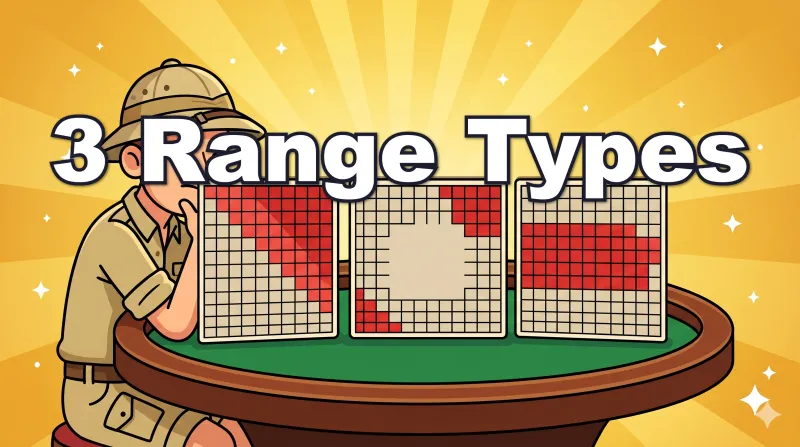
Poker ranges come in three classic shapes: Linear, Polarized, and Condensed. Each one contains a very different set of hands, and how you should play with them differs accordingly. Let's start with the definitions one by one.
What You'll Learn
- Definitions and concrete examples of Linear, Polarized, and Condensed ranges
- The core rule: "Betting = Polarized / Calling = Condensed / a raise swaps the roles"
- How range construction shifts in preflop and postflop trees
- The relationship between range construction and bet sizing (and common misconceptions)
📝 About the range charts in this section: All three range charts below are preflop examples (based on GTO Wizard solutions). The same three categories apply postflop too, but preflop is the easiest place to grasp the shape visually.
Linear Range
A range filled top-down with the strongest hands, including the absolute nuts (premium pairs and big aces), with strength tapering smoothly from strong to medium.
- Example: an EP open range like
22+, A2s+, K5s+, Q8s+, JTs, T9s, 98s-54s, ATo+, KTo+, QTo+, JTo
Think of it as: "I just kept adding the next best hand from the top." That's a linear range.
※ Red squares = hands in the range. Visualization of an EP open range (based on GTO Wizard solutions). You can see how the strongest hands are packed into the top, with strength tapering down to suited connectors and broadways.
Polarized Range
A range made of two extremes — strong hands (value) plus weak hands (bluffs), with the middle hollowed out.
- Example: a 3bet bluff range vs. a late-position open like
TT+, ATs+, KQs, AQo+ + A2s-A5s, K8s-K9s
The middle hands (small-to-medium pairs like 99-77, and middling broadways like KJ, KT, QJ, JT) are deliberately excluded. They're "too strong to bluff with, but too weak to 3bet for value."
※ Red squares = hands in the range. Visualization of an OOP 3bet range (based on GTO Wizard solutions). The strongest hands and the low suited As/Ks (bluffs) form the two extremes, with the middle (medium pairs, medium broadways) hollowed out.
Condensed Range (≒ Capped Range)
A range with no nut hands — strength has an upper cap. The mass sits in the medium-strength showdown hands.
- Example: BB calling range vs. a late-position open (premiums and AK are gone because they were 3bet)
※ Red squares = hands in the range. Visualization of a BB call range vs. a late-position open (based on GTO Wizard solutions). The premiums (AA-TT, AKs/AKo, AQs, AJs, KQs) and the low-Ax bluff 3bet hands are gone, leaving a clear cap on strength.
📝 Capped vs. Condensed: "Capped range" and "Condensed range" are not strictly distinguished — both refer to a range that is "capped at the top / contains no nut hands" and are often used interchangeably. From here on, this article uses "Condensed."
Three Ranges Compared with Histograms
Plotting all three with strength on the x-axis (left: weak ↔ right: strong) and frequency on the y-axis makes the differences obvious at a glance.
Three Ranges Side by Side
| Construction | Nut hands | Middle hands | Weak hands (bluffs) | Center of mass |
|---|---|---|---|---|
| Linear | Included | Thick | Few | Skewed strong |
| Polarized | Included | Thin / hollow | Many | Both extremes |
| Condensed | Excluded | Thick | Few | Center |
💡 Two questions to identify a range: ① Are the nut hands included? → If not, it's Condensed. ② Are the middle hands thick? → If yes, Linear. If thin, Polarized.
🧭 Bet = Polarized, Call = Condensed — A Raise Swaps the Roles
A range's construction is largely determined by the action each player has taken. The principle is simple.
- The side that bet/raised → Polarized (strong hands as value, weak hands as bluffs)
- The side that called → Condensed (strongest hands moved up via reraise, weak hands folded out, leaving the medium band)
- Each new raise swaps the roles between the two players
That said, here are a few exceptions worth knowing:
- The very first raise of the hand (preflop open raise) is Linear: nobody has acted yet, so you simply pick the top hands in order.
- Preflop reraises (3bet/4bet) default to Polarized, but become Linear against opponents who don't fold: when fold equity is available, you add bluffs to make the range two-sided. Against sticky opponents, bluffs don't profit, so you stick to pure value — Linear.
Walking Through a Preflop Tree
Trace the action UTG opens → BB responds, and watch the swap unfold:
| Action | Aggressor | Defender |
|---|---|---|
| UTG opens | UTG → Linear | BB → hasn't acted yet |
| BB calls | UTG → Linear (unchanged) | BB → Condensed |
| BB 3bets (reraise) | BB → Polarized | UTG → still Linear (now defending) |
| UTG calls the 3bet | BB → Polarized (unchanged) | UTG → Condensed |
| UTG 4bets | UTG → Polarized (attacker again) | BB → still Polarized (now defending) |
| BB calls the 4bet | UTG → Polarized | BB → Condensed |
The point: each time someone raises, "the player who's currently attacking" becomes Polarized, and "the calling range of the player defending" becomes Condensed.
Walking Through a Postflop Tree
The same swap happens postflop. Take BTN open, BB call, all the way to the river, and trace bet → raise → reraise:
| Action | BTN (aggressor) | BB (defender) |
|---|---|---|
| BTN bets the river | Bet range is Polarized (value + bluffs; medium hands check) | Defending |
| BB raises | Polarized (now defending) | Raise range is Polarized (strong hands + bluffs) |
| BTN calls | Call portion is Condensed (strongest hands reraise, weakest fold) | Polarized (unchanged) |
| BTN reraises | Polarized again (back to attacker) | Condensed if BB calls |
The same structure as preflop: the side that bet/raised goes Polarized; the side that called goes Condensed, and each raise swaps the roles.
※ One caveat: a CB (continuation bet) often isn't actually polarized. On dry boards a small "range bet"-style CB mixes value, bluffs, and medium hands all together — that's not a polarized range. The "Bet = Polarized" rule fits cleanest on the river, or on wet boards where the CB is large and polar. For more on CBs themselves, see the article below.
⚠️ Common Misconceptions
❌ "Polarized Range = Overbet"
A polarized range doesn't always bet large — a polarized range can use a 1/3-pot small bet too. "Polarized" describes the shape of the bet range (strong hands and weak hands cleanly separated), not the bet size. Bet size and range shape are correlated, but they aren't the same thing.
❌ "Condensed = Weak"
The medium-strength hands that sit at the center of a condensed range aren't actually strong or weak in themselves. The real problem is that they don't profit much from big bets, and they're vulnerable to leverage (the threat of further bets) when a strong opponent attacks. Condensed ranges tend to play passively — but that's a property of the situation, not of the hands.
🎓 Practice
Q1: UTG open-raises. What is UTG's range construction?
Show answer
Linear. Nobody has acted yet, so UTG just packs hands top-down. Even though UTG is the aggressor, the very first raise of the hand is the one exception — it's Linear, not Polarized.
Q2: CO opens, BTN calls. What is BTN's calling range construction?
Show answer
Condensed. Premiums (QQ+, AK) get 3bet, and clearly weak hands fold, leaving the medium band — small/medium pairs, suited broadways, suited connectors. This is the textbook "calling range = condensed" example.
Q3: BTN bets on the river. What is the bet range's construction?
Show answer
Polarized. The river is the last street, so the only reason to bet is to extract value from worse hands or to fold out better hands. There's nothing in between — medium hands naturally check. The bet range is therefore strong hands plus bluffs, the classic two-sided shape.
Q4: BTN bets the river, BB raises. What is BB's raise range construction?
Show answer
Polarized. The raise flips the attacker role from BTN to BB, so BB now has a strong hands + bluffs construction. If BTN calls the raise, BTN's call portion becomes Condensed (strongest hands reraise, weakest fold).
🎯 Summary
- Linear = top-down construction; Polarized = value + bluffs at two extremes; Condensed = no nut hands, middle band only (≒ Capped)
- Core rule: the side that bet/raised is Polarized; the side that called is Condensed. Each new raise swaps the roles between the two players
- Exceptions: the very first raise is Linear / reraises against sticky callers go Linear / range-bet-style CBs aren't really polarized
- Range construction and bet size aren't a one-to-one mapping. A polarized range can still use a 1/3-pot bet — "polarized" describes the shape, not the size
Now that you can spot the three range constructions, walk through the AKQ Game to see how the structural fight between Polarized and Condensed actually generates EV in a tiny three-card toy game.
Found this helpful?
Bookmark this page to revisit anytime!
Ctrl+D (Mac: ⌘+D)
Found an error or have a question about this article? Let us know.
✉️ Contact Us